
Skip to content
The Encyclopedia of Horology

Tool · Nuremberg astrolabe

Gilt Brass Planispheric Astrolabe

Partially verified

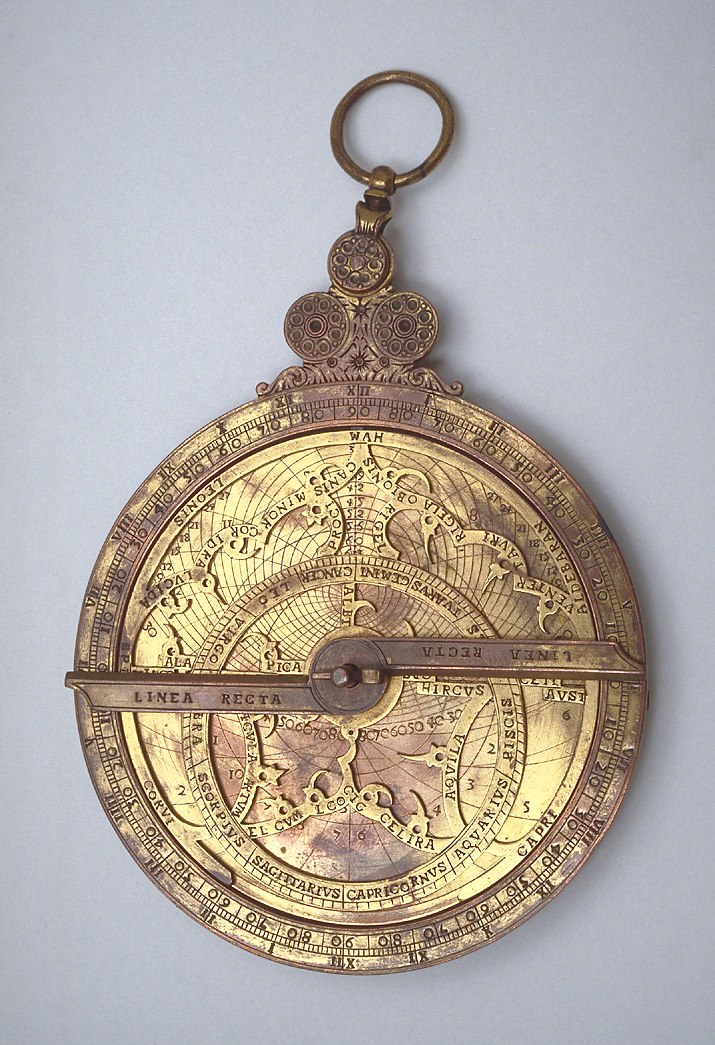
This 108 mm diameter planispheric astrolabe, crafted from gilt brass, is attributed to an unidentified 16th-century imitator of the Nuremberg instrument maker Georg Hartmann. While the instrument bears a signature and date of 1541, specific technical features—such as the use of Arabic numerals for latitudes, the lack of a fabrication number, and the unconventional notation of the year—contrast with known works by Hartmann. The instrument features a rete with twenty-four star-pointers, a central plate with Regiomontanus house-division projections, and a reverse side with a zodiacal calendar and shadow squares. The suspension system involves a ring and a swivelling pin on a throne decorated with rosettes.

Planispheric astrolabe in gilt brass, dated 1541.
Planispheric astrolabe in gilt brass, dated 1541. — Museum Boerhaave, Leiden. Rights pending — permission not yet requested. Original source

Catalogue identity

Source
www.mhs.ox.ac.uk
Category
Tool · Nuremberg astrolabe
Maker / attribution
Georg Hartmann (attributed to a contemporary imitator)
Reference
Not recorded
Catalogue / lot identifier
3087
Source-reported date
1541
Source-reported place
Nuremberg

Source-reported attribution and specifications are not independent authentication. A listing does not establish present ownership, current display, availability or permission to reproduce.

Object description

Construction and Design

The instrument is constructed from gilded brass and measures 108 mm in diameter. It is designed with a suspension ring passing through a swivel pin at the throne, which is decorated with three eight-petalled rosettes on both sides. The front limb displays an altitude scale and an equal hour scale.

The rete is designed to rotate freely over a single central plate, which is held in position by a lug. This plate is engraved on both sides for distinct latitudes. The reverse of the instrument is also marked with altitude scales and a zodiacal calendar for the Julian calendar, though this side remains unfinished.

Evidence for this section
  • “The planispheric astrolabe is made of gilded brass.”
  • “The throne is decorated on both sides with three eight-petalled rosettes resembling the Hartmann type.”
  • “The reverse, which is laid out for the latitude of 44?, is unfinished.”

Technical Attribution

Although the instrument features a signature and a date of 1541, there are significant indicators that it was produced by a contemporary imitator rather than Georg Hartmann himself.

The inscription of the year in Roman numerals, rather than the Arabic numerals associated with Hartmann's work, is cited as a further inconsistency. These discrepancies suggest that while the instrument was created in the 16th century, it was the product of a different, less precise workshop.

Evidence for this section
  • “there are several indications that it is in fact the work of a 16th-century imitator.”
  • “However, none of the parts carries any marks identifying the fabrication number as the Hartmann astrolabes commonly do.”
  • “the notation of the year in Roman numerals instead of Arabic numerals strongly argues that this astrolabe was not the work of Hartmann”

Provenance and Documentation

The instrument is currently held by the Museum Boerhaave in Leiden and is identified by inventory number 3087. It was previously recorded under the references IC 535 and A 383 before its acquisition at an auction in 1953.

The object has been the subject of scholarly research regarding its attribution, with references made to H. Klemm's 1989 publication on Georg Hartmann, which provides context for the maker's known instruments and the output of his period.

Evidence for this section
  • “The instrument (IC 535, previously catalogued as A 383) was acquired at an auction in 1953.”
  • “See H. Klemm, Georg Hartmann aus Eggolsheim (1489-1564)”

Open research questions

  • What specific technical tools or punches were used for the lettering on this instrument compared to verified Hartmann works?
  • Why was the reverse plate left unfinished at the latitude of 44 degrees?

Source evidence

Recorded claims and source quotations for Gilt Brass Planispheric Astrolabe
FieldSource-reported valueSource quotation
MaterialGilt brass“Gilt brass; 108 mm in diameter”
Diameter108 mm“108 mm in diameter”
Date1541“Dated 1541; Nuremberg”
Maker SignatureGEORGIVS HARTMAN NOREMBERGE FACIBAT ANNO M D XLI“The instrument is signed on the reverse 'GEORGIVS HARTMAN NOREMBERGE FACIBAT ?ANNO?M?D?XLI?'”
Inventory Number3087“Inventory number: 3087”
House SystemRegiomontanus“boundaries of the astrological houses according to the house-division system known in the West as that of Regiomontanus”
Acquisition1953“The instrument (IC 535, previously catalogued as A 383) was acquired at an auction in 1953.”

Visible details

  • Throne decorated with three eight-petalled rosettes
  • Rete contains 24 star-pointers
  • Reverse features zodiacal calendar and symmetrical shadow boxes

Research qualifications

  • Signed as Georg Hartmann but suspected to be the work of an imitator
  • Unfinished state of the reverse latitude projections

Photograph identity and source facts were screened before import; rights clearance remains pending.

Consulted source

Astrolabe

Reviewed 2026-10-26 · Record 0d178244bb

Terms in this record

Glossary explanations for terms named in this object’s record.