Skip to content
The Encyclopedia of Horology

Tool · Nuremberg astrolabe

Astrolabe by Georg Hartmann

Partially verified

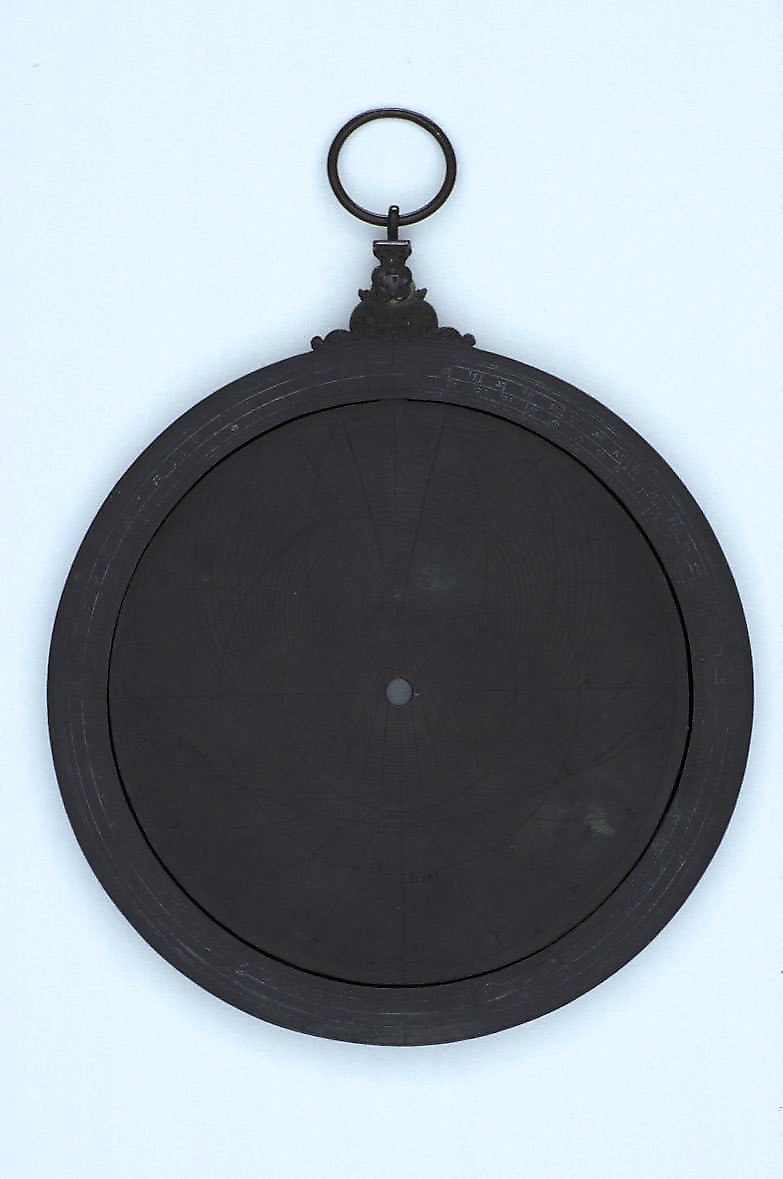
This brass astrolabe, measuring 162 mm in diameter, was made by Georg Hartmann in 1527. The instrument features a mater constructed from two soldered layers of brass, comprising the plate and the combined limb and throne. The throne is decorated with scrollwork and flowers, while the suspension consists of a saddle-like shackle and two rings. The face includes concentric degree scales and hour numbering. Three plates are present, engraved with various lines for coordinates, including tropic lines, equator lines, and latitude indicators for Nuremberg and other locations. The back of the mater includes a degree scale, zodiacal signs, a calendar scale, and a central double shadow square. A signature and date are engraved within the shadow square, alongside the Laudian coat-of-arms on the top half. The rete, pin, wedge, rule, and alidade are missing from the instrument.

Front view of the brass astrolabe mater showing the limb and throne
Front view of the brass astrolabe mater showing the limb and throne — © Museum of the History of Science, Oxford. Rights pending — permission not yet requested. Original source

Catalogue identity

Source
www.mhs.ox.ac.uk
Category
Tool · Nuremberg astrolabe
Maker / attribution
Georg Hartmann
Reference
Not recorded
Catalogue / lot identifier
38642
Source-reported date
1527
Source-reported place
Nuremberg

Source-reported attribution and specifications are not independent authentication. A listing does not establish present ownership, current display, availability or permission to reproduce.

Object description

Construction and Design

The astrolabe is composed of a mater formed from two soldered brass layers, creating the base for the limb and the throne. The throne features scrollwork and floral decoration, while the suspension system uses a shackle and two rings. The limb is divided into two concentric circles, with the outer circle containing degree markings and hour divisions, and the inner circle featuring quadrant divisions.

The instrument includes three internal plates engraved with meridians, equator lines, and tropic markers. These plates also display latitude engravings, including specific markings for Nuremberg at 49 degrees 27 minutes. The rear of the mater features additional circular scales for zodiacal signs and a calendar, surrounding a central shadow square and the Laudian coat-of-arms.

Evidence for this section
  • “The mater of the astrolabe is made of two soldered layers of brass, one for the plate and the other for the limb and the throne.”
  • “The throne is decorated with two flowers resting on scrollwork and is filleted on the sides.”
  • “The third plate is engraved for 'LATI LIII' and on the other side for 'LATI LIIII'.”

Provenance and History

The astrolabe was documented in England by the seventeenth century, where it entered the collection of Archbishop Laud. This ownership is confirmed by the presence of his coat-of-arms on the back of the instrument. The archbishop's arms are those of the archbishopric of Canterbury combined with his own heraldic devices.

The instrument currently exhibits a darkened, black exterior surface. This coloration is suspected to be a result of long-term exposure to atmospheric conditions, specifically the environment of a nineteenth-century gas-lit room. While the exterior and some internal areas show this effect, the inner surfaces of the plates remain unaffected by this process.

Evidence for this section
  • “This astrolabe by Georg Hartmann of Nuremberg was in England by the 17th century when it came into the possession of Archbishop Laud, whose coat-of-arms now appears on the back.”
  • “The instrument is completely black on the outside, due probably to atmospheric conditions, such as a gas-lit room in the nineteenth century”

State of Preservation

The instrument is incomplete, with several key functional components missing. Specifically, the rete, pin, and wedge are absent from the central assembly. Additionally, the rule and alidade, which are necessary for taking measurements using the instrument, are not present.

Despite the absence of these parts, the primary brass structure of the mater and the three plates remain intact. The engraved details, including the latitude lines, zodiacal scales, and signature, remain visible, and the overall dimensions of the 162 mm diameter frame are maintained.

Evidence for this section
  • “The rete , pin and wedge are missing.”
  • “The rete, rule and alidade are missing.”

Open research questions

  • What specific materials were used for the blackening process to confirm if it is a chemical reaction from gas lighting?
  • Are there archival records detailing the transition of this instrument from Archbishop Laud to the Museum of the History of Science?

Source evidence

Recorded claims and source quotations for Astrolabe by Georg Hartmann
FieldSource-reported valueSource quotation
MakerGeorg Hartmann“Signed by Georg Hartmann”
Date1527“Dated 1527”
Place of originNuremberg“Nuremberg”
Inventory number38642“Inventory number 38642”
Diameter162 mm“162 mm in diameter”
SignatureGEORGIVS HARTMAN NOREMBERGE FECIT ANNO M D XXVII“'GEORGIVS HARTMAN NOREMBERGE FECIT ANNO M D XXVII'”

Visible details

  • Darkened exterior surface finish
  • Saddle-like suspension shackle
  • Engraved signature and date on the back
  • Laudian coat-of-arms on the reverse

Research qualifications

  • Cause of the blackening is attributed to possible nineteenth-century gas-lit conditions
  • Exact extent of missing components beyond the rete, pin, wedge, rule and alidade

Photograph identity and source facts were screened before import; rights clearance remains pending.

Consulted source

Astrolabe

Reviewed 2026-10-26 · Record 2a0f3972c8

Terms in this record

Glossary explanations for terms named in this object’s record.