
Skip to content
The Encyclopedia of Horology

Tool · French astrolabe

Astrolabe by Anthoine Mestrel

Partially verified

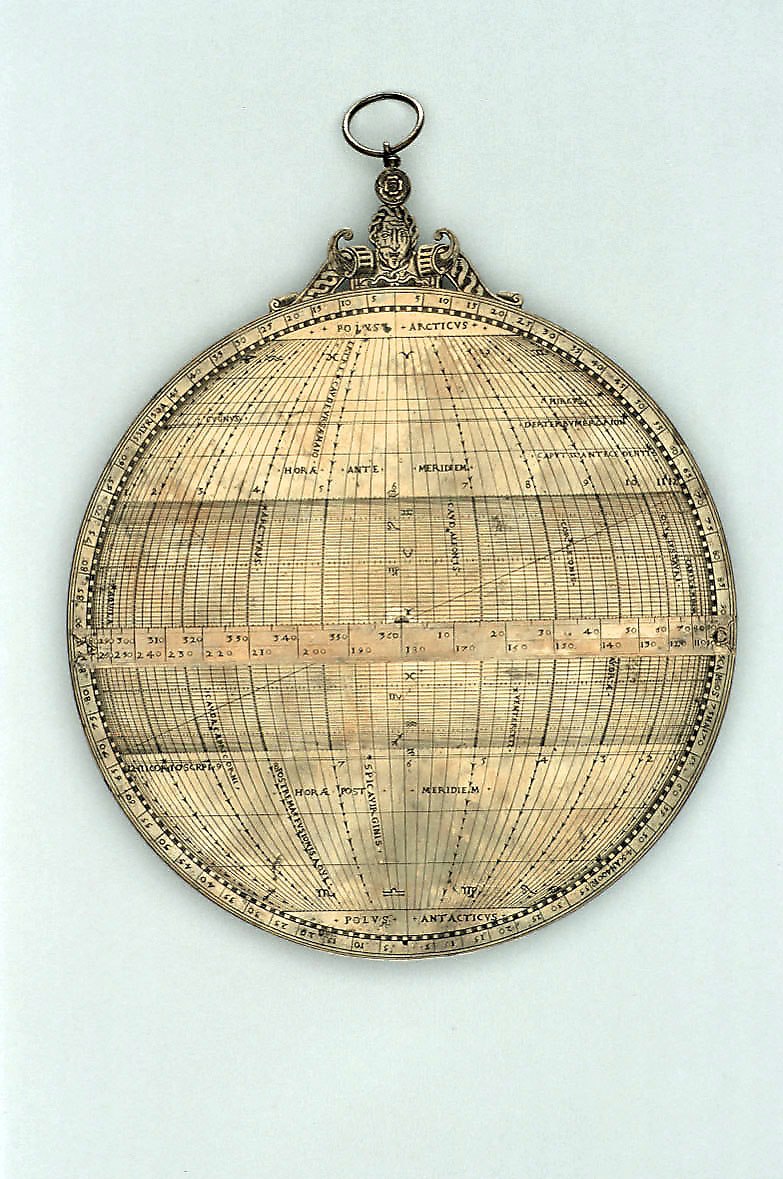
This gilt brass astrolabe, measuring 256 mm in diameter, was made by Anthoine Mestrel in Paris in 1551. It lacks traditional plates and instead utilizes a universal projection developed by the mathematician Juan de Rojas, designed to function at any latitude. The instrument is equipped with an elaborately pierced throne featuring a head and ornamental scrolls, accompanied by a shackle and suspension ring. It features a removable zodiacal calendar plate and incorporates complex scales for right ascension, declination, and time conversion. The instrument also includes a rule and an alidade with pinhole sights. The astrolabe is signed '+AN+THOIT+NE+' / 'MES+TREL APARIS' and dated 1551. Its design and technical components closely resemble the instruments illustrated in Juan de Rojas's 1551 publication, Commentariorum in astrolabium, although a direct relationship between the specific book and this instrument remains unconfirmed by researchers.

Gilt brass astrolabe by Anthoine Mestrel, Paris, 1551 (Inv. 32378).
Gilt brass astrolabe by Anthoine Mestrel, Paris, 1551 (Inv. 32378). — Museum of the History of Science, Oxford. Rights pending — permission not yet requested. Original source

Catalogue identity

Source
www.mhs.ox.ac.uk
Category
Tool · French astrolabe
Maker / attribution
Anthoine Mestrel
Reference
Not recorded
Catalogue / lot identifier
32378
Source-reported date
1551
Source-reported place
France

Source-reported attribution and specifications are not independent authentication. A listing does not establish present ownership, current display, availability or permission to reproduce.

Object description

Construction and Design

The astrolabe is constructed of gilt brass and measures 256 mm in diameter. It is distinguished by an elaborately shaped, pierced throne that incorporates a human head flanked by ornamental scrolls, fitted with a shackle and suspension ring. Unlike traditional instruments of this type, it does not rely on a standard set of plates. Instead, it utilizes a universal projection associated with the Spanish mathematician Juan de Rojas, which allows the user to operate the instrument at any latitude.

The mater is fabricated from a single brass plate and houses a removable, rotatable plate engraved with a zodiacal calendar containing Latin month names and day counts. The central area on the reverse is partitioned, with the upper portion providing diagrams for converting between equal and unequal hours, and the lower portion featuring a double shadow square marked 'VMBRAVERSA' and 'VMBRARECTA'.

Evidence for this section
  • “The mater is made from a single brass plate and has an elaborately shaped, pierced and decorated throne comprising on both sides a head and ornamental scrolls”
  • “This astrolabe does not have the customary set of plates , but instead the universal projection associated with the Spanish mathematician Juan de Rojas”
  • “A rotatable and removable plate has an outermost zodiacal scale with the names and symbols of the zodiacal signs”

Technical Scales and Markings

The instrument features extensive mathematical engravings. One side features a universal projection with an outer degree scale and right ascension lines drawn for every 12 minutes. These lines are intersected by declination parallels for every 2 degrees of the sun's position in the ecliptic. Hour markings include both ante and post meridiem designations. The reverse side features a limb scale of hours, a degree scale, and a calendar scale with named stars arranged according to their position.

The rule is finished with shaped ends and a degree scale, while the alidade is fitted with double pinhole sights and decorated, shaped ends. The arms of the alidade include scales for 'HOR? ORTVS' and 'HOR? OCCASVS', with corresponding divisions for time measurement.

Evidence for this section
  • “On outer degree scale 0 to 90 to 0 to 90 to 0, divided to 5, subdivided to 1 with alternate hatching, numbered by 5.”
  • “The other side has a scale of hours on the limb, XII to I twice, and within this a degree scale 90 to 0 to 90 to 0 to 90, divided to 5, subdivided to 1 with alternate hatching, numbered by 5.”
  • “Alidade with double pinhole sights, shaped and decorated ends, decorated centre and scales of either arm”

Attribution and Literature

The instrument is signed '+AN+THOIT+NE+' / 'MES+TREL APARIS' and dated 1551. It is held by the Museum of the History of Science, Oxford, under inventory number 32378. The instrument bears a notable resemblance to illustrations found in the 1551 text 'Commentariorum in astrolabium' by Juan de Rojas, also published in Paris.

While the decorative motifs and technical specifications align with the designs presented in the Rojas publication, the specific connection between this instrument and the book has not been confirmed. Academic references include J. Bennett and S. Johnston's 1996 work, 'The Geometry of War 1500-1750', which discusses these specific types of astrolabes.

Evidence for this section
  • “Signed '+AN+THOIT+NE+' / 'MES+TREL APARIS' and dated '1551'.”
  • “it resembles very closely the instrument illustrated in a book by Rojas on this type of astrolabe , published in Paris the same year.”
  • “the relationship between the book and the instrument is not known.”

Open research questions

  • What is the specific provenance of this astrolabe prior to its acquisition by the Museum of the History of Science?
  • To what extent did Anthoine Mestrel collaborate directly with Juan de Rojas regarding the production of this instrument?

Source evidence

Recorded claims and source quotations for Astrolabe by Anthoine Mestrel
FieldSource-reported valueSource quotation
MakerAnthoine Mestrel“Signed by Anthoine Mestrel”
Date1551“Dated 1551”
MaterialGilt brass“Gilt brass”
Diameter256 mm“256 mm in diameter”
Inventory Number32378“Inventory number: 32378”
Signature+AN+THOIT+NE+ MES+TREL APARIS“Signed '+AN+THOIT+NE+' / 'MES+TREL APARIS'”

Visible details

  • Throne features a central head with scrollwork
  • Mater is made from a single brass plate
  • One side bears a universal projection of the Rojas type
  • Includes a double shadow square on the central space

Research qualifications

  • The exact relationship between this specific instrument and the book by Rojas remains unknown
  • The spelling of 'ANTACTICVS' on the instrument is noted as an error in the source

Photograph identity and source facts were screened before import; rights clearance remains pending.

Consulted source

Astrolabe

Reviewed 2026-10-26 · Record 42d4d1a551

Terms in this record

Glossary explanations for terms named in this object’s record.