
Skip to content
The Encyclopedia of Horology

Tool · Arabic-inscribed astrolabe

Astrolabe by 'Abd al-A'imma

Partially verified

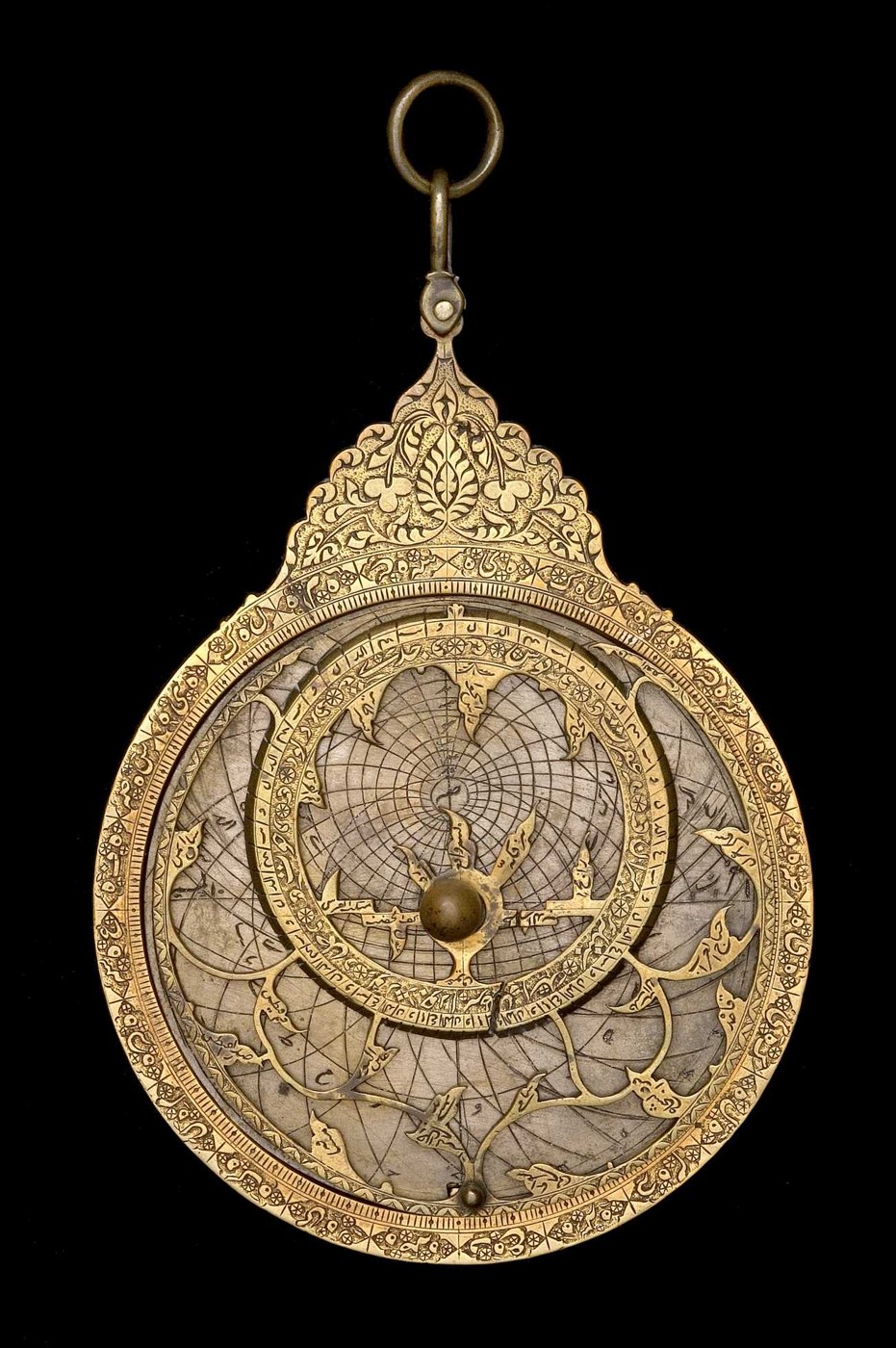
This early 18th-century brass astrolabe is attributed to the maker 'Abd al-A'imma of Iṣfahān. The instrument features a one-piece mater and limb construction with a degree scale on the limb. The throne is of the indo-persian engraved type, featuring an integrated base embossed with an ornate foliate design, a round cross-section ring, and an omega-type shackle. The back of the instrument contains 16 distinct scales, including altitude, sine/cosine, cotangent, and shadow squares, alongside a serial number reading 'Opus twenty-four' and the maker's signature in a cartouche. The rete is of the foliate type and currently lacks star pointers. It is held by a simple, recent replacement nut and bolt. The instrument includes four plates with latitudes ranging from 29° to 37° and a gazetteer containing coordinates for 32 cities.

Front view of the astrolabe showing the mater, limb, and rete, with visible star pointers present on the rete.
Front view of the astrolabe showing the mater, limb, and rete, with visible star pointers present on the rete. — History of Science Museum, University of Oxford. Rights pending — permission not yet requested. Original source

Catalogue identity

Source
www.mhs.ox.ac.uk
Category
Tool · Arabic-inscribed astrolabe
Maker / attribution
'Abd al-A'imma
Reference
Not recorded
Catalogue / lot identifier
43739
Source-reported date
early 18th century
Source-reported place
Iṣfahān
Source-reported serial
رابع عشرون

Source-reported attribution and specifications are not independent authentication. A listing does not establish present ownership, current display, availability or permission to reproduce.

Object description

Construction and Design

The astrolabe is crafted from brass and features a one-piece construction for the mater and limb. The throne, identified as the indo-persian engraved type, is attached via an integrated base embossed with a foliate pattern. The instrument is suspended by a simple round cross-section ring and an omega-shaped shackle. A central tab for the tympans is positioned at the base, 180 degrees from the throne.

The rete is of the foliate single-knob style, with the ecliptic broken at the Cancer sign and the horizontal support bar. , and it is secured to the instrument with a nut and bolt identified as a recent replacement.

Evidence for this section
  • “The throne is of the indo-persian, engraved type made of brass attached with integrated base made of brass and has a simple, round cross-section ring”
  • “The rete is of the foliate (single knob) type. The ecliptic is broken in the middle of the sign Cancer”
  • “The rete is attached using a nut & bolt. Simple, recent replacement.”

Scales and Inscriptions

The back of the astrolabe is densely inscribed with 16 distinct scales arranged in concentric circles and quadrants. These include functions for altitude, declination, the azimuth of the Qibla, sine/cosine, cotangent, and shadow squares. Additional inner scales account for zodiacal signs, lunar mansions, faces, and triplicities.

Inscriptions are present on the back edge, including the serial number designated as 'Opus twenty-four'. The maker's signature, reading 'Abd al-A'imma, is located within a cartouche on the instrument's back. The womb of the mater houses a gazetteer detailing coordinates for 32 cities, including Baghdad, Isfahan, and Mecca.

Evidence for this section
  • “The back contains 16 scales of the following types: Altitude; Declination; Azimuth of Qibla; Altitude of noon sun; Sine/Cosine; Cotangent; Terms; Zodiacal signs; Faces; Lunar Mansions; Shadow square; Triplicities.”
  • “The back is inscribed: with a serial number marked as عمل رابع عشرون (Opus twenty-four). At bottom edge. with a maker's signature marked as عبد الائمة (ʿAbd al-Aʾimmah). In cartouche.”

Provenance and Acquisition

The astrolabe is part of the Clay Collection, which was acquired by the History of Science Museum at the University of Oxford from R. S. Clay in 1944. R. S. Clay was an optical physicist who curated his collection through acquisitions from various London-based auction houses and dealers during the early 20th century.

The object is catalogued under inventory number 43739 and accession number 1944-1/580. The collection primarily focused on optical instruments, with this piece representing one of two astrolabes acquired from Clay's holdings.

Evidence for this section
  • “Purchased from R. S. Clay in 1944”
  • “The Clay Collection, purchased by the Museum from R. S. Clay, an optical physicist, consisted mainly of optical instruments, but also contained two astrolabes.”

Open research questions

  • What is the reason for the lack of stars on the rete, and were they intentionally omitted or lost due to wear?
  • Could the 'recent replacement' of the nut and bolt indicate a period of instability or repair in the 20th century?

Source evidence

Recorded claims and source quotations for Astrolabe by 'Abd al-A'imma
FieldSource-reported valueSource quotation
Maker‘Abd al-A’imma“Maker ‘Abd al-A’imma”
MaterialBrass“Material Brass”
Dateearly 18th century“Date early 18th century”
PlaceIṣfahān“Place Iṣfahān”
Serial NumberOpus twenty-four“serial number marked as عمل رابع عشرون (Opus twenty-four)”
AcquisitionPurchased in 1944“Purchased from R. S. Clay in 1944”
Plates4“There are 4 plates”
Inventory Number43739“Inventory no. 43739”

Visible details

  • Foliate engraved throne design
  • Ornate, foliate-style rete construction
  • Serial number 'رابع عشرون' (Opus twenty-four) inscribed on the back edge
  • Maker signature 'عبد الائمة' in a cartouche on the back

Research qualifications

  • The nut and bolt are documented as recent replacements
  • The rete is noted to contain zero stars marked with bulb pointers

Photograph identity and source facts were screened before import; rights clearance remains pending.

Consulted source

Astrolabe, inventory 43739 (Iṣfahān, early 18th century)

Reviewed 2026-10-26 · Record 098913a5d9

Terms in this record

Glossary explanations for terms named in this object’s record.