
Skip to content
The Encyclopedia of Horology

Clock · Wall clock

Antique English Fusee Wall Clock by Joseph Bramble

Partially verified

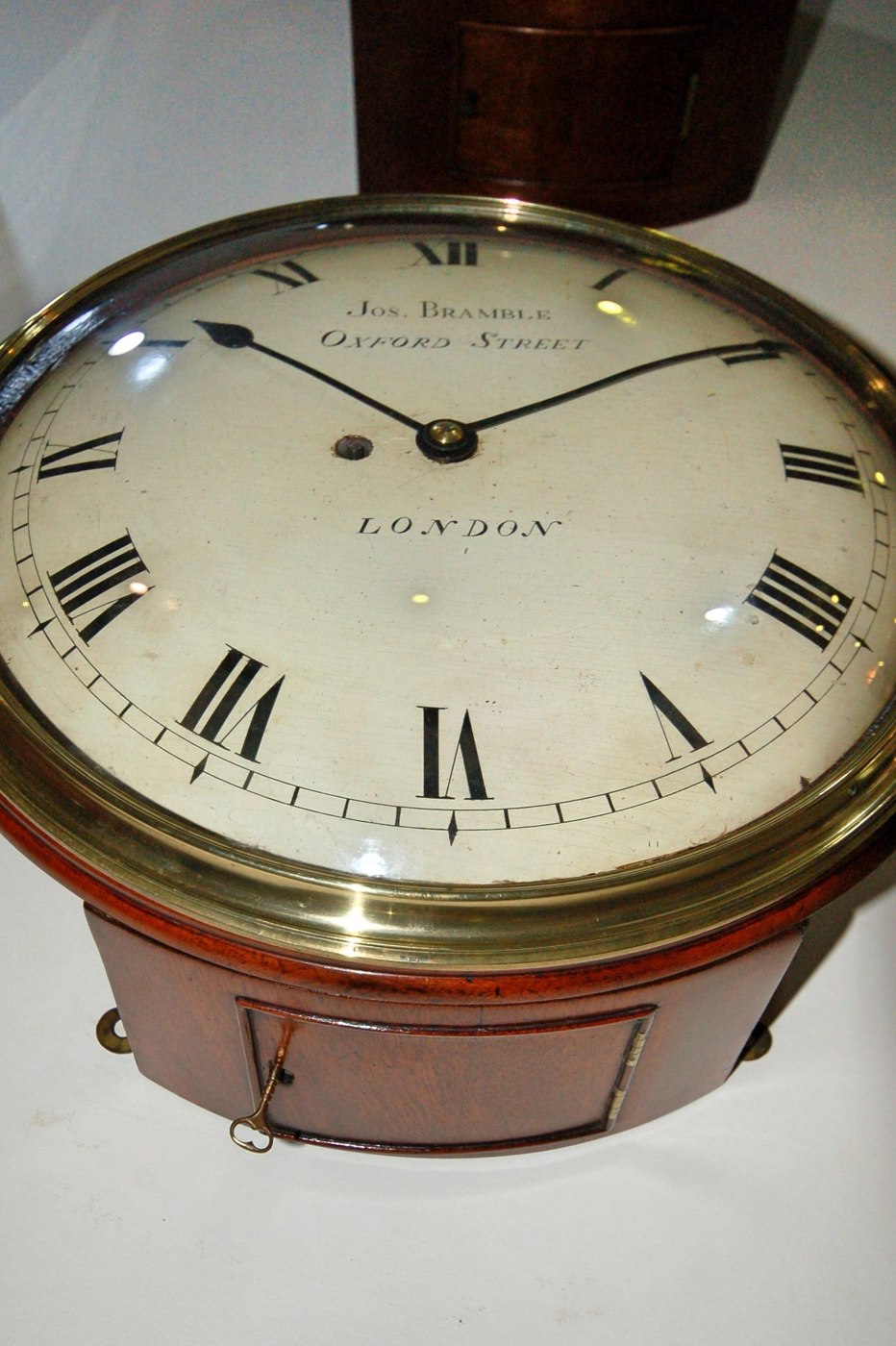
This antique wall clock is attributed to the London-based clockmaker Joseph Bramble, active on Oxford Street, and dates to approximately 1820. It follows the traditional design of an English wall dial clock, featuring a circular mahogany case and a fusee-driven mechanical movement. The dial is a 12-inch convex painted surface, white with black Roman numerals, signed “Jos. Bramble / Oxford Street / LONDON.” The clock is powered by an 8-day chain-driven fusee mechanism equipped with a stopwork system. A distinct technical feature noted in the documentation is the use of a verge escapement paired with a crown wheel, a configuration that predates the common anchor escapements found in many later wall-mounted timepieces of this period. The mahogany housing includes a cast brass bezel and an access door on the side fitted with a metal lock and key.

Front view of the clock showing the dial, hands, and mahogany case frame.
Front view of the clock showing the dial, hands, and mahogany case frame. — Pendulum of Mayfair. Rights pending — permission not yet requested. Original source

Catalogue identity

Source
zamanito.com
Category
Clock · Wall clock
Maker / attribution
Joseph Bramble
Reference
Not recorded
Catalogue / lot identifier
Source URL identifies the listing
Source-reported date
circa 1820
Source-reported place
United Kingdom

Source-reported attribution and specifications are not independent authentication. A listing does not establish present ownership, current display, availability or permission to reproduce.

Object description

Dial and Case Construction

The case is equipped with a cast brass bezel that frames the 12-inch convex dial. This dial is finished in white and displays black Roman numerals along with minute markers. The signature, “Jos. Bramble / Oxford Street / LONDON,” is positioned in the center of the dial.

Access to the internal components is facilitated by a side door integrated into the mahogany body, which includes a metal locking mechanism operated by a key.

Evidence for this section
  • “بدنه ساعت شامل قابی ظریف و کم‌عرض از چوب ماهون است که دور تا دور زه برنجی ریخته‌گری‌شده (Cast Brass Bezel) با فرم‌دهی دقیق را در بر گرفته است”
  • “در بخش مرکزی صفحه، نام سازنده و موقعیت کارگاه به‌صورت «Jos. Bramble / Oxford Street / LONDON» با خطی ظریف نگاشته شده”

Movement and Escapement

The movement is an 8-day duration design utilizing a chain-driven fusee system to maintain constant power, regulated by a stopwork mechanism. According to the provided information, the movement employs a crown wheel, distinguishing it from the anchor escapements that became standard in later period wall clocks.

The source notes that the movement’s configuration, specifically the verge escapement, is a rare feature for this type of wall clock. This mechanism necessitates precise maintenance and handling, particularly to ensure the integrity of the fusee and barrel components over time.

Evidence for this section
  • “مکانیزم ساعت ۸ روزه (8-Day) بوده و از نوع فیوزی زنجیری/تسمه‌ای به همراه سیستم توقف (Stopwork) است”
  • “بهره‌گیری از چرخ‌دنگ میل پره‌ای اولیه و نادر (Verge Escapement) همراه با چرخ تاجی (Crown Wheel) عنوان شده است”

Attribution and Condition

The timepiece is attributed to the maker Joseph Bramble of Oxford Street, London, with a manufacturing date estimated at circa 1820. The documentation provided by the seller serves as the basis for this attribution. No records of recent servicing or verification of current timekeeping performance are included in the source material.

Prospective evaluation of the clock should prioritize several key areas. These include verifying the originality of the verge escapement to rule out later conversions, checking the condition of the fusee and barrel, ensuring the mahogany case joints remain secure, and assessing the state of the original paint on the convex dial.

Evidence for this section
  • “اثر ساعت‌ساز لندنی Joseph Bramble از خیابان Oxford Street لندن و متعلق به حدود سال ۱۸۲۰ میلادی است”
  • “وضعیت کارکرد دقیق یا سابقه سرویس اخیر در متن منبع تصریح نشده است”

Open research questions

  • What is the specific archival evidence for Joseph Bramble's activity at Oxford Street in the 1820s?
  • Are there visible markings on the movement plates that confirm the original manufacture of the verge escapement?

Source evidence

Recorded claims and source quotations for Antique English Fusee Wall Clock by Joseph Bramble
FieldSource-reported valueSource quotation
MakerJoseph Bramble“ساعت‌ساز لندنی Joseph Bramble”
LocationOxford Street, London“Oxford Street، لندن”
Datecirca 1820“حدود ۱۸۲۰”
Dial size12 inches“صفحه محدب ۱۲ اینچی”
Escapement typeVerge escapement“چرخ‌دنگ میل پره‌ای اولیه و نادر (Verge Escapement)”
Case materialMahogany“چوب ماهون (Mahogany)”

Visible details

  • Cast brass bezel surrounding the dial
  • Convex painted dial with Roman numerals
  • Mahogany case with side-mounted access door

Research qualifications

  • Operating condition and recent service history are not confirmed by the source
  • Authenticity of the verge escapement versus potential later conversion requires verification

Photograph identity and source facts were screened before import; rights clearance remains pending.

Consulted source

Antique Wall Clock by Joseph Bramble, Oxford Street – London C1820

Reviewed 2026-11-02 · Record c315125256

Terms in this record

Glossary explanations for terms named in this object’s record.