
Skip to content
The Encyclopedia of Horology

Pocket watch · Hunting-cased pocket chronometer

Albert H. Potter & Co. 18K Gold Hunting-Cased Pocket Chronometer

Partially verified

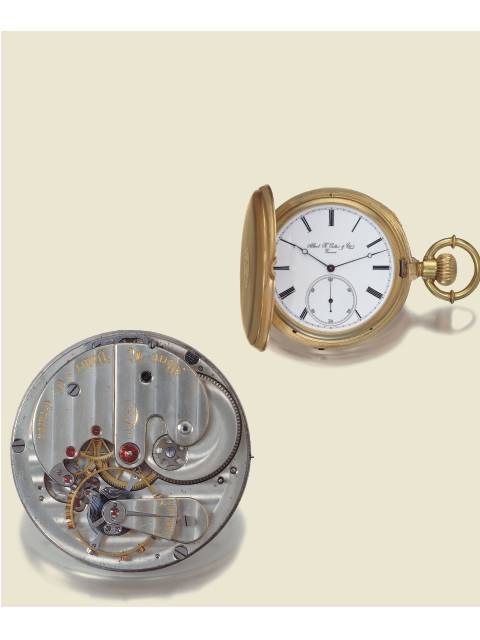
This 18K gold, hunting-cased, keyless pocket chronometer, identified as No. 41, is attributed to Albert H. Potter & Co. of Geneva, circa 1877. The watch features a bassine-style case with an engine-turned exterior and a central monogram. Internally, it is distinguished by a 44 mm (19 1/2''') nickel movement featuring fausses côtes decoration and a patented split-plate kidney caliber. The movement operates with a going barrel and a straight-line calibrated lever escapement, utilizing a cut bimetallic compensation balance with platinum and gold adjustment screws. The white enamel dial provides radial Roman numerals and subsidiary seconds, complemented by blued steel Breguet hands. A notable construction element is the gold glazed cuvette, which allows observation of the movement.

18K gold hunting-cased pocket chronometer No. 41 by Albert H. Potter & Co. with its movement visible.
18K gold hunting-cased pocket chronometer No. 41 by Albert H. Potter & Co. with its movement visible. — Antiquorum. Rights pending — permission not yet requested. Original source

Catalogue identity

Source
catalog.antiquorum.swiss
Category
Pocket watch · Hunting-cased pocket chronometer
Maker / attribution
Albert H. Potter & Co.
Reference
Not recorded
Catalogue / lot identifier
299
Source-reported date
circa 1877
Source-reported place
Switzerland
Source-reported serial
41

Source-reported attribution and specifications are not independent authentication. A listing does not establish present ownership, current display, availability or permission to reproduce.

Object description

Case and Dial Construction

The watch is housed in an 18K gold bassine-style hunting case. The exterior of the front cover exhibits engine-turned surface work and includes a small central monogram. The case design incorporates a polished band and a glazed gold cuvette, allowing for the inspection of the movement without removal. Inside the back cover, the watch contains a photographic portrait of a woman and a baby.

The dial is finished in white enamel and follows a traditional layout, featuring black radial Roman numerals for the hour markers and an outer minute track. The time is displayed via blued steel Breguet-style hands, and a subsidiary seconds dial is sunk into the lower portion of the enamel face. The dial is signed by the maker.

Evidence for this section
  • “Four-body, "bassine", solid, engine-turned cover, the front one with small central monogram, polished band, gold glazed cuvette”
  • “White enamel, radial Roman numerals, outer minute ring, subsidiary sunk seconds. Blued steel Breguet hands.”

Movement and Escapement

The movement measures 19 1/2''' (44 mm) and is constructed from nickel with fausses côtes decoration applied to both the front and back plates. It utilizes a patented split-plate kidney caliber, which facilitates the setting of the gear train. The mechanism uses a going barrel and a straight-line calibrated lever escapement. The regulation of the balance is achieved via a cut bimetallic compensation balance, which is fitted with gold temperature-adjusting screws and platinum quarter screws.

The watch includes a blued steel Breguet balance spring and contains 21 jewels. The winding and setting mechanism includes an intermediate wheel that moves vertically to engage with the train. Furthermore, the click pin, located by the barrel, is designed to allow the release of the mainspring tension.

Evidence for this section
  • “nickel, "fausses côtes" decoration on front and back plates, patented split-plate "kidney" caliber”
  • “straight line calibrated lever escapement, cut bimetallicompensation balance with gold temperature-adjusting screws and platinum quarter screws”
  • “its intermediate setting wheel moves vertically for engagement, the click pin protruding by the barrel affords an easy and secure means of letting the spring off”

Signatures and Technical Notes

The timepiece is signed on both the dial and the movement. The auction house has provided a technical assessment, noting that the plate design was patented on April 5, 1887, and describing the movement as a unique iteration of the maker's approach to watch construction, despite the winding mechanism itself lacking a formal patent.

According to the auction house report, the overall condition of the watch is graded as very good, with the movement and dial assigned specific condition ratings.

Evidence for this section
  • “Signed on dial and movement, case stamped with gold warranty mark used by Potter.”
  • “The elegant plate design of this caliber, patented on April 5, 1887, allows for easy setting of the train.”
  • “Overhaul recommended, at buyer's expense”

Open research questions

  • What is the significance of the 1887 patent date when the watch is dated to 1877?
  • Is the photographic portrait inside the case considered original to the object?

Source evidence

Recorded claims and source quotations for Albert H. Potter & Co. 18K Gold Hunting-Cased Pocket Chronometer
FieldSource-reported valueSource quotation
MakerAlbert H. Potter & Co.“Albert H. Potter & Co. Geneva”
Serial Number41“No. 41”
Datecirca 1877“made circa 1877”
Case Material18K gold“18K gold, hunting-cased, keyless pocket chronometer”
Movement Diameter44 mm (19 1/2''')“M. 44 mm (19 1/2''')”
Jewels21“21 jewels”
Case StyleBassine“Four-body, "bassine", solid, engine-turned cover”
ConditionOverhaul recommended“Overhaul recommended, at buyer's expense”

Visible details

  • Case features engine-turned cover with central monogram
  • White enamel dial with radial Roman numerals
  • Movement displays fausses côtes decoration on plates
  • Glazed gold cuvette exposes movement

Research qualifications

  • Patented movement caliber date conflicts with 1877 production date
  • Auction description recommends overhaul

Photograph identity and source facts were screened before import; rights clearance remains pending.