
Skip to content
The Encyclopedia of Horology

Clock · Longcase clock

Ahasuerus Fromanteel early pendulum longcase clock movement and dial in custom architectural case

Partially verified

Source documentation describes a rare early pendulum clock movement and dial by Ahasuerus Fromanteel, London, dating to circa 1665 and later, presented in a custom 20th-century ebony-veneered architectural case. The 8.5-inch gilt brass dial incorporates winged cherub spandrels, a solid silver chapter ring, and a date aperture above the signature 'A Fromanteel, Londini.' The two-train movement features shouldered plates, bolt-and-shutter maintaining power, a knife-edge verge escapement with a short bob pendulum, and an outside countwheel strike operating a hammer mounted on the backplate. The custom case is constructed with an ebony veneer on an oak carcass and features a triangular pediment.

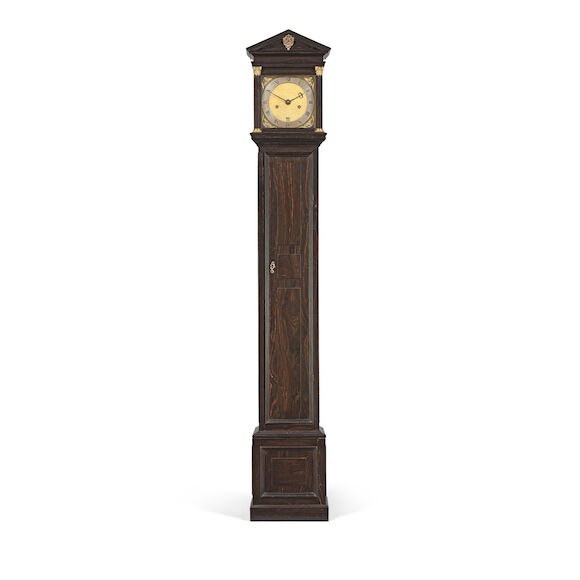
Full-length front view of the ebony-veneered architectural longcase clock
Full-length front view of the ebony-veneered architectural longcase clock — Bonhams. Rights pending — permission not yet requested. Original source

Catalogue identity

Source
www.bonhams.com
Category
Clock · Longcase clock
Maker / attribution
Ahasuerus Fromanteel
Reference
Not recorded
Catalogue / lot identifier
62
Source-reported date
circa 1665 and later
Country
United Kingdom

Source-reported attribution and specifications are not independent authentication. A listing does not establish present ownership, current display, availability or permission to reproduce.

Object description

Movement Construction and Features

The movement is identified as an early pendulum type attributed to Ahasuerus Fromanteel. It features typical tall, shouldered plates and incorporates a bolt-and-shutter maintaining power mechanism. The going train is equipped with a knife-edge verge escapement and a short bob pendulum.

The striking train utilizes an outside countwheel. The striking hammer is mounted on a steel post fixed to the backplate via a brass bracket. According to provided documentation, this specific mounting arrangement on the backplate is considered to indicate a production date later than movements where the hammer is fitted to the frontplate.

Evidence for this section
  • “The two train movement with typical tall, shouldered 'Fromanteel' shaped plates”
  • “the going train with bolt-and-shutter maintaining power to a knife-edge verge escapement and short bob pendulum”
  • “the strike train with small outside countwheel”
  • “the latter set on a tall steel post held within within a fancy brass bracket mounted on the backplate.”
  • “The vertical striking hammer arbor is a feature seldom seen in movements other than those made by Fromanteel: this being fixed to the backplate denotes a date later than those fitted to the frontplate.”

Dial Specifications

The 8.5-inch square gilt brass dial features winged cherub's head spandrels. It contains a solid silver Roman and Arabic chapter ring with a narrow minute band and fleur-de-lys half-hour markers.

The center of the dial is matted and features a chamfered date aperture located above the VI numeral. The signature 'A Fromanteel, Londini.' is inscribed directly beneath the date aperture.

Evidence for this section
  • “The 8.5 inch square gilt brass dial with winged cherub's head spandrels framing the solid silver Roman and Arabic chapter ring”
  • “the finely matted centre with crisply chamfered date aperture above VI and signed directly beneath A Fromanteel, Londini.”

Case Composition

The clock is housed in a 20th-century ebony-veneered case built on an oak carcass. The design is described as being based on 17th-century originals, featuring an architectural style with a triangular pediment, moulded cornice, and three-quarter Corinthian columns.

The trunk door contains three applied panels within a moulded surround. The sides of the hood feature large glazed windows intended for observation of the internal movement.

Evidence for this section
  • “The custom-made 20th century case veneered allover in ebony on an oak carcass and faithfully based on the 17th century originals”
  • “the lift-up hood with typical triangular pediment”
  • “the sides with large glazed observation windows”

Open research questions

  • What specific archival or physical evidence differentiates the 'Fromanteel-style' brass mount from period examples?
  • Are there other documented instances of backplate-mounted striking hammers on Fromanteel clocks beyond the reference provided in the R.A. Lee letter?

Source evidence

Recorded claims and source quotations for Ahasuerus Fromanteel early pendulum longcase clock movement and dial in custom architectural case
FieldSource-reported valueSource quotation
MakerAhasuerus Fromanteel, London“Ahasuerus Fromanteel, London, circa 1665 and later”
Dial signatureA Fromanteel, Londini.“signed directly beneath A Fromanteel, Londini.”
Dial dimensions8.5 inch square“The 8.5 inch square gilt brass dial”
EscapementKnife-edge verge escapement“knife-edge verge escapement and short bob pendulum”
Case construction20th-century ebony veneer on oak carcass“The custom-made 20th century case veneered allover in ebony on an oak carcass”
ProvenanceEx-collection R.A. Lee (Fine Arts) Ltd“Purchased from R.A. Lee (Fine Arts) Ltd, February 1983.”

Visible details

  • Slender dark architectural case with a triangular pediment hood and central gilt mount.
  • Three-quarter Corinthian column supports flanking the square glazed dial opening.
  • Square brass dial with circular chapter ring and corner spandrels clearly visible through the hood glass.

Research qualifications

  • The case is a 20th-century reconstruction made to house the 17th-century movement and dial.
  • Internal movement plates, verge escapement, and strike work are obscured inside the case in this full-length view.

Photograph identity and source facts were screened before import; rights clearance remains pending.

Terms in this record

Glossary explanations for terms named in this object’s record.