
Skip to content
The Encyclopedia of Horology

Pocket watch · Keyless pendant watch

Adam Mickiewicz Patek et Ce keyless pendant watch

Partially verified

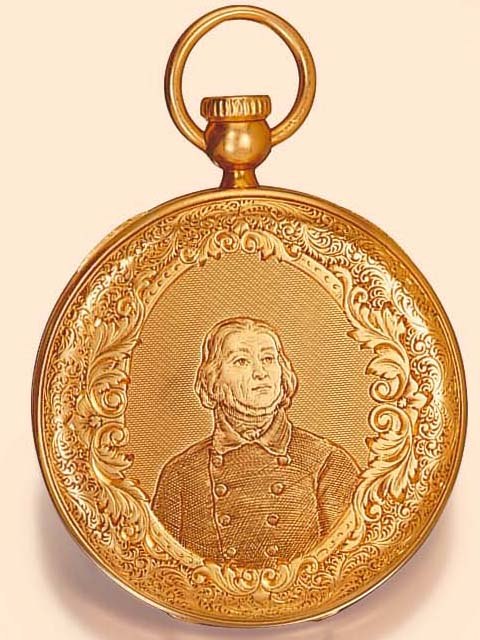
This keyless pendant watch, bearing serial number 2584, was manufactured by Patek et Ce in 1847 for the Polish market. The watch is distinguished by its 'Empire' style, four-body gold case, which features an engraved portrait on the back set against an engine-turned background. This portrait is identified as the Polish poet Adam Mickiewicz. The case includes a reeded band and a gold hinged cuvette. The timepiece measures 35 mm in diameter. Internally, it houses a 31 mm frosted gilt movement featuring 10 jewels, a cylinder escapement, and a three-arm gilt balance with a flat balance spring. Notably, the movement incorporates Adrien Philippe's patented keyless winding system, designated as system number 3. The watch is signed on the dial, the cuvette, and the movement, and it bears the company's trademark punched on the pillar plate under the dial. The piece is accompanied by an extract from the archives.

Back view of the gold 'Empire' pocket watch showing the engine-turned engraving of Adam Mickiewicz.
Back view of the gold 'Empire' pocket watch showing the engine-turned engraving of Adam Mickiewicz. — Antiquorum. Rights pending — permission not yet requested. Original source

Catalogue identity

Source
catalog.antiquorum.swiss
Category
Pocket watch · Keyless pendant watch
Maker / attribution
Patek et Ce
Reference
Not recorded
Catalogue / lot identifier
12
Source-reported date
1847
Source-reported place
Switzerland
Source-reported serial
2584

Source-reported attribution and specifications are not independent authentication. A listing does not establish present ownership, current display, availability or permission to reproduce.

Object description

Case and Dial

The watch is housed in a four-body case described as 'Empire' in style. The back of the case is decorated with a detailed engraving of a man's portrait, which is set against an engine-turned ground. This central portrait is framed by a decorative border consisting of foliate and vermicelli motifs. The perimeter of the case features a reeded band, and a gold hinged cuvette is present.

The dial is constructed from white enamel and utilizes Roman numerals to indicate the hours. The perimeter of the dial features outer minute divisions. The time is displayed via fine blued steel Breguet-style hands, which provide a contrast against the white enamel surface. The signature of the maker is present on the dial.

Evidence for this section
  • “C. Four-body, "Empire", back finely engraved with a man's portrait on an engine-turned ground, foliate and vermicelli border, reeded band, gold hinged cuvette.”
  • “D. White enamel, Roman numerals, outer minute divisions. Fine blued steel Breguet hands.”

Movement and Mechanism

The watch is powered by a 31 mm movement (13 3/4 lines, model 15). It is finished in frosted gilt and contains 10 jewels. The timekeeping is regulated by a cylinder escapement and a three-arm gilt balance wheel equipped with a flat balance spring.

A significant technical feature of this movement is the incorporation of Adrien Philippe's patented keyless winding system, specifically designated as number 3. This mechanism allows the watch to be wound without the use of a separate winding key. The movement is signed, and the company trademark is punched onto the pillar plate located beneath the dial.

Evidence for this section
  • “M. 31 mm. (13 3/4''', model 15, frosted gilt, 10 jewels, cylinder escapement, three-arm gilt balance with flat balance spring, Adrien Philippe's patented keyless winding system No. 3.”
  • “Signed on dial, cuvette and movement, punched with company's trademark on the pillar plate under the dial.”

Condition and Authenticity

The auction description provides a grading system for the watch. The overall grade for the object is listed as 'A Good'. Specifically, the case and the movement are both assigned a grade of '3 Good'.

The watch is sold with an accompanying extract from the company archives, which authenticates the manufacture date of 1847 and its intended destination for the Polish market. The source notes that the portrait engraved on the case represents the poet Adam Mickiewicz.

Evidence for this section
  • “Grading System Grade: A Good Case: 3 Good Movement: 3* Good Overhaul recommended, at buyer's expense”
  • “Accompanied by the Extract from the Archives.”
  • “Adam Mickiewicz is the most famous and beloved Polish poet.”

Open research questions

  • What specific design characteristics define the 'Empire' style case of this 1847 Patek et Ce watch?
  • To what extent did the specific Polish market influence the production of Patek et Ce watches during this period?

Source evidence

Recorded claims and source quotations for Adam Mickiewicz Patek et Ce keyless pendant watch
FieldSource-reported valueSource quotation
MakerPatek et Ce“Patek et Ce”
Serial Number2584“No. 2584”
Date1847“made for the Polish market in 1847”
Case TypeFour-body, Empire“C. Four-body, "Empire”
Movement Diameter31 mm“M. 31 mm. (13 3/4'''”
Jewels10 jewels“10 jewels”
Winding SystemAdrien Philippe's patented keyless winding system“Adrien Philippe's patented keyless winding system No. 3.”

Visible details

  • Case features engine-turned background and foliate/vermicelli border
  • Case back depicts a portrait of a man
  • Movement equipped with Adrien Philippe's patented keyless winding mechanism
  • Dial displays Roman numerals and outer minute divisions

Research qualifications

  • The exact identification of the engraved portrait as Adam Mickiewicz is stated by the auction house but relies on historical interpretation.
  • The movement requires an overhaul as per the reported condition grades.

Photograph identity and source facts were screened before import; rights clearance remains pending.

Terms in this record

Glossary explanations for terms named in this object’s record.