
Skip to content
The Encyclopedia of Horology

Pocket watch · Musical pocket watch

Abraham Chapuis & Barral Musical Pocket Watch

Partially verified

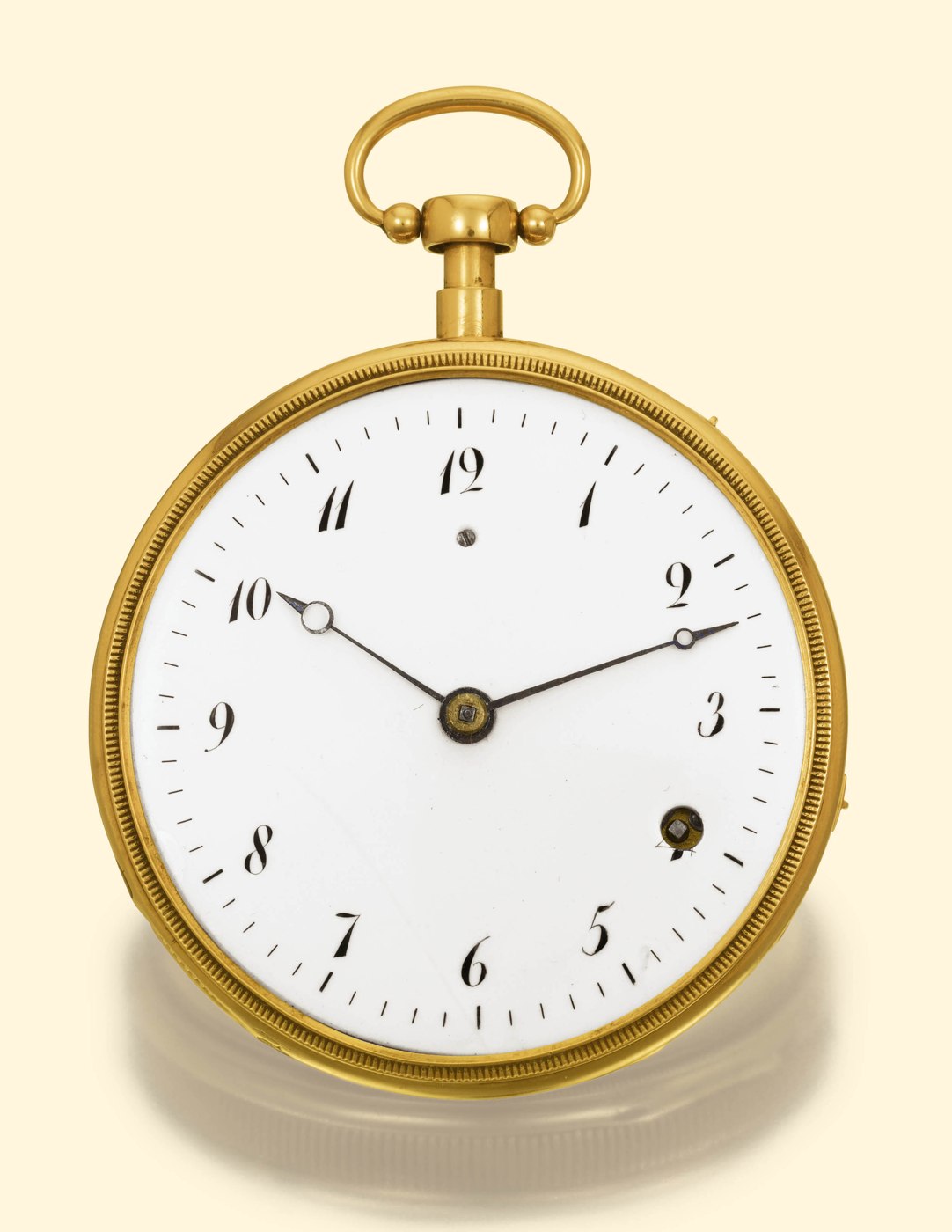
This musical pocket watch was manufactured by Abraham Chapuis & Barral in Geneva, 1812. The timepiece features a four-body 'Empire' style case with a polished back and reeded band and bezels. The dial is white enamel with Breguet numerals, outer minute divisions, and a winding aperture located at 4 o'clock, paired with blued-steel Breguet hands. The movement is 50 mm (22''') in diameter, equipped with a fixed barrel and a cylinder escapement with a three-arm brass balance. Notably, the watch incorporates a musical function utilizing a pinned cylinder and 35 tuned vibrating blades organized into twelve sections. A gold engine-turned cover protects the pinned cylinder, and tempo adjustment is managed by a pinion governor. The watch, accompanied by a gold chain and key, is capable of quarter-repeating on gongs by depressing the pendant.

Front view of the Abraham Chapuis & Barral musical pocket watch showing the white enamel dial and Breguet numerals.
Front view of the Abraham Chapuis & Barral musical pocket watch showing the white enamel dial and Breguet numerals. — Antiquorum. Rights pending — permission not yet requested. Original source

Catalogue identity

Source
catalog.antiquorum.swiss
Category
Pocket watch · Musical pocket watch
Maker / attribution
Abraham Chapuis & Barral
Reference
Not recorded
Catalogue / lot identifier
132
Source-reported date
1812
Source-reported place
Geneva, Switzerland

Source-reported attribution and specifications are not independent authentication. A listing does not establish present ownership, current display, availability or permission to reproduce.

Object description

Case and Dial Construction

The watch is housed in a four-body 'Empire' style gold case. The exterior features a polished back, while the band and bezels are decorated with reeding. A gilt hinged cuvette is present within the case assembly. The watch has a diameter of 58 mm.

The dial is constructed from white enamel and features Breguet numerals. Outer minute track divisions are present, and a winding aperture is positioned at the 4 o'clock index. The time is displayed via a set of blued-steel Breguet hands.

Evidence for this section
  • “Four-body, "Empire", polished back, reeded band and bezels, gilt hingedcuvette.”
  • “White enamel, Breguet numerals, outer minute divisions, windingaperture at 4.”
  • “Blued-steel Breguet hands.”

Movement and Musical Mechanism

The movement is built with a fixed barrel and a cylinder escapement, utilizing a three-arm brass balance with a flat balance spring. The watch provides a quarter-repeating function, which is activated by depressing the pendant.

The integrated musical mechanism is of particular construction, using a pinned cylinder rather than a pinned barrel. The system consists of 35 tuned vibrating blades, separated into twelve sections, with one section containing two blades and the others containing three. Tempo control is handled by a pinion governor situated in an eccentric socket, and the cylinder is shielded by a gold engine-turned cover.

Evidence for this section
  • “fixed barrel, cylin-der escapement, three-arm brass balance with flat balance spring”
  • “repeatingon gongs by depressing the pendant”
  • “pinion governor in eccentric socket for tempo adjust-ment”

Provenance and Historical Context

Abraham Chapuis & Barral were active in the early 19th century and are known for producing musical watches using cylinder escapements. Research indicates that their watches often utilized quarter-repeating mechanisms alongside virgule or reverse cylinder escapements.

The construction of this specific watch is noted for its rarity due to the placement of the gongs on the pillar plate beneath the dial, as well as the use of the pinned cylinder. This item is referenced in the literature authored by Katheleen H. Pritchard.

Evidence for this section
  • “Abraham Chapuis & Barral. Working during the early 19th century, they made musical watches with cylin- der.”
  • “The construction is unusual due to the use of a pinned cylinder for the music rather than the more usual pinned barrel, and to the arrangement of the gongs on the pillar plate under the dial.”
  • “Katheleen H. Pritchard in Swiss Timepiece Makers, West Kennebunk, 1997, p. C-27.”

Open research questions

  • What is the specific provenance history for this object prior to its inclusion in the current catalogue?
  • Are there other extant timepieces by Abraham Chapuis & Barral that share this specific configuration of musical blades?

Source evidence

Recorded claims and source quotations for Abraham Chapuis & Barral Musical Pocket Watch
FieldSource-reported valueSource quotation
MakerAbraham Chapuis & Barral“A(braham) Chapuis & Barral, fecit à Genève 1812.”
Date1812“fecit à Genève 1812.”
Case diameter58 mm“Diam. 58 mm.”
Repeating mechanismQuarter-repeater“quarter-repeating”
Included accessoriesGold chain and key“accompanied by a gold chain and key.”

Visible details

  • White enamel dial with Breguet numerals
  • Winding aperture located at the 4 o'clock position
  • Gold-colored case with reeded side bands
  • Blued-steel hands of Breguet style

Research qualifications

  • The movement is noted by the auction description to require an overhaul.
  • The dial is classified as being in 'Fair' condition.

Photograph identity and source facts were screened before import; rights clearance remains pending.