
Skip to content
The Encyclopedia of Horology

Clock · Bracket clock

A. Woodroffe musical eight-bell triple fusee bracket clock

Partially verified

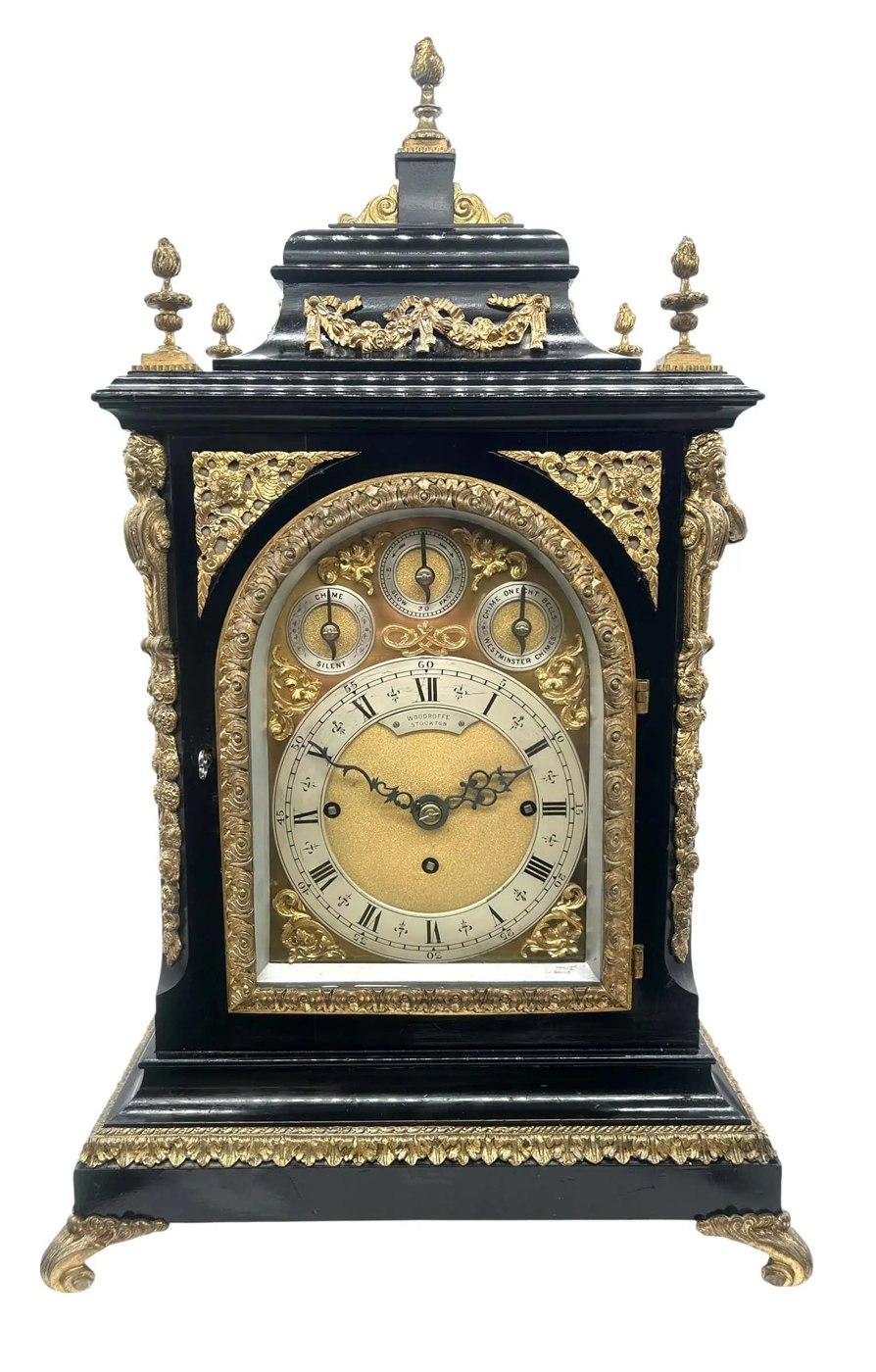
This musical triple fusee bracket clock, identified as an English production from the late Victorian period, is signed by A. Woodroffe of Stockton-on-Tees. The movement is an 8-day, three-train mechanical system, with the musical train utilizing a pinned brass cylinder to operate an assembly of 8 bells for quarter-chimes. The hours are struck on a separate bell or coiled gong. Three subsidiary dials located in the arch provide controls for chime selection, chime/silent function, and pendulum regulation. The cabinet is constructed from ebonised wood and is accented with gilded brass ormolu fittings, including classical side pillars, corner appliqués, and flame finials on a basket-style top. Acoustic side panels feature pierced fretwork lined with silk to facilitate sound transmission.

Frontal view of the A. Woodroffe bracket clock, showing the dial, subsidiary dials, and ormolu mounts.
Frontal view of the A. Woodroffe bracket clock, showing the dial, subsidiary dials, and ormolu mounts. — Vintage Clocks UK. Rights pending — permission not yet requested. Original source

Catalogue identity

Source
vintageclocks.uk
Category
Clock · Bracket clock
Maker / attribution
A. Woodroffe
Reference
JN150
Catalogue / lot identifier
JN150
Source-reported date
circa 1880–1890
Source-reported place
England

Source-reported attribution and specifications are not independent authentication. A listing does not establish present ownership, current display, availability or permission to reproduce.

Object description

Case and Dial

The clock is housed in an ebonised wooden cabinet designed with a basket-style top, adorned with gilded brass fittings, including classical pillars at the sides, corner appliqués, and flame-shaped finials. The side panels feature pierced ormolu fretwork, which is lined with silk to protect the movement while allowing for sound projection.

The dial architecture includes a silvered brass chapter ring marked with black Roman numerals. The surrounding faceplate is crafted from embossed ormolu. The upper arch contains three subsidiary dials, providing functions for chime and silent operation, tune selection, and a rise-and-fall regulation lever for the pendulum.

Evidence for this section
  • “Cabinetry:Masterfully crafted out of premium hardwoodsin ebonised wood.”
  • “The side walls contain pierced brass, ormolu, or wooden fretwork backing panels silk lined”
  • “A silvered brass chapter ring etched with black Roman numerals and framed by an ornate gilt-brass or embossed ormolu faceplate.”

Movement and Mechanism

The clock operates on an 8-day, three-train mechanical movement powered by triple fusees. This mechanism uses chain or gut-line fusee cones to maintain constant force to the gear trains. The musical train utilizes a pinned brass cylinder to trigger the 8 tuned bells for quarter-chime sequences.

Standard hour striking is performed on a separate deep-toned bell or coiled steel gong. The user controls the chime features through the subsidiary dials, which allow for switching between specific sequences such as Westminster or Whittington/Cambridge, or silencing the bells entirely.

Evidence for this section
  • “The movement features three separate winders driven by chain or gut-line fusee cones.”
  • “The musical train operates via a pinned brass cylinder (drum). It plays a musical sequence or quarter-chimes on a nested assembly of 8 tuned bells every 15 minutes.”
  • “Hours are standardly announced with full heavy strikes on a separate, deep-toned coiled steel gong or a large low bell.”

History and Attribution

The retailer, A. Woodroffe, operated at 58 High Street, Stockton-on-Tees, from 1879 into the 20th century. The company, which expanded to become Woodroffe & Son, functioned as horologists and jewellers.

It is reported that retailers of this era frequently commissioned movements from specialized makers in London or the Black Forest before signing the dials with their own house name.

Evidence for this section
  • “F.A. Woodroffe (later Woodroffe & Son) operated as high-end clockmakers, watchmakers, and jewellers at 58 High Street, Stockton-on-Tees from 1879 well into the 20th century.”
  • “Like many luxury regional retailers of the Victorian era, they routinely commissioned elite horologists—frequently from London or the Black Forest—and signed the dial with their own prestigious house name.”

Open research questions

  • What is the specific manufacturer of the movement if marked on the plates?
  • Are there any maker's marks or stamps hidden on the internal movement plates or case back?

Source evidence

Recorded claims and source quotations for A. Woodroffe musical eight-bell triple fusee bracket clock
FieldSource-reported valueSource quotation
MakerA. Woodroffe“Retailer / Signatory:A. Woodroffe, Stockton-on-Tees.”
Movement Type8-Day, Triple Fusee“Movement Type:8-Day, Triple Fusee (Three-Train) mechanical movement”
Datecirca 1880–1890“Era:Late Victorian (Circa 1880–1890).”
Dimensions39 x 69 x 69 cm“Measures 69cm high, 69cm wide, 39cm deep”
Bells8“musical 8-bell triple fusee bracket clock”
SKUJN150“SKU: JN150”

Visible details

  • Silvered brass chapter ring with black Roman numerals
  • Triple subsidiary dials for chime selection, chime/silent, and regulation
  • Pierced brass ormolu acoustic side frets

Research qualifications

  • Movement origin not specified, despite attribution to London or Black Forest makers
  • Exact composition of the hardwood base not verified

Photograph identity and source facts were screened before import; rights clearance remains pending.

Terms in this record

Glossary explanations for terms named in this object’s record.