
Skip to content
The Encyclopedia of Horology

Clock · Automaton table clock

A German Renaissance gilt-copper and gilt-brass 'reiter uhr' automaton table clock, Nikolaus Schmidt

Partially verified

According to the auction catalogue, this German Renaissance automaton table clock dates to circa 1580 and is attributed to Nikolaus Schmidt in Augsburg. The gilt-copper and brass case stands on bun feet and supports an equestrian figure dressed in period attire holding a baton. The auctioneer notes that during striking on a bell via a locking plate mechanism, the rider's head turns from side to side. The internal two-train movement utilizes fusee and chain with pinned barrel caps, verge escapement with a later-fitted hairspring and regulator, and oval brass plates bearing the stamped maker's mark 'NS'. The repoussé base is engraved with strapwork, foliage, and dial indicators.

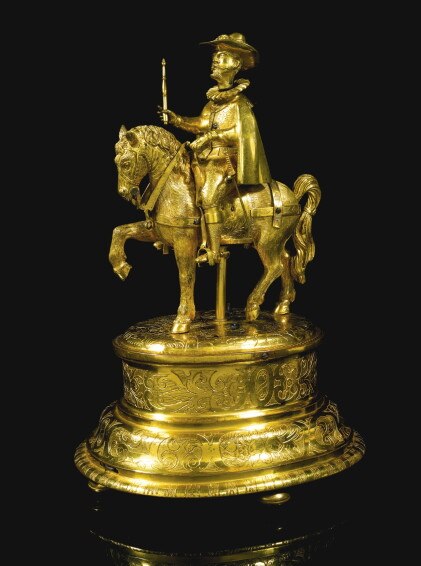
Gilt-copper and gilt-brass equestrian automaton table clock surmounted by a rider on horseback
Gilt-copper and gilt-brass equestrian automaton table clock surmounted by a rider on horseback — Sotheby's. Rights pending — permission not yet requested. Original source

Catalogue identity

Source
www.sothebys.com
Category
Clock · Automaton table clock
Maker / attribution
Nikolaus Schmidt
Reference
Not recorded
Catalogue / lot identifier
10
Source-reported date
circa 1580
Country
Germany

Source-reported attribution and specifications are not independent authentication. A listing does not establish present ownership, current display, availability or permission to reproduce.

Object description

Visual Composition and Equestrian Form

The object presents as a multi-tiered horizontal table clock surmounted by a sculptural equestrian group in gilded metal. The rider is modeled in period attire, including a hat, neck ruff, and cape, mounted on a horse with a raised foreleg.

The equestrian figure rests on an oval repoussé plinth with a stepped, molded base decorated with foliate engraving and strapwork. The entire assembly is elevated on small turned bun feet attached beneath the bottom plinth.

Evidence for this section
  • “A fully gilded rider dressed with a hat, ruff, and cape is mounted on a horse with raised foreleg.”
  • “The horse and rider stand atop an oval, multi-tiered gilded metal base ornamented with foliate engraving.”
  • “Small turned bun feet are visible underneath the bottom plinth.”

Reported Horological and Automaton Mechanism

According to the auction catalogue, the internal clockwork consists of a two-train fusee and chain movement built with plain steel pillars and oval brass plates stamped "NS" for Nikolaus Schmidt. The escapement is catalogued as verge with a plain brass balance, striking on a bell via a locking plate.

The catalogue notes that the equestrian sculpture incorporates an automaton action linked to the striking train, causing the rider's head to turn from side to side during striking. The upper side of the repoussé gilt-copper base is reported to be engraved with an hours dial and a strike recording dial alongside depictions of buildings and creatures.

Evidence for this section
  • “the two train fuse and chain movement with pinned barrel caps, oval brass plates stamped NS for Nikolaus Schmidt”
  • “verge and plain brass balance escapement with later hairspring and regulator, locking plate striking on a bell”
  • “the figure moving his head from side to side as the clock strikes”
  • “the repoussé gilt-copper base decorated on the upper side with building and creatures and engraved with hours dial and strike recording dial”

Modifications and Source Limitations

The auctioneer's condition report documents multiple alterations and later replacements across both the mechanism and the external figures. The movement features a later balance spring and regulation assembly, along with a replaced strike hammer and striking click work. The hour and strike hands are also identified as replacements.

Externally, the catalogue notes that the baton in the rider's right hand and the sword are replacements, while the figure and plinth case are reported by the seller to retain much of their original gilding. Because neither the upper surface dials nor the internal gear trains are visible in the provided primary photograph, confirmation of these mechanical components relies strictly on the seller's documentation.

Evidence for this section
  • “later balance spring and regulation, strike hammer replaced, striking click work replaced”
  • “Hour and strike hands replaced.”
  • “baton in right hand replaced, sword replaced”

Open research questions

  • What specific mechanical linkage connects the locking-plate striking train to the neck pivot of the equestrian figure?
  • When and by whom were the replacement hairspring, regulation assembly, hands, sword, and baton fitted to the clock?
  • Does the damascened iron base plate retain original securing screws or mounting points for the internal movement plates?

Source evidence

Recorded claims and source quotations for A German Renaissance gilt-copper and gilt-brass 'reiter uhr' automaton table clock, Nikolaus Schmidt
FieldSource-reported valueSource quotation
Maker's MarkStamped NS for Nikolaus Schmidt“oval brass plates stamped NS for Nikolaus Schmidt”
Dimensions29 cm (11½ in.) high“29cm. 11½in. high”
MaterialsCopper, brass, steel“Copper, brass, steel”
Automaton ActionHead turns side to side when striking“the figure moving his head from side to side as the clock strikes”
Movement ConstructionTwo-train fusee and chain movement with oval brass plates“the two train fuse and chain movement with pinned barrel caps, oval brass plates”
Base Underside ConstructionDamascened iron underside with gilt bun feet“the damascened iron underside with gilt bun feet”
Documented ProvenanceTime Museum, Rockford, Illinois, Inventory No. 557“Time Museum, Rockford, Illinois, Inventory No. 557.”
Literature ReferenceKlaus Maurice & Otto Mayr, The Clockwork Universe (1980), fig. 73“Maurice, Klaus & Mayr, Otto, eds., The Clockwork Universe, German Clocks & Automata, 1550-1650, Washington D.C., 1980, Fig.73.”

Visible details

  • A fully gilded rider dressed with a hat, ruff, and cape is mounted on a horse with raised foreleg.
  • The horse and rider stand atop an oval, multi-tiered gilded metal base ornamented with foliate engraving.
  • Small turned bun feet are visible underneath the bottom plinth.

Research qualifications

  • Source notes the hairspring and regulator, strike hammer, striking click work, hour and strike hands, sword, and baton are replacements.
  • The internal movement and the top surface dials are not visible in the primary photograph.

Photograph identity and source facts were screened before import; rights clearance remains pending.

Terms in this record

Glossary explanations for terms named in this object’s record.