
Skip to content
The Encyclopedia of Horology

Clock · Table clock

A German Gilt Metal and Silvered Brass Table Clock

Partially verified

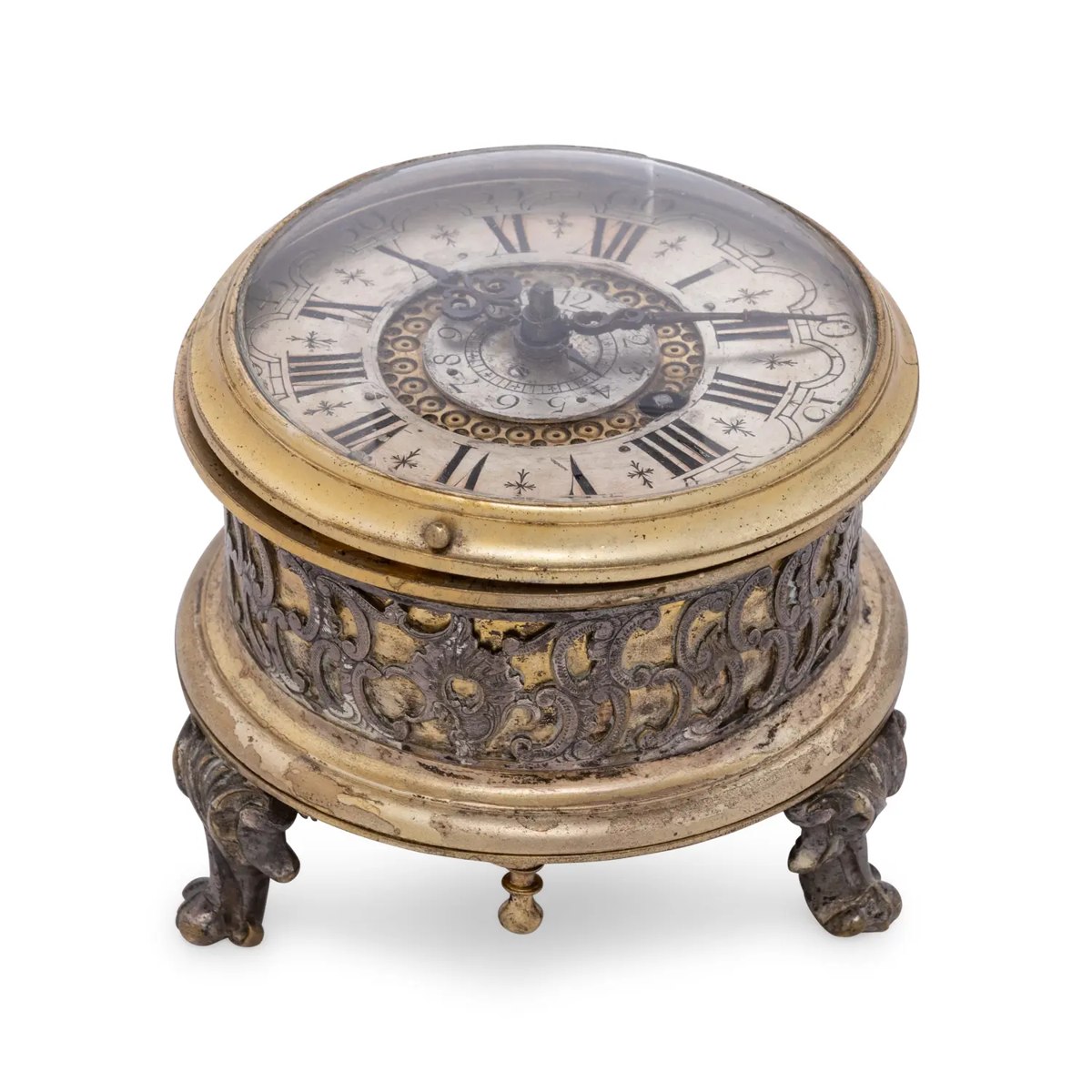
This German gilt metal and silvered brass horizontal table clock is attributed by the source to Johann Heinrich Naumann of Dresden and dated to the first half of the 18th century. Raised on cast claw feet with a central lower drop finial, the drum-form case features pierced foliate scrollwork encircling the sides. The horizontal upper dial is enclosed beneath a domed glass crystal, showing Roman hour numerals, ornamental star-like half-hour markers, and an inner numbered disc. The auction house reports that the movement is a chain-driven single fusee mechanism with the works signed J.H. Naumann.

Three-quarter elevated view of the German gilt metal and silvered brass horizontal table clock
Three-quarter elevated view of the German gilt metal and silvered brass horizontal table clock — Freeman's. Rights pending — permission not yet requested. Original source

Catalogue identity

Source
freemansauction.com
Category
Clock · Table clock
Maker / attribution
Johann Heinrich Naumann
Reference
Not recorded
Catalogue / lot identifier
203
Source-reported date
First half 18th century
Country
Germany

Source-reported attribution and specifications are not independent authentication. A listing does not establish present ownership, current display, availability or permission to reproduce.

Object description

Object Identity and Form

This German table clock features a cylindrical drum-form case constructed of gilt metal and silvered brass. It is elevated on ornate cast figural claw feet, featuring a central spherical pendant finial on the underside.

The horizontal dial, positioned on top, is protected by a domed glass crystal. The visible dial configuration includes a Roman numeral chapter ring, a pierced openwork inner ring, and a central numbered disc.

Evidence for this section
  • “Cylindrical drum case with applied or pierced scrollwork around the silvered and gilt side band”
  • “Horizontal top dial covered by a domed glass crystal”
  • “Supported on ornate cast figural claw feet with a central spherical pendant finial underneath”

Mechanism and Attribution

The clock is attributed to the Dresden-based maker Johann Heinrich Naumann and is dated to the first half of the 18th century. The internal movement is reported by the auction source as a chain-driven single fusee mechanism, which the source states is signed 'J.H. Naumann'.

The current functionality of the internal mechanism remains unverified; the auction house notes the clock lacks a winding key but reports that the works appear intact.

Evidence for this section
  • “Johann Heinrich Naumann, Dresden, First Half 18th Century”
  • “having a chain-driven single fusee movement, the works signed J.H. Naumann”
  • “Lacking winding key but works appear intact”

Condition and Observations

The top glass cover exhibits chipping along the edges, and the collar of the top assembly shows separation at the seam.

A painted museum accession number is present on the underside of the clock. Access to the movement is facilitated by a front bezel hinge and opening push-pin.

Evidence for this section
  • “Some chipping to edes of glass cover on top. Collar of top with some separation at seam.”
  • “Painted museum accession number on underside.”
  • “Small hinge and opening push-pin visible at the front bezel”

Open research questions

  • Does the internal J.H. Naumann signature match documented authentic examples of the maker's hand-engraving?
  • Does the painted accession number on the underside correspond to a specific deaccession record within the Indianapolis Museum of Art archives?

Source evidence

Recorded claims and source quotations for A German Gilt Metal and Silvered Brass Table Clock
FieldSource-reported valueSource quotation
Maker attribution and originJohann Heinrich Naumann, Dresden, First Half 18th Century“Johann Heinrich Naumann, Dresden, First Half 18th Century”
MovementChain-driven single fusee movement, works signed J.H. Naumann“having a chain-driven single fusee movement, the works signed J.H. Naumann”
DimensionsHeight 3 x width 3 1/2 inches“Height 3 x width 3 1/2 inches.”
Provenance noteSold to benefit the Acquisition Fund of the Indianapolis Museum of Art at Newfields“Sold to Benefit the Acquisition Fund of the Indianapolis Museum of Art at Newfields”
DimensionsHeight 3 inches by width 3.5 inches“Height 3 x width 3 1/2 inches.”
Institutional ProvenanceSold to benefit the Acquisition Fund of the Indianapolis Museum of Art at Newfields“Sold to Benefit the Acquisition Fund of the Indianapolis Museum of Art at Newfields”

Visible details

  • Cylindrical drum case with applied or pierced scrollwork around the silvered and gilt side band
  • Horizontal top dial covered by a domed glass crystal
  • Dial features a wide Roman numeral chapter ring, pierced openwork inner ring, and a central numbered disc
  • Supported on ornate cast figural claw feet with a central spherical pendant finial underneath
  • Small hinge and opening push-pin visible at the front bezel

Research qualifications

  • Internal movement is not visible in the provided image; fusee mechanism details and signature are source-reported.
  • Source notes the clock lacks a winding key, exhibits chipping along the edges of the top glass cover, and has collar seam separation.

Photograph identity and source facts were screened before import; rights clearance remains pending.

Consulted source

A German Gilt Metal and Silvered Brass Table Clock | Freeman's

Reviewed 2026-10-25 · Record 1d10127f22

Terms in this record

Glossary explanations for terms named in this object’s record.