
Skip to content
The Encyclopedia of Horology

Clock · Longcase clock

A George III Mahogany Eight-Day Longcase Clock

Partially verified

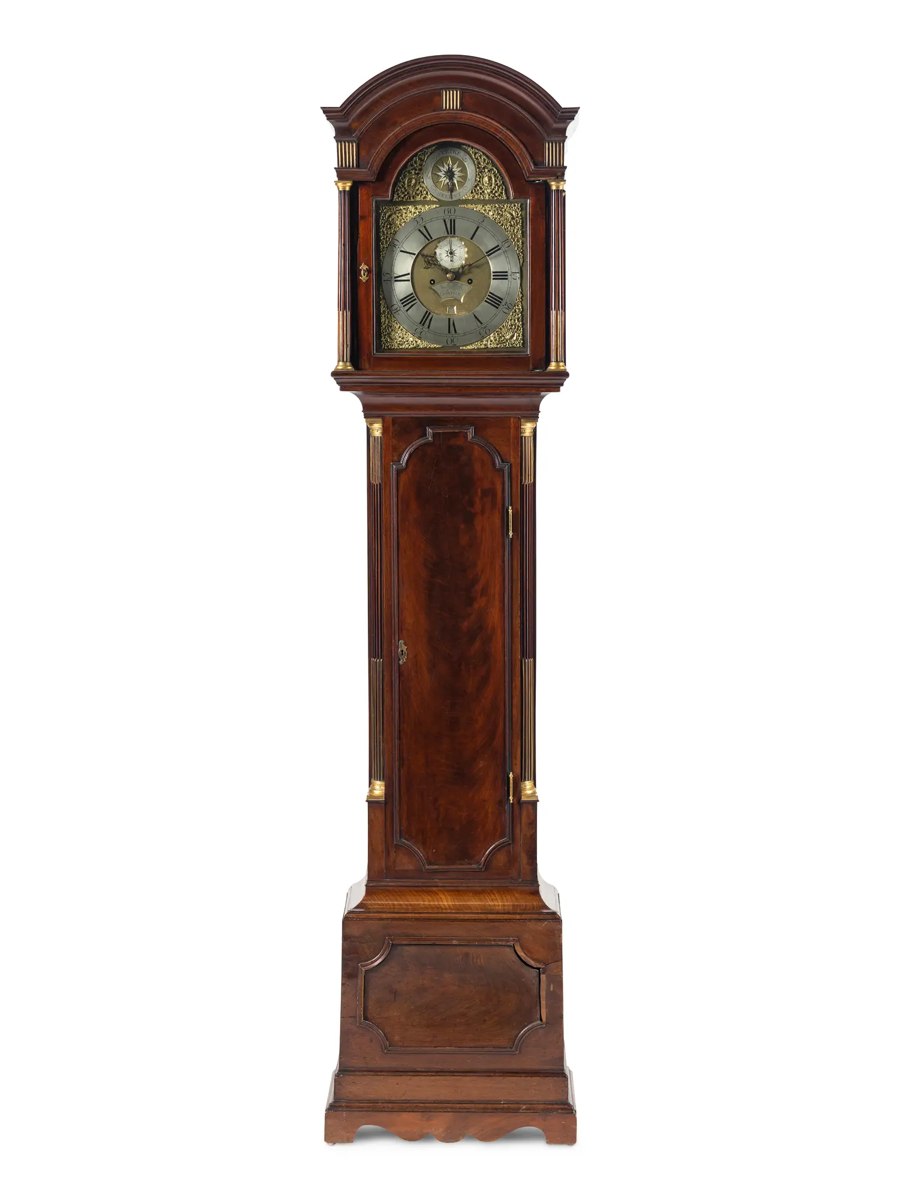
According to the auction house, this George III longcase clock stands 91 3/4 inches high in a mahogany case. The composite dial is signed Jos. Millis, London, and dates to circa 1775. The auction description notes an eight-day time and strike movement that chimes on the hour, though it observes that the works are likely a marriage to the case because the saddle board fails to line up with the support boards. Visually, the arched hood features fluted columns with brass-toned capitals enclosing a brass spandrel dial with an arched auxiliary display.

Full frontal view of the George III mahogany eight-day longcase clock
Full frontal view of the George III mahogany eight-day longcase clock — Freeman's. Rights pending — permission not yet requested. Original source

Catalogue identity

Source
freemansauction.com
Category
Clock · Longcase clock
Maker / attribution
Jos. Millis
Reference
Not recorded
Catalogue / lot identifier
308
Source-reported date
Circa 1775
Country
United Kingdom

Source-reported attribution and specifications are not independent authentication. A listing does not establish present ownership, current display, availability or permission to reproduce.

Object description

Case Construction and Form

The clock stands 91 3/4 inches tall, with a width of 21 1/2 inches and a depth of 10 inches. It is constructed of mahogany.

The arched hood is designed with fluted columns and brass-toned capitals. Reported condition issues include age splits to the side of the hood, a replaced glass on the hood, and an area of loss to the molded decoration on the right side of the base.

Evidence for this section
  • “Height 91 3/4 x width 21 1/2 x depth 10 inches.”
  • “A George III Mahogany Eight-Day Longcase Clock”
  • “Some age splits to side of hood, the class on hood replaced.”
  • “Area of loss to moulded decoration on right side of base decoration.”

Dial and Visual Appointments

The composite dial is signed 'Jos. Millis, London' and is dated to circa 1775.

The clock features an eight-day time and strike movement. It is reported to take a wind, run, and chime on the hour, though it has not been tested for accuracy or duration.

Evidence for this section
  • “Dial Signed Jos. Millis, London, Circa 1775”
  • “having an eight-day time and strike movement.”
  • “Works take a wind and appear to run, chiming on the hour. Not tested for accuracy or duration.”

Condition and Provenance

The auction house notes that the clock appears in stable condition overall, though it exhibits scuffs, marks, and scratches consistent with age and use.

The internal works are identified by the source as likely being a marriage to the case, citing that the saddle board does not align properly with the support boards.

Evidence for this section
  • “Clock appears in overall decent, stable condition. Old scuffs, marks and scratches throughout consistent with age and use.”
  • “The works are likely a marriage with the case as the saddle board does not line up with support boards perfectly.”

Open research questions

  • Does the saddle board misalignment indicate a replacement movement or a modification to the original case interior?
  • Are there additional identifiers on the movement plates that confirm the manufacturer?

Source evidence

Recorded claims and source quotations for A George III Mahogany Eight-Day Longcase Clock
FieldSource-reported valueSource quotation
Dial SignatureJos. Millis, London“Dial Signed Jos. Millis, London, Circa 1775”
Movement TypeEight-day time and strike“having an eight-day time and strike movement.”
DimensionsHeight 91 3/4 x width 21 1/2 x depth 10 inches“Height 91 3/4 x width 21 1/2 x depth 10 inches.”
Case MaterialMahogany“A George III Mahogany Eight-Day Longcase Clock”

Visible details

  • Arched hood with fluted columns and brass-toned capitals
  • Composite dial with ornate brass spandrels, silvered chapter ring, and subsidiary dial in the arch
  • Long waist door with shaped molded panel and figured veneer
  • Plinth base with shaped molding and scalloped skirt

Research qualifications

  • Source reports the movement is likely a marriage with the case as the saddle board does not align properly with the support boards
  • Internal movement, weights, and pendulum are not visible in the provided photograph
  • Source reports replaced glass on the hood, age splits, and an area of loss to molded decoration on the right side of the base

Photograph identity and source facts were screened before import; rights clearance remains pending.

Consulted source

A George III Mahogany Eight-Day Longcase Clock | Freeman's

Reviewed 2026-10-22 · Record b9655d0780

Terms in this record

Glossary explanations for terms named in this object’s record.