
Skip to content
The Encyclopedia of Horology

Clock · Bracket clock

A George III mahogany bracket clock by Joseph Jennings

Partially verified

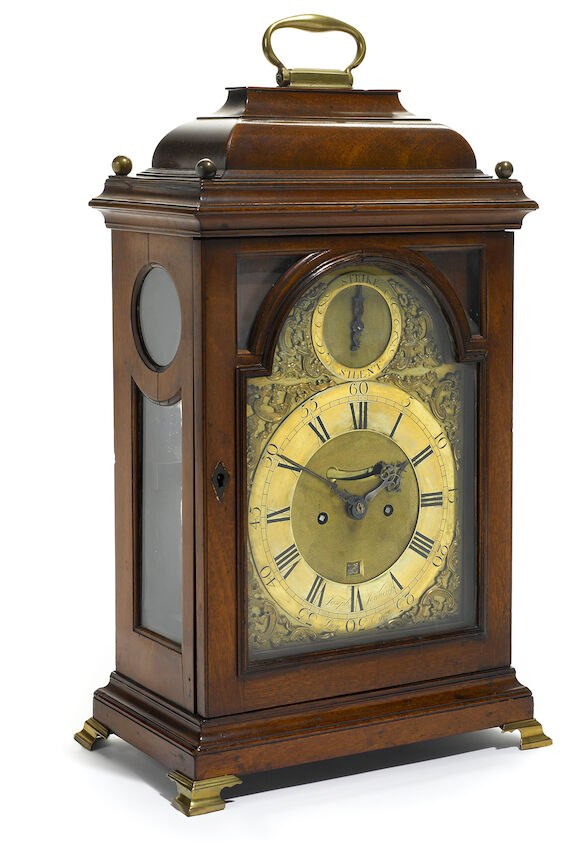
According to Bonhams, this George III mahogany bracket clock was made by Joseph Jennings of London in the fourth quarter of the 18th century. The clock case stands 22 inches (56 cm) high and features an inverted bell top with a brass carrying handle, glazed sides, a glazed panel door, and brass ogee bracket feet. Its arched brass dial includes Roman hours, Arabic five-minute divisions, ornate cast spandrels, a subsidiary strike/silent dial in the arch, a mock pendulum aperture, and a square date aperture. The auction catalogue reports an internal twin-train fusee movement with verge escapement, pull repeat mechanism striking on a bell, and an engraved backplate.

George III mahogany bracket clock by Joseph Jennings of London
George III mahogany bracket clock by Joseph Jennings of London — Bonhams. Rights pending — permission not yet requested. Original source

Catalogue identity

Source
www.bonhams.com
Category
Clock · Bracket clock
Maker / attribution
Joseph Jennings
Reference
Not recorded
Catalogue / lot identifier
2022
Source-reported date
fourth quarter 18th century
Country
United Kingdom

Source-reported attribution and specifications are not independent authentication. A listing does not establish present ownership, current display, availability or permission to reproduce.

Object description

Case Architecture and Form

The clock case is constructed in mahogany and stands 22 inches (56 cm) high. It features an inverted bell-top profile surmounted by a carrying handle, with visible observations noting spherical brass finials and a brass handle. The front is enclosed by a glazed panel door and the sides are glazed, with observations noting an upper circular glazed window and lower rectangular glazed window on the side.

The case terminates at the base on brass ogee bracket feet, supporting the rectangular molded base.

Evidence for this section
  • “The inverted bell top surmounted by a carrying handle, enclosed by a glazed panel door, flanked by glazed sides, on brass ogee bracket feet”
  • “height 22in (56cm)”
  • “Inverted bell-top mahogany case surmounted by a brass carrying handle and small spherical brass finials”
  • “Side of the case features an upper circular glazed window and lower rectangular glazed window”
  • “Clock base rests on four brass ogee bracket feet”

Dial Composition and Features

The front door reveals an arched brass dial plate mounted with cast corner and arch spandrels. Time is marked on the primary chapter ring using Roman hours and Arabic five-minute numerals.

The center of the dial features a matte finish and contains a mock pendulum aperture, a square calendar aperture, and winding arbors. Above the main chapter ring, the arch incorporates a subsidiary strike/silent dial.

Evidence for this section
  • “the arched brass dial with Roman hours and Arabic minutes with strike/silent dial above, having mock pendulum and date aperture to the matte center within cast spandrels”
  • “Main chapter ring with Roman hour numerals and Arabic five-minute numerals, centered by winding arbors, a mock pendulum slit, and a square calendar aperture”
  • “Upper arch houses a subsidiary Strike/Silent dial”

Attribution and Provenance

The bracket clock is attributed by the auction house to Joseph Jennings of London, assigned to the fourth quarter of the 18th century during the George III period.

The lot was offered as property from a private California collection at Bonhams Los Angeles on 12 June 2012, achieving a realized price of US$3,750 including buyer's premium.

Evidence for this section
  • “A George III mahogany bracket clock Joseph Jennings, London fourth quarter 18th century”
  • “Property from a Private California Collection”
  • “Sold for US$3,750 inc. premium”

Open research questions

  • Does the dial or backplate bear an engraved maker's signature and location, and what is its specific transcription?
  • Has the verge escapement survived unaltered or has it undergone restoration or reconversion?

Source evidence

Recorded claims and source quotations for A George III mahogany bracket clock by Joseph Jennings
FieldSource-reported valueSource quotation
MakerJoseph Jennings, London“Joseph Jennings, London”
Datefourth quarter 18th century“fourth quarter 18th century”
Height22in (56cm)“height 22in (56cm)”
MovementTwin train fusee movement with verge escapement and pull repeat striking on a bell“twin train fusee movement with verge escapement and pull repeat mechanism striking on a bell”
BackplateWell engraved backplate“having a well engraved backplate”
ProvenanceProperty from a Private California Collection“Property from a Private California Collection”
Dial Center FinishMatte center“matte center within cast spandrels”
Auction ResultSold for US$3,750 inc. premium (12 June 2012)“Sold for US$3,750 inc. premium”

Visible details

  • Inverted bell-top mahogany case surmounted by a brass carrying handle and small spherical brass finials
  • Arched front glass door displaying an arched brass dial with cast spandrels
  • Main chapter ring with Roman hour numerals and Arabic five-minute numerals, centered by winding arbors, a mock pendulum slit, and a square calendar aperture
  • Upper arch houses a subsidiary Strike/Silent dial
  • Side of the case features an upper circular glazed window and lower rectangular glazed window
  • Clock base rests on four brass ogee bracket feet

Research qualifications

  • Internal twin-train fusee movement, verge escapement, bell, and engraved backplate are obscured inside the case and rely entirely on source reporting

Photograph identity and source facts were screened before import; rights clearance remains pending.

Terms in this record

Glossary explanations for terms named in this object’s record.