
Skip to content
The Encyclopedia of Horology

Movement · Thirty-hour longcase clock movement

A George II thirty-hour longcase clock movement with eight-inch dial

Partially verified

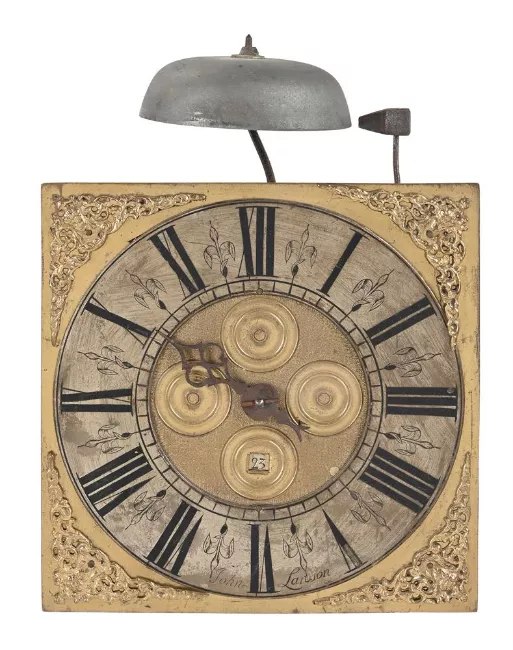
This George II period thirty-hour longcase clock movement, attributed to John Lawson of Keighley, is designed with an external countwheel striking train and an anchor escapement for regulation by a seconds pendulum. Built with four pillars, including two lower steel pillars, the mechanism features an overhead bell and hammer assembly. Its eight-inch square brass dial displays four concentric ring-turned medallions on a matted centre, a calendar aperture, and an applied silvered Roman numeral chapter ring embellished with half-hour markers. The dial is signed John Lawson at the base and retains a single pierced steel hand.

Front view of the eight-inch brass dial with single hand, calendar aperture, and overhead bell
Front view of the eight-inch brass dial with single hand, calendar aperture, and overhead bell — Dreweatts. Rights pending — permission not yet requested. Original source

Catalogue identity

Source
auctions.dreweatts.com
Category
Movement · Thirty-hour longcase clock movement
Maker / attribution
John Lawson
Reference
Not recorded
Catalogue / lot identifier
1078
Source-reported date
mid 18th century
Country
United Kingdom

Source-reported attribution and specifications are not independent authentication. A listing does not establish present ownership, current display, availability or permission to reproduce.

Object description

Identity and Attribution

This thirty-hour longcase clock movement is identified by the signature 'John Lawson' located on the lower edge of the dial chapter ring. The item is described as dating to the mid-18th century.

The source notes that a clockmaker named John Lawson is recorded in Brian Loomes' 'Yorkshire Clockmakers' as working in Keighley before moving to Bradford in 1760, where he is documented until at least 1777.

Evidence for this section
  • “JOHN LAWSON, KEIGHLEY, MID 18th CENTURY”
  • “signed John, Lawson to lower edge”
  • “John Lawson is recorded in Loomes, Brian Yorkshire Clockmakers as working in Keighley before moving to Bradford in 1760 where he remained until at least 1777”

Movement Mechanism

The movement features a four-pillar design, with two of the lower pillars constructed from steel. It utilizes an external countwheel striking train and an anchor escapement regulated by a seconds pendulum.

The mechanism includes an overhead bell mounted on a curved stem. The pendulum, weight, and seatboard are not included with the movement.

Evidence for this section
  • “The four pillar (lower two steel) external countwheel striking movement with anchor escapement for regulation by a seconds pendulum”
  • “(no pendulum, weight or seatboard)”

Dial and Visual Features

The movement is fitted with an eight-inch square brass dial. The matted center is decorated with four concentric ring-turned medallions and contains a calendar aperture.

The dial features an applied Roman numeral chapter ring with leaf-engraved half-hour markers and mask-centered scroll cast spandrels at the angles. It is operated by a single scroll-pierced steel hand.

Evidence for this section
  • “the 8 inch square brass dial with calendar aperture and four concentric ring-turned medallions to the matted centre”
  • “within applied Roman numeral chapter ring with leaf-engraved half hour markers”
  • “with scroll pierced steel hand and mask-centred scroll cast spandrels to angles”

Open research questions

  • Does the inclusion of steel for the lower pillars correlate with specific regional construction techniques in Keighley during this period?
  • Is the calendar aperture wheel mechanism original to the movement?

Source evidence

Recorded claims and source quotations for A George II thirty-hour longcase clock movement with eight-inch dial
FieldSource-reported valueSource quotation
Escapement and StrikingExternal countwheel striking movement with anchor escapement“The four pillar (lower two steel) external countwheel striking movement with anchor escapement for regulation by a seconds pendulum”
Dial Construction8-inch square brass dial with calendar aperture and four concentric ring-turned medallions“the 8 inch square brass dial with calendar aperture and four concentric ring-turned medallions to the matted centre”
SignatureSigned John Lawson on the lower chapter ring“signed John, Lawson to lower edge”
Spandrel StyleMask-centred scroll cast spandrels“mask-centred scroll cast spandrels to angles”
Missing ComponentsLacks pendulum, weight, or seatboard“(no pendulum, weight or seatboard)”
Physical Dimensions3.2cm from dial bottom to base; 14cm deep; 17.5cm high“3.2cm (1.25ins) from bottom of dial to base of the movement, 14cm (5.5ins) deep including crutch, 17.5cm (10.75ins) high including the bell.”

Visible details

  • Square brass dial plate fitted with cast scroll spandrels in each of the four corners.
  • A single scroll-pierced steel hand indicating the time against the Roman numeral chapter ring.
  • Overhead bell mounted on a curved stem with an adjacent striking hammer mechanism.
  • Matted dial centre decorated with four concentric ring-turned circular medallions, the lowest of which encloses a square calendar aperture showing numeral 23.
  • Signed 'John Lawson' across the lower portion of the chapter ring on either side of the VI numeral.

Research qualifications

  • Pendulum, weight, and seatboard are absent according to the auction description.
  • Longcase clock case is not included.

Photograph identity and source facts were screened before import; rights clearance remains pending.

Consulted source

A GEORGE II THIRTY-HOUR LONGCASE CLOCK MOVEMENT WITH EIGHT-INCH DIAL

Reviewed 2026-10-22 · Record 2ff01dfc05

Terms in this record

Glossary explanations for terms named in this object’s record.