
Skip to content
The Encyclopedia of Horology

Pocket watch · Hunter-case pocket chronometer

19th Century Gold Hunter-Case Pocket Chronometer

Partially verified

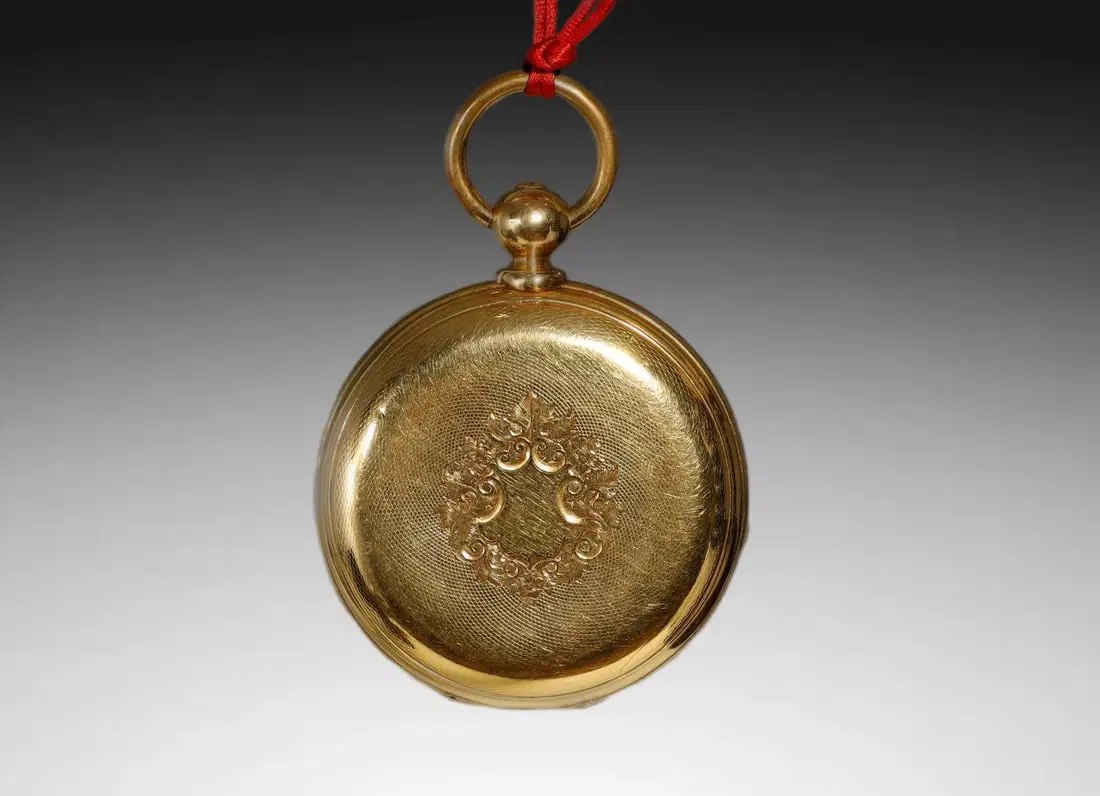
This 19th-century pocket chronometer is housed in a yellow gold hunter case measuring 3.8 cm in diameter, reported by the auctioneer as 18-karat gold. The exterior cover displays fine concentric engine-turned guilloché surrounding an unengraved foliate and scroll rococo-style cartouche, surmounted by a spherical pendant knob, circular bow, and a red silk suspension cord. According to the source, the interior features an engine-turned dust cover, a white enamel dial signed 'CHRONOMETRE / No 82517' with Roman numerals and subsidiary seconds, and a full-plate gilt fusee movement numbered 82517.

Back cover view of the closed gold hunter-case pocket watch showing the engine-turned guilloché, central cartouche, bow, and red cord
Back cover view of the closed gold hunter-case pocket watch showing the engine-turned guilloché, central cartouche, bow, and red cord — Ancient Traces. Rights pending — permission not yet requested. Original source

Catalogue identity

Source
www.liveauctioneers.com
Category
Pocket watch · Hunter-case pocket chronometer
Maker / attribution
Not established
Reference
Not recorded
Catalogue / lot identifier
0034B
Source-reported date
Circa 1855–1870
Country
Europe
Source-reported serial
82517

Source-reported attribution and specifications are not independent authentication. A listing does not establish present ownership, current display, availability or permission to reproduce.

Object description

Case Construction

The timepiece is housed in a three-body 18-karat yellow gold hunter-style case measuring 3.8 cm in diameter. The exterior back cover features a concentric engine-turned guilloche pattern surrounding an unengraved foliate and scroll rococo-style cartouche.

The assembly includes a spherical pendant knob and a gold bow that suspends a red silk fob cord. The interior dust cover is also decorated with radiating engine-turned patterns. As the item is presented closed in the source imagery, the dial and internal movement are not visible in the provided photograph.

Evidence for this section
  • “The three-body 18 karat yellow gold hunter case of characteristic domed form”
  • “Height (case diameter): 3.8 cm”
  • “outer back cover finely engine-turned with concentric guilloche decoration, centred by a rococo cartouche of foliate and scroll design, vacant”
  • “the interior dust cover similarly engine-turned with radiating engine-turned decoration”
  • “the substantial gold bow with spherical pendant knob suspending a gold split ring, with original red silk fob cord.”

Dial and Mechanism

The white enamel dial is signed 'CHRONOMETRE / No 82517' and features Roman numerals, a minute track, and a subsidiary seconds dial at six o'clock. The watch is equipped with blued and gilt serpentine Breguet-style hands and a copper-colored sweep seconds hand.

The movement is a full-plate gilt fusee type, numbered 82517. It includes a fusee and chain, an engraved foliate balance cock, a three-arm compensation balance, and is jeweled in ruby throughout the top plate. The watch is accompanied by an iron winding and setting key.

Evidence for this section
  • “signed CHRONOMETRE / No 82517”
  • “full-plate gilt fusee movement, No. 82517”
  • “with fusee and chain maintaining constant force to the going train”
  • “set with elegant blued and gilt serpentine Breguet-style hands, with a copper-coloured sweep seconds hand.”
  • “Accompanied by the original two-ended iron winding and setting key.”

Attribution and Historical Context

The chronometer is dated to the mid-19th century, approximately 1855–1870. The source notes that the term 'Chronometre' on the dial historically designated timepieces fitted with a detent or high-grade lever escapement.

The piece is stated to originate from a private European collection. No specific maker is identified in the provided source documentation.

Evidence for this section
  • “Europe, 19th Century, Circa 1855–1870”
  • “The designation Chronometre on the dial is significant: in the 19th century this term was reserved for timepieces fitted with a detent or high-grade lever escapement”
  • “Provenance: from a private European collection.”

Open research questions

  • Are there hidden maker's hallmarks inside the case back or on the movement plates?
  • Does the serial number 82517 correlate to a specific workshop or manufacturer?

Source evidence

Recorded claims and source quotations for 19th Century Gold Hunter-Case Pocket Chronometer
FieldSource-reported valueSource quotation
Case Material18 karat yellow gold“three-body 18 karat yellow gold hunter case”
Case Diameter3.8 cm“Height (case diameter): 3.8 cm”
Movement Number82517“full-plate gilt fusee movement, No. 82517”
Dial SignatureCHRONOMETRE / No 82517“signed CHRONOMETRE / No 82517”
Movement TypeFull-plate gilt fusee movement“full-plate gilt fusee movement, No. 82517, with fusee and chain maintaining constant force to the going train”
Escapement TypeDetent or lever“the escapement consistent with a detent or lever chronometer escapement”
Serial Number82517“No 82517”

Visible details

  • Closed yellow gold hunter case with dense engine-turned pattern across the cover.
  • Central foliate and scroll rococo-style cartouche with an unengraved centre.
  • Spherical neck and pendant surmounted by a round gold bow holding a red suspension cord.

Research qualifications

  • The front cover is closed, leaving the dial and hands unverified in the provided image.
  • Internal movement details, hallmarks, and the stated winding key are not visible in Photo 0.

Photograph identity and source facts were screened before import; rights clearance remains pending.

Terms in this record

Glossary explanations for terms named in this object’s record.