
Skip to content
The Encyclopedia of Horology

Clock · Bracket clock

18th Century Bracket Clock by William Creak

Partially verified

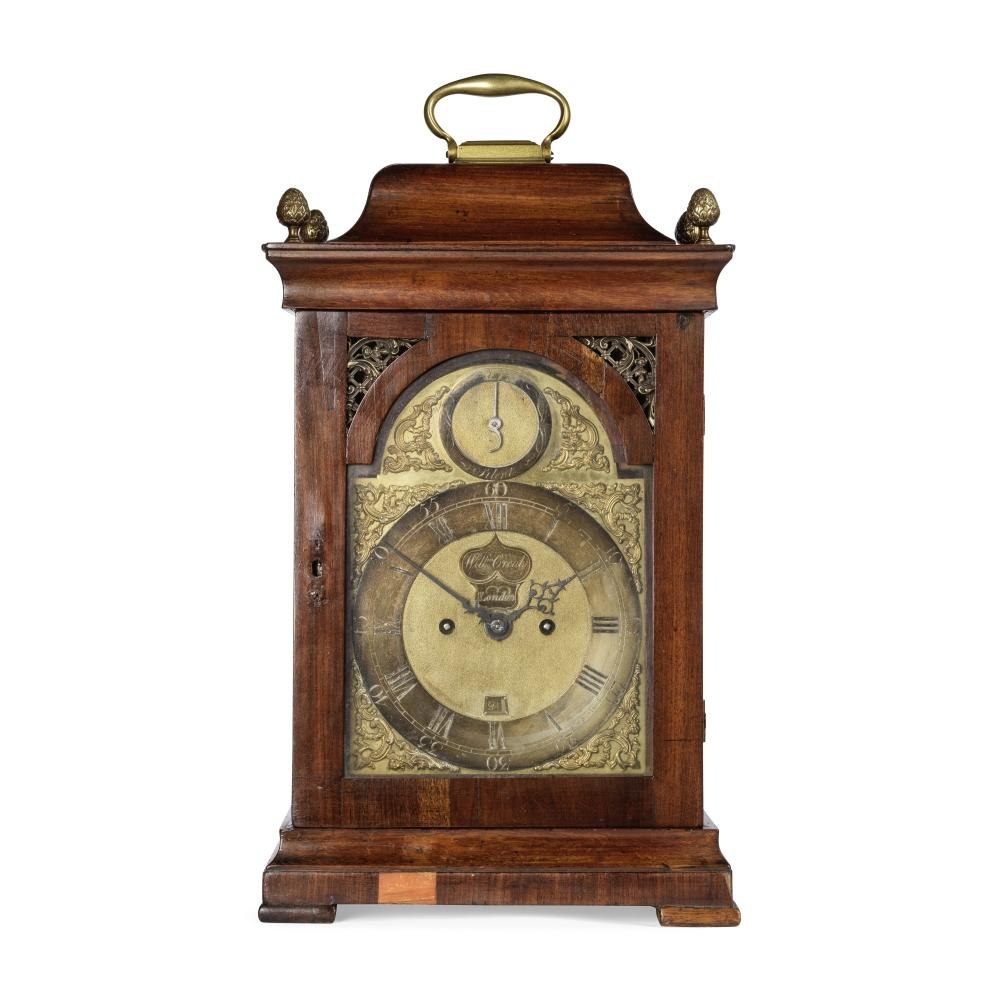
This 18th-century bracket clock features an 18th-century movement by William Creak of London, housed within a case of later date. The timepiece stands 62cm high, surmounted by a brass carrying handle over a bell-top design adorned with four acorn finials. The mahogany-finished case includes inset sound frets, glazed side observation windows, and block feet. Its 7-inch brass dial displays Roman and Arabic numerals, with a matted center featuring a countersunk, shaped cartouche signed "William Creek, London." Further dial features include a decorated calendar aperture, a strike/silent indicator in the break arch, and six cast brass spandrels. The double-fusee movement is constructed with five knopped pillars, a verge escapement, and a short bob pendulum. It strikes the hour on an internal bell. The movement's backplate is decorated with engraved chinoiserie motifs and flowing scrolls, and the auction description reports that the trains are currently ticking and striking.

Front view of the bracket clock showing the dial, hands, and case details.
Front view of the bracket clock showing the dial, hands, and case details. — Bonhams (via Invaluable). Rights pending — permission not yet requested. Original source

Catalogue identity

Source
www.invaluable.com
Category
Clock · Bracket clock
Maker / attribution
William Creak
Reference
Not recorded
Catalogue / lot identifier
283
Source-reported date
18th century
Source-reported place
London, England

Source-reported attribution and specifications are not independent authentication. A listing does not establish present ownership, current display, availability or permission to reproduce.

Object description

Case and Dial

The clock is housed in a wooden case of later date, which is surmounted by a brass carrying handle. The top follows a bell-top profile and is decorated with four acorn finials positioned above a moulded top section. The case front features inset sound frets, while the sides are fitted with glazed observation windows, allowing view into the movement. The structure sits on a moulded base raised on block feet.

The 7-inch brass dial is designed with both Roman and Arabic numerals. The matted center houses a countersunk cartouche signed "William Creek, London" alongside a shaped calendar aperture. The dial is bordered by six cast brass spandrels, and the break arch features a strike/silent indicator for managing the clock’s audible output.

Evidence for this section
  • “The case surmounted by a brass carrying handle over a bell top, surrounded by four acorn finials”
  • “The 7 inch brass dial with Roman and Arabic numerals”
  • “The break arch with strike/silent indicator.”

Movement and Escapement

The internal mechanism is an 18th-century double-fusee movement, which is held together by five knopped pillars. It utilizes a verge escapement paired with a short bob pendulum to regulate timekeeping. The clock provides an hourly strike function, utilizing a bell mounted above the movement plate to produce sound.

The backplate of the movement is decorated with fine engraving, featuring flowing scroll patterns and chinoiserie motifs. According to the auction report, both the timekeeping and striking trains are operational.

Evidence for this section
  • “The double-fusee movement united by five knopped pillars with verge escapement and short bob pendulum”
  • “striking the hours on a bell mounted above.”
  • “The backplate engraved with flowing scrolls and chinoiserie motifs.”

Provenance and Authenticity

The auction records indicate that this object consists of a historical movement paired with a later-dated case. The movement is attributed to William Creak of London. The spelling of the signature on the dial cartouche is noted as "William Creek, London," which varies slightly from the attribution provided in the auction description.

The object is part of the property of a distinguished private collector.

Evidence for this section
  • “Mouvement de pendule du XVIIIe siècle par William Creak, caisse d'époque postérieure”
  • “countersunk shaped name cartouche signed William Creek, London”
  • “Property of a Distinguished Private Collector”

Open research questions

  • What is the specific date of the later case construction?
  • How does the discrepancy between the dial signature spelling and the attributed maker affect the historical assessment of the dial?

Source evidence

Recorded claims and source quotations for 18th Century Bracket Clock by William Creak
FieldSource-reported valueSource quotation
MakerWilliam Creak“William Creak, London”
Height62cm“62cm (24ins) high.”
EscapementVerge“verge escapement”
Movement TypeDouble-fusee“The double-fusee movement”
Dial Size7 inches“The 7 inch brass dial”
ConditionTicking and striking“Both trains currently ticking and striking.”
Backplate DecorationChinoiserie motifs“The backplate engraved with flowing scrolls and chinoiserie motifs.”

Visible details

  • Case features brass carrying handle and acorn finials
  • Dial includes a strike/silent indicator in the break arch
  • Backplate contains engraved chinoiserie and scrollwork details
  • Calendar aperture is located within the center of the brass dial

Research qualifications

  • Case is noted as being of later construction than the movement
  • The dial signature spelling 'Creek' differs from the source's attribution to 'Creak'

Photograph identity and source facts were screened before import; rights clearance remains pending.

Terms in this record

Glossary explanations for terms named in this object’s record.