
Source catalogue · individual objects
Object Catalogue
Individual objects described by auction houses, specialist dealers and collection catalogues. Attribution, dates and specifications remain source-reported unless independently established; rights clearance is pending.
Browse makers and their key pieces · Lepaute profile
8 of 5699 objects · Page 1 of 1
Pocket watch · Open-face watch
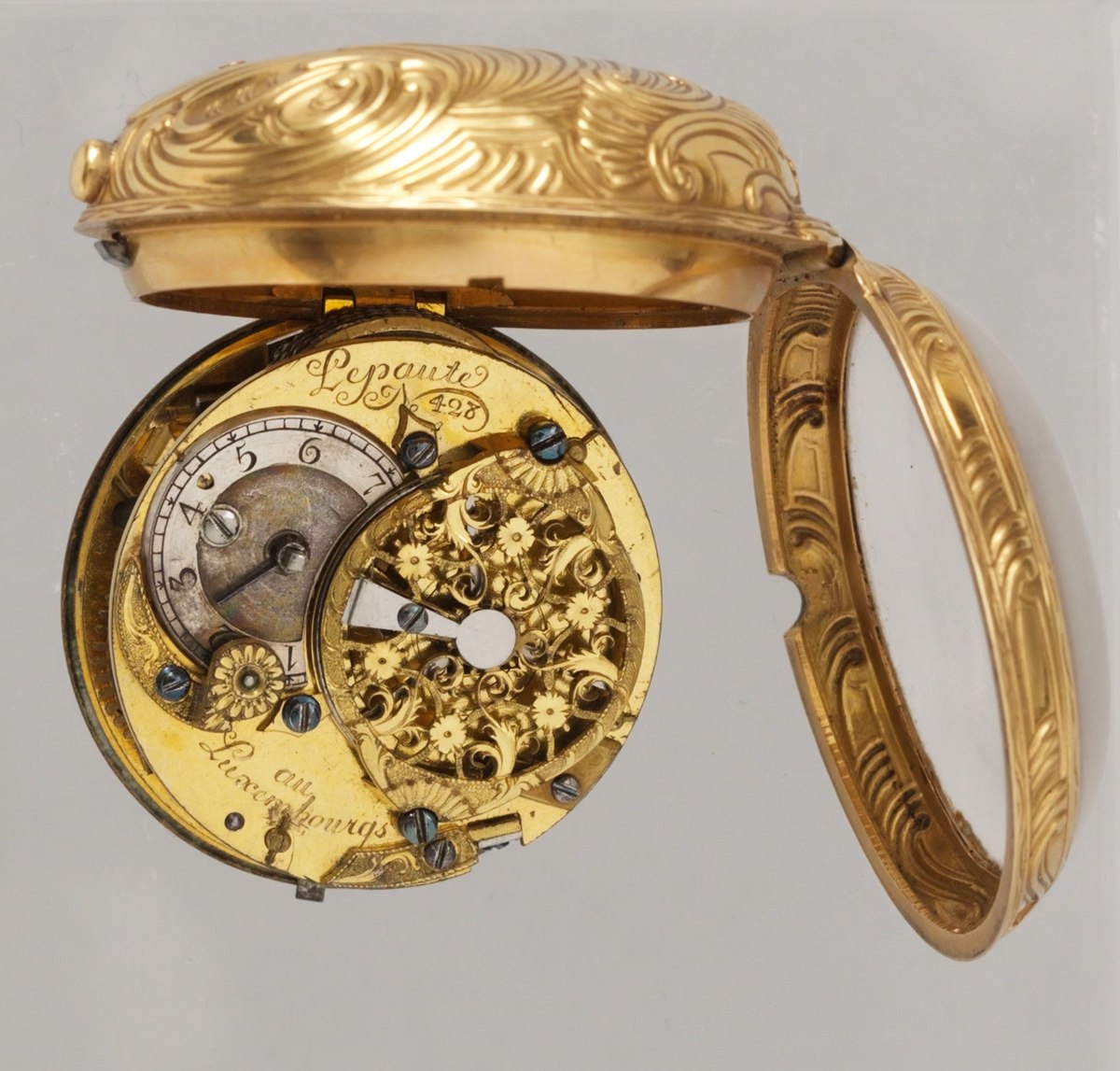
Lepaute 18th-century gold pocket watch
This 18th-century French pocket watch is housed in an 18-karat gold case measuring 4.5 cm in diameter. The source reports indistinct hallmarks on the case and a white enamel dial marked 'Lepaute'. Visible in the hinged open assembly is a gilt movement signed 'Lepaute No 428' and 'au Luxembourgs'. The top plate features an intricately pierced and engraved floral balance cock, blued steel screws, and a silvered regulator disc graduated 1 through 6. Elaborate chased or repoussé scroll and wave motifs decorate the exterior and interior of the gold case and bezel.
Full description
www.bukowskis.com · 1113
Pocket watch · Repeating watch
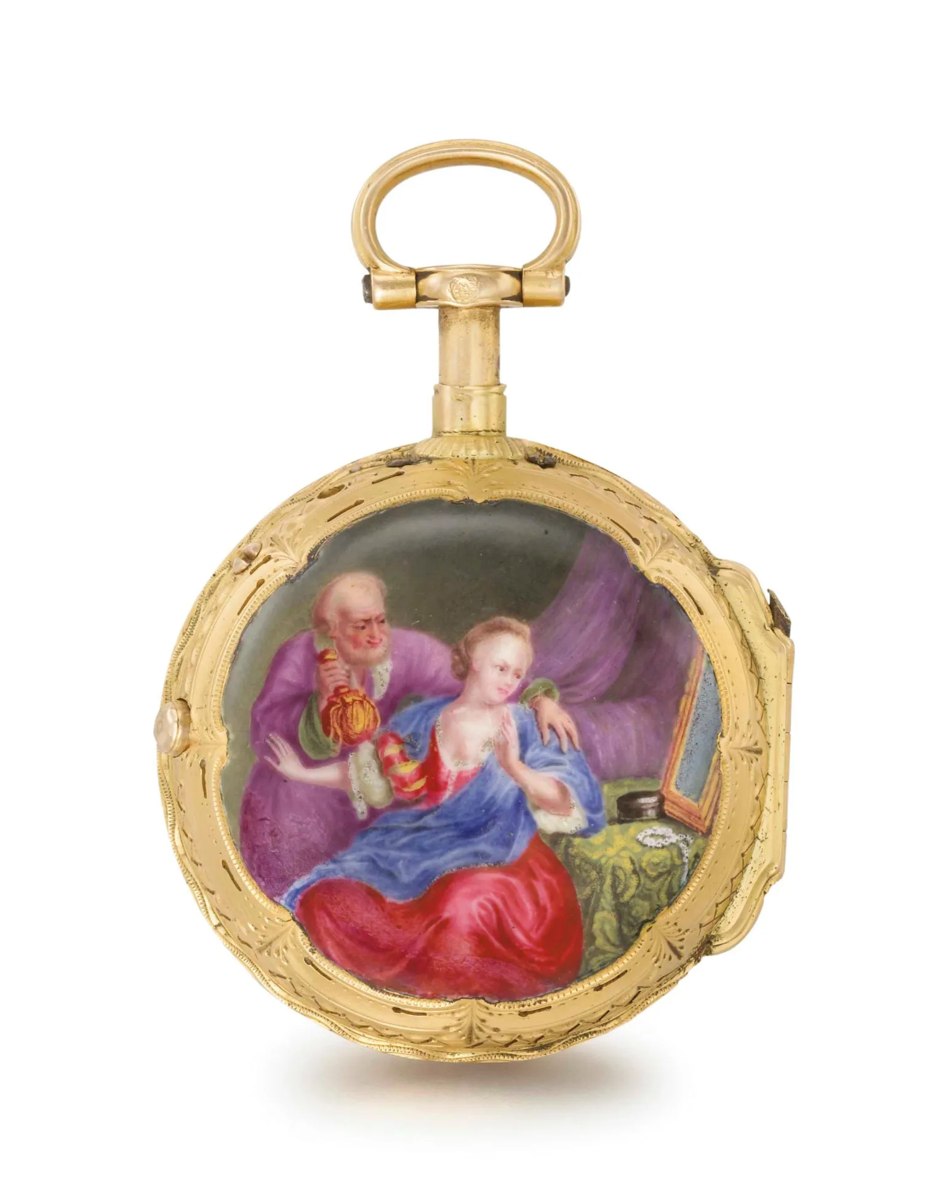
Lepaute 18K Gold and Enamel Openface Quarter Repeating Verge Pocket Watch
Catalogued as signed by Lepaute a Paris circa 1770, this 30 mm openface pocket watch is cased in 18K gold. The back of the circular case features a polychrome painted enamel scene depicting 'The Temptation' after Herman Van der Myn, framed by a chased geometrically decorated bezel and pierced rim. The source reports that the piece is powered by a gilt-finished verge movement with a chain fusée and finely pierced and engraved balance cock, offering quarter repeating on two hammers onto a bell operated through the pendant.
Full description
everywatch.com · 222
Pocket watch · Open-face watch
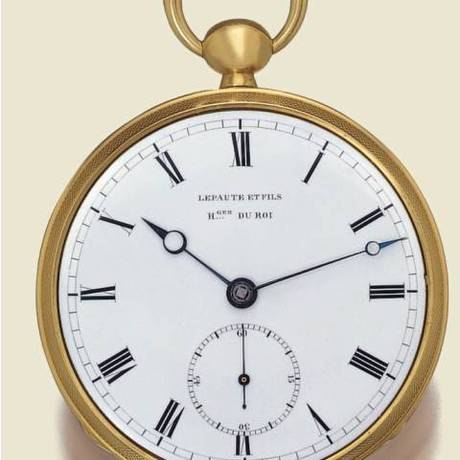
Lepaute et Fils à Paris 18K gold pocket watch with stop feature, No. 3433 + 36
This circa 1830 French pocket watch by Lepaute et Fils à Paris features a 52 mm four-body 18K gold case in 'bassine et filets' form, decorated with engine turning along the back cover, band, and bezels. The white enamel dial displays radial Roman numerals, an outer minute track, blued steel Breguet hands, and a subsidiary seconds subdial at 6 o'clock. The source reports a 45.7 mm gilt full-plate movement utilizing cylindrical pillars, fusee with chain, a cylinder escapement, and a stop mechanism controlled by a lever located at 3 o'clock under the bezel.
Full description
catalog.antiquorum.swiss · 287
Clock · Mantel clock
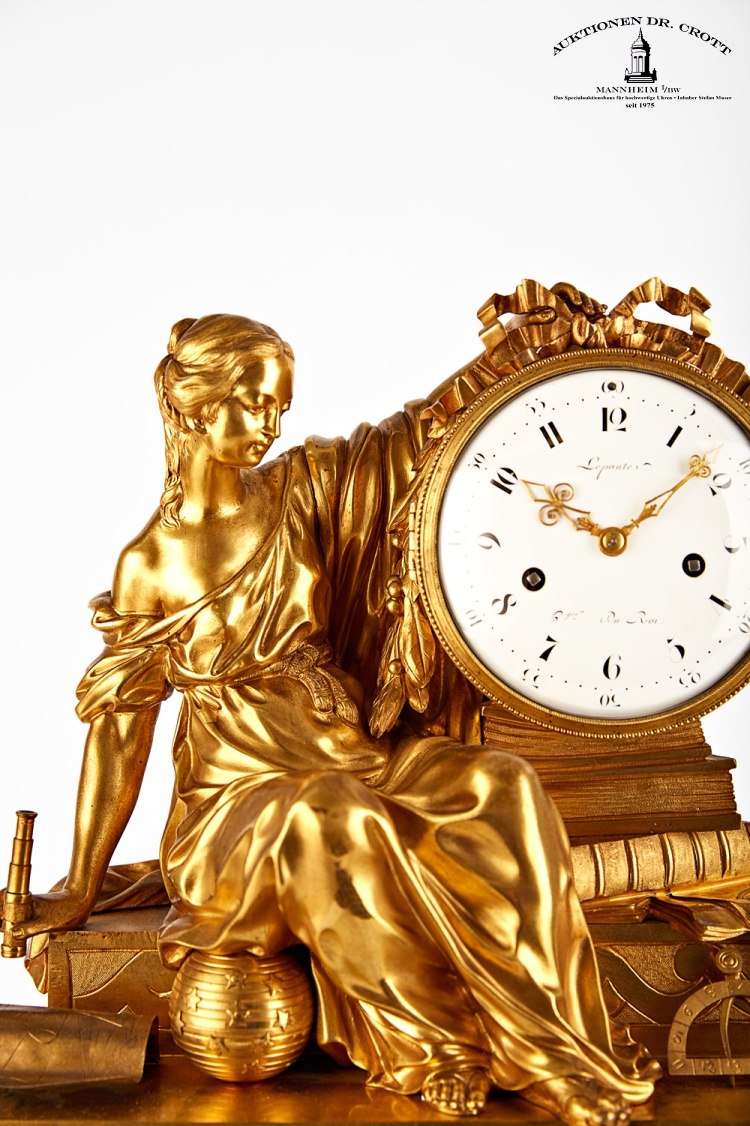
Lepaute 'Urania' Musical Mantel Clock
This ormolu mantel clock, representing Urania, the muse of astronomy, depicts the draped muse holding a telescope beside a clock case resting upon stacked books. Accompanying scientific attributes include a celestial globe, maps, and astronomical instruments. The white enamel dial features radial Arabic numerals, pierced gilt hands, and winding apertures. According to auction cataloguers, the time movement is a firegilt round brass full plate movement with an anchor escapement, count wheel, and short pendulum striking the hours and half-hours on a single bell. The base houses an associated musical movement with gut and fusee, governor, 17 bells, and 27 hammers playing six melodies.
Full description
www.invaluable.com · 446
Pocket watch · Repeating watch
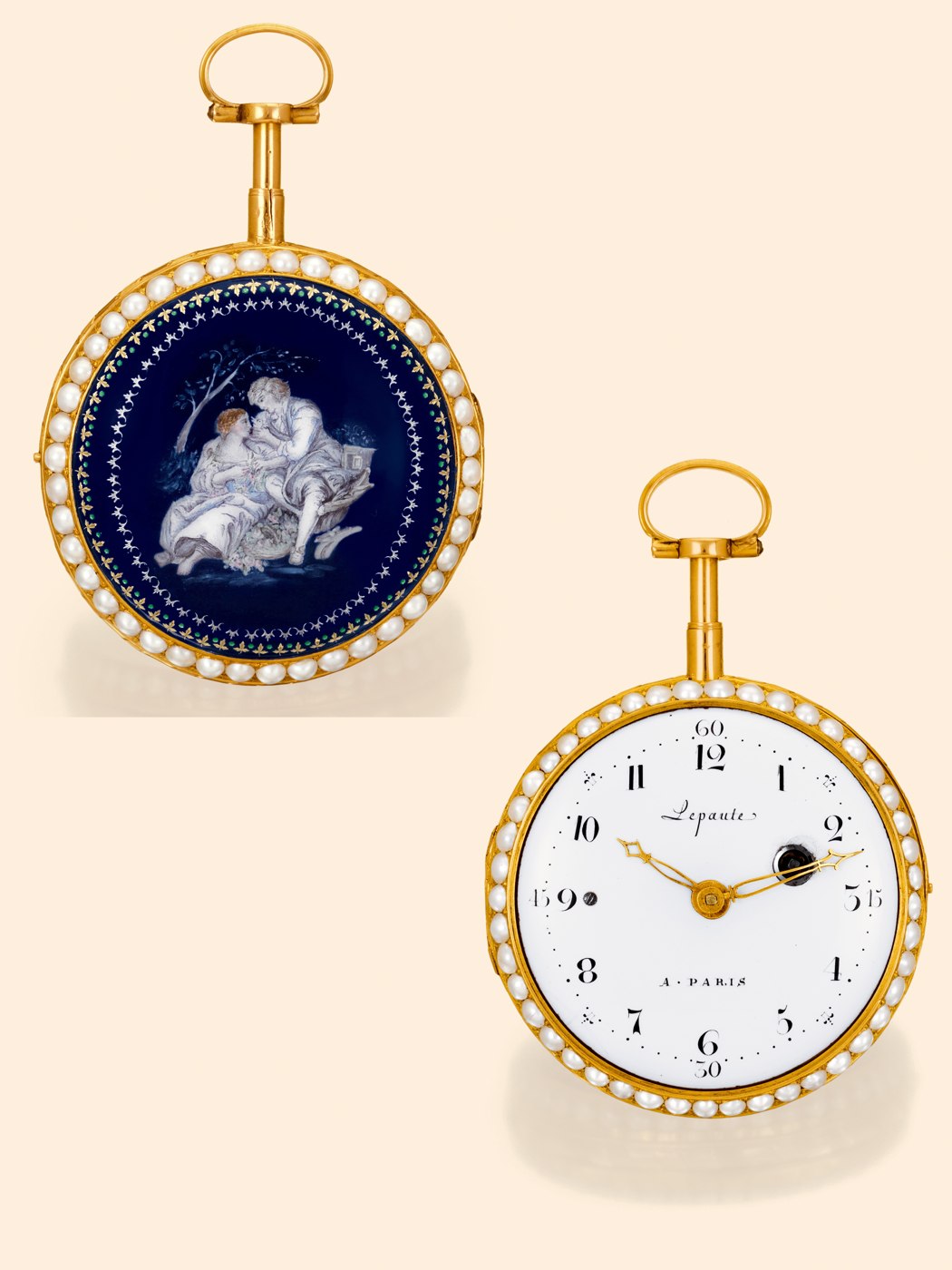
Lepaute à Paris Quarter Repeating Pendant Watch, No. 540
This pendant watch, attributed to Lepaute à Paris and numbered 540, dates to approximately 1780. The object is a quarter repeating watch with a gold two-body case, featuring a sprung hinged bezel set with pearls and a back decorated with a painted enamel scene of lovers in a rustic arbor against a translucent dark blue ground, bordered by gold and silver paillon. The white enamel dial displays Arabic numerals, dot minute divisions, and fleur-de-lys markers for five-minute intervals, complemented by pierced gold cathedral-style hands. Internally, the watch contains a 38 mm frosted gilt full-plate movement with turned pillars. The mechanism includes a fusee with chain, a verge escapement, and a brass three-arm balance with a blued steel flat spring. A pierced and chased continental balance cock sits above the movement, which activates the repeating function by depressing the pendant. The piece is signed on both the dial and movement.
Full description
catalog.antiquorum.swiss · 77
Clock · Mystery clock
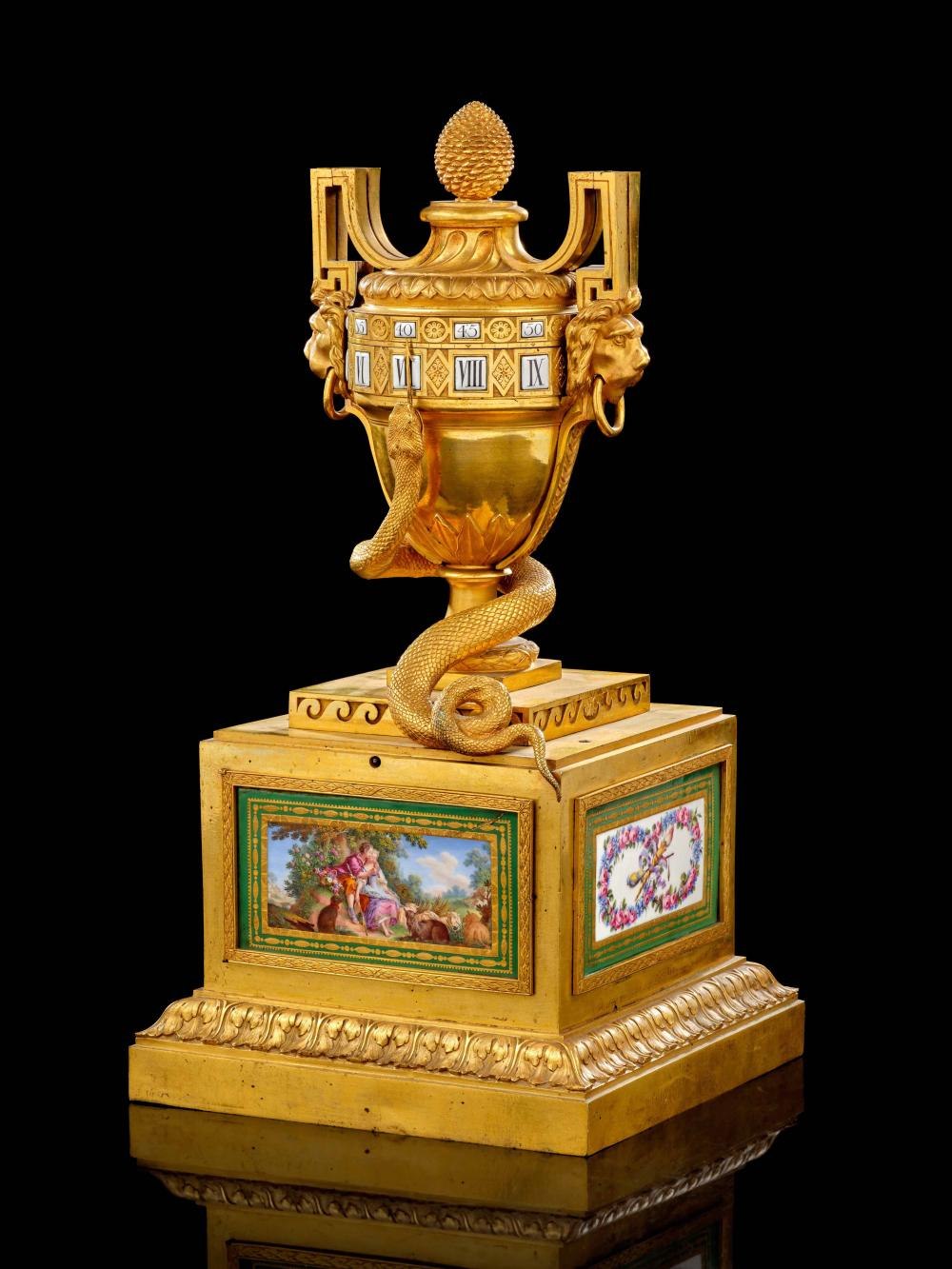
Pendule à cercles tournants
This rotating dial clock is housed in a gilt-bronze vase, featuring an integrated serpent whose tongue acts as the hour and minute indicator for the rotating porcelain-accented dial. The movement is signed by Lepaute. The clock rests upon a pedestal decorated with Sèvres porcelain plaques dated 1768. The primary central plaque, featuring a scene after Boucher, is attributed to painter Charles-Nicolas Dodin. Side plaques, depicting floral and decorative motifs, are attributed to painter Jean-Baptiste Tandart. The bronze casing includes lion-mask side handles and a pinecone finial. The object measures 47 cm in height and 24 cm in width. According to family tradition, it was gifted by wallpaper manufacturer Jean-Baptiste Réveillon to his lawyer, Guillaume Alexandre Tronson du Coudray, and subsequently passed through direct descent to the current owners.
Full description
www.invaluable.com · 57
Clock · Mantel clock
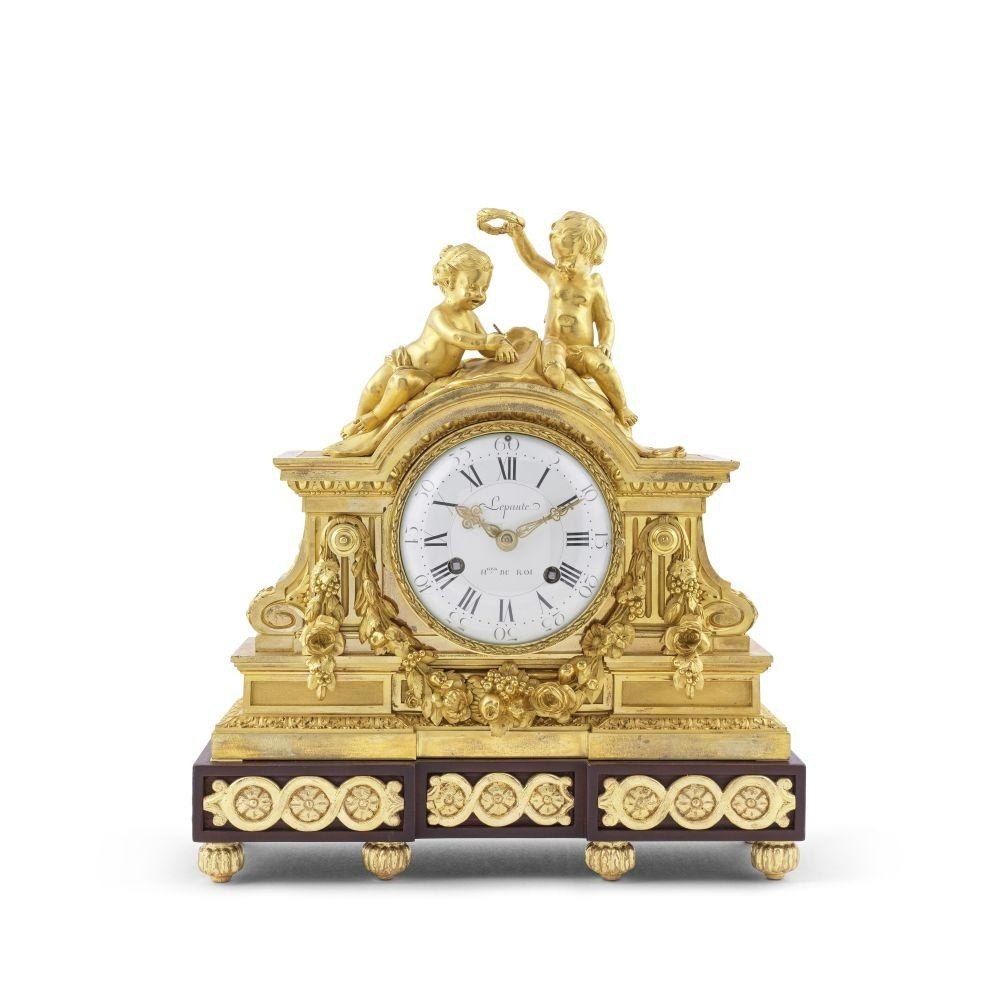
Le Paute Ormolu Mantel Clock
This late 18th-century mantel clock, described as a 'pendule borne', is executed in ormolu. Attributed to the Parisian maker Le Paute, who held the title Horloger du Roi, the clock features an ormolu case themed as the Victory of Science. The composition includes putti at play surmounting the main structure, which is further decorated with a prominent swagged motif beneath the dial. The 6-inch white enamel dial displays black Roman numerals and Arabic five-minute markers, signed 'Le Paute, Hger du Roi' in the center. The movement utilizes a silk suspension pendulum and includes a striking mechanism with a numbered star count wheel. The clock rests upon an ebonised base, which is noted as an associated, later addition. According to the auction report, the movement is currently functional, capable of both ticking and striking the hours.
Full description
Source listing · 206932721
Clock · Wall clock
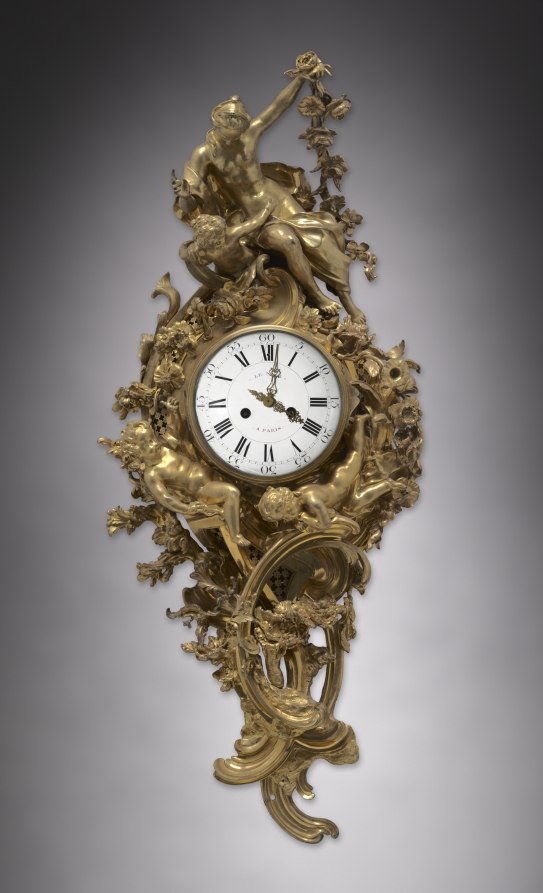
Wall Clock (Cleveland Museum of Art 1950.376)
This wall clock, held in the collection of the Cleveland Museum of Art under accession number 1950.376, is dated to circa 1750–1760. The object is constructed from gilt bronze and measures approximately 116.9 cm in height, 50.8 cm in width, and 27.7 cm in depth. It features a decorative gilt-bronze frame incorporating sculptural elements of figures and floral motifs. It entered the collection via the John L. Severance Fund. The provenance of the clock includes the firm Rosenberg & Stiebel, based in New York. The object has been cited in various museum publications, including the 1966 and 1969 editions of the Handbook of the Cleveland Museum of Art. Its origin is associated with France, though further verification of its maker and specific horological type remains a subject for ongoing research.
Full description
Source listing · 1950.376