
Skip to content
The Encyclopedia of Horology

Clock · Rotating dial clock

Pendule à cercles tournants

Partially verified

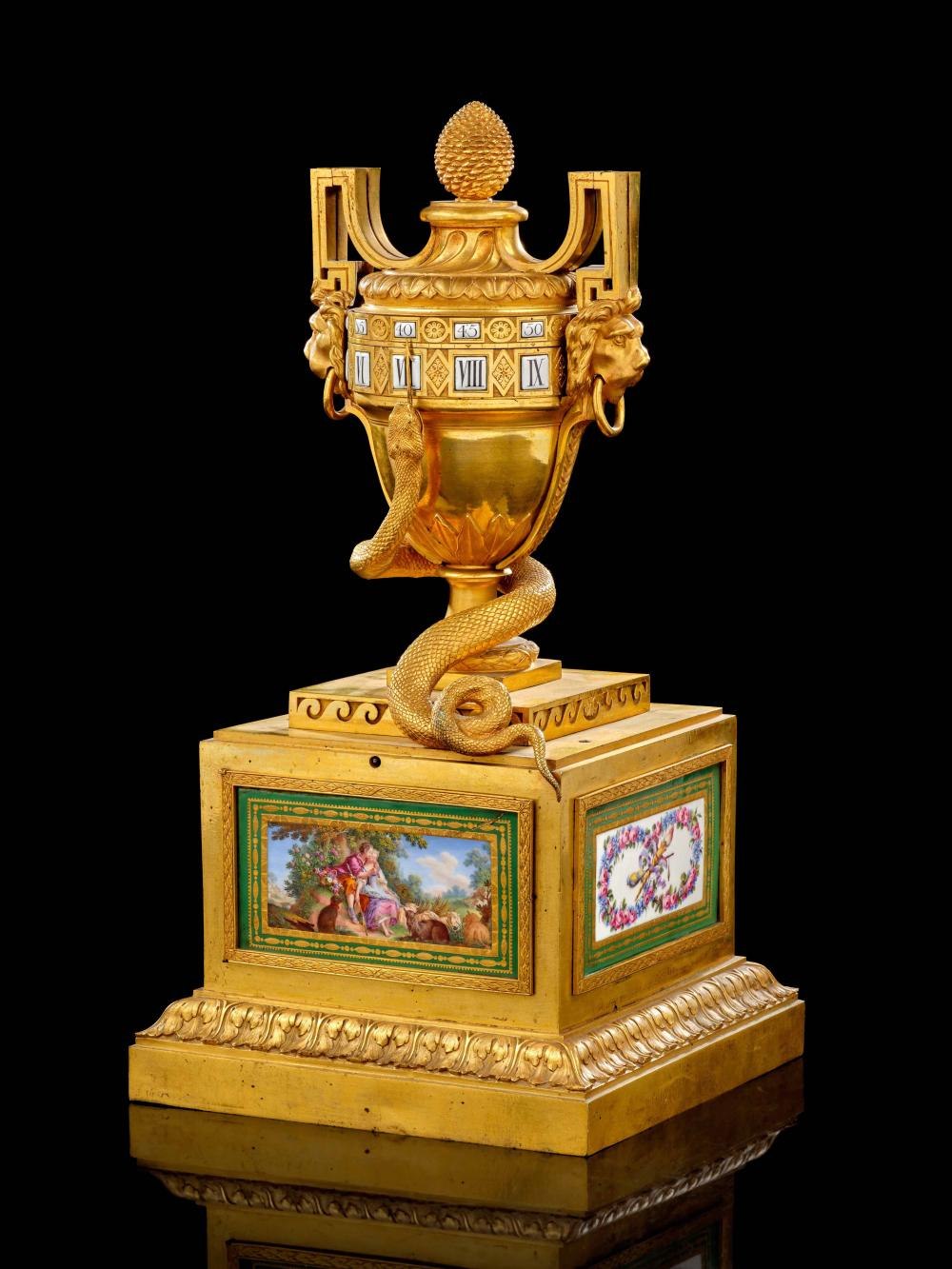
This rotating dial clock is housed in a gilt-bronze vase, featuring an integrated serpent whose tongue acts as the hour and minute indicator for the rotating porcelain-accented dial. The movement is signed by Lepaute. The clock rests upon a pedestal decorated with Sèvres porcelain plaques dated 1768. The primary central plaque, featuring a scene after Boucher, is attributed to painter Charles-Nicolas Dodin. Side plaques, depicting floral and decorative motifs, are attributed to painter Jean-Baptiste Tandart. The bronze casing includes lion-mask side handles and a pinecone finial. The object measures 47 cm in height and 24 cm in width. According to family tradition, it was gifted by wallpaper manufacturer Jean-Baptiste Réveillon to his lawyer, Guillaume Alexandre Tronson du Coudray, and subsequently passed through direct descent to the current owners.

A view of the rotating dial clock showing the gilt-bronze vase, serpent pointer, and decorated Sèvres porcelain base.
A view of the rotating dial clock showing the gilt-bronze vase, serpent pointer, and decorated Sèvres porcelain base. — Artcurial (via Invaluable). Rights pending — permission not yet requested. Original source

Catalogue identity

Source
www.invaluable.com
Category
Clock · Rotating dial clock
Maker / attribution
Lepaute
Reference
Not recorded
Catalogue / lot identifier
57
Source-reported date
1768
Source-reported place
France

Source-reported attribution and specifications are not independent authentication. A listing does not establish present ownership, current display, availability or permission to reproduce.

Object description

Case and Dial Construction

The clock is constructed as a gilt-bronze vase featuring a rotating dial mechanism. The dial is composed of concentric rings inscribed with hour and minute markers. A decorative serpent is coiled around the body of the vase; its extended tongue serves as the fixed pointer for reading the time as the dial rotates behind it.

The vase is capped with a lid surmounted by a pinecone motif. The body of the clock is flanked by decorative handles featuring lion masks that hold rings. The entire assembly sits upon a rectangular plinth.

Evidence for this section
  • “le cadran à cercles tournants inscrit dans un vase couvert autour duquel s'enroule un serpent dont la langue indique les heures et les minutes”
  • “le couvercle surmonté d'une prise à motif de pomme de pin”
  • “le corps flanqué d'anses à décor de moufles de lion retenant un anneau”

Porcelain Decoration

The pedestal is ornamented with Sèvres porcelain plaques, which are dated to 1768. The primary plaque on the front depicts a scene of a flute lesson, executed by painter Charles-Nicolas Dodin. This image is based on the work of François Boucher.

The lateral sides of the pedestal are fitted with smaller plaques featuring polychrome decorations of floral wreaths, torches, and quivers. These panels are credited to Jean-Baptiste Tandart. All porcelain elements are set within framing decorated with green and gold.

Evidence for this section
  • “reposant sur un socle orné de plaques en porcelaine de Sèvres”
  • “La plaque principale par Charles-Nicolas Dodin, à décor polychrome de la leçon de flûte d’après Boucher”
  • “les plaque des côtés par Jean-Baptiste Tandart, à décor polychrome de carquois, flambeaux, quenouilles et de couronnes de roses et barbeaux”

Provenance and Historical Context

According to family tradition, the clock was gifted to the lawyer Guillaume Alexandre Tronson du Coudray by Jean-Baptiste Réveillon as payment for legal services during the late 18th century. Following Tronson du Coudray's death, the object was passed to his daughter, Euphrasie Tronson du Coudray, and subsequently inherited by members of the Michelin and Lefebvre de Laboulaye families.

The clock remains within the lineage of these families to the current owners.

Evidence for this section
  • “Par tradition familiale offerte par Jean-Baptiste Réveillon (1725-1811) à Guillaume Alexandre Tronson du Coudray (1750-1798), son avocat”
  • “Puis, par descendance, jusqu’aux propriétaires actuels.”

Open research questions

  • Are there records in the Sèvres archives confirming the production date of these specific plaques?
  • Can the association with Réveillon be corroborated by legal or estate documentation from the period?

Source evidence

Recorded claims and source quotations for Pendule à cercles tournants
FieldSource-reported valueSource quotation
MakerLepaute“le mouvement signé "Lepaute AParis”
Date of porcelain1768“lettre-date P pour 1768”
Dimensions47 cm H x 24 cm W“H : 47 cm (18 ½ in.) l. : 24 cm (9 ½ in.)”
Painter (central plaque)Charles-Nicolas Dodin“La plaque principale par Charles-Nicolas Dodin”
Painter (side plaques)Jean-Baptiste Tandart“les plaque des côtés par Jean-Baptiste Tandart”
MaterialsGilt bronze and Sèvres porcelain“En bronze ciselé, doré et plaques en porcelaine de Sèvres”
ProvenanceGifted by Jean-Baptiste Réveillon to Guillaume Alexandre Tronson du Coudray“offerte par Jean-Baptiste Réveillon (1725-1811) à Guillaume Alexandre Tronson du Coudray (1750-1798), son avocat”

Visible details

  • Rotating dial with Roman numerals for hours and Arabic numerals for minutes
  • Gilt-bronze snake figure coiled around the vase body
  • Sèvres porcelain panels with green and gold framing
  • Lion-mask handles holding suspended rings

Research qualifications

  • Provenance is based on family tradition
  • The attribution of the gift from Réveillon to Tronson du Coudray is unverified

Photograph identity and source facts were screened before import; rights clearance remains pending.

Consulted source

PENDULE À CERCLES TOURNANTS D’ÉPOQUE TRANSITION

Reviewed 2026-10-26 · Record 0fd430862c

Terms in this record

Glossary explanations for terms named in this object’s record.