Composition and Allegorical Case Design
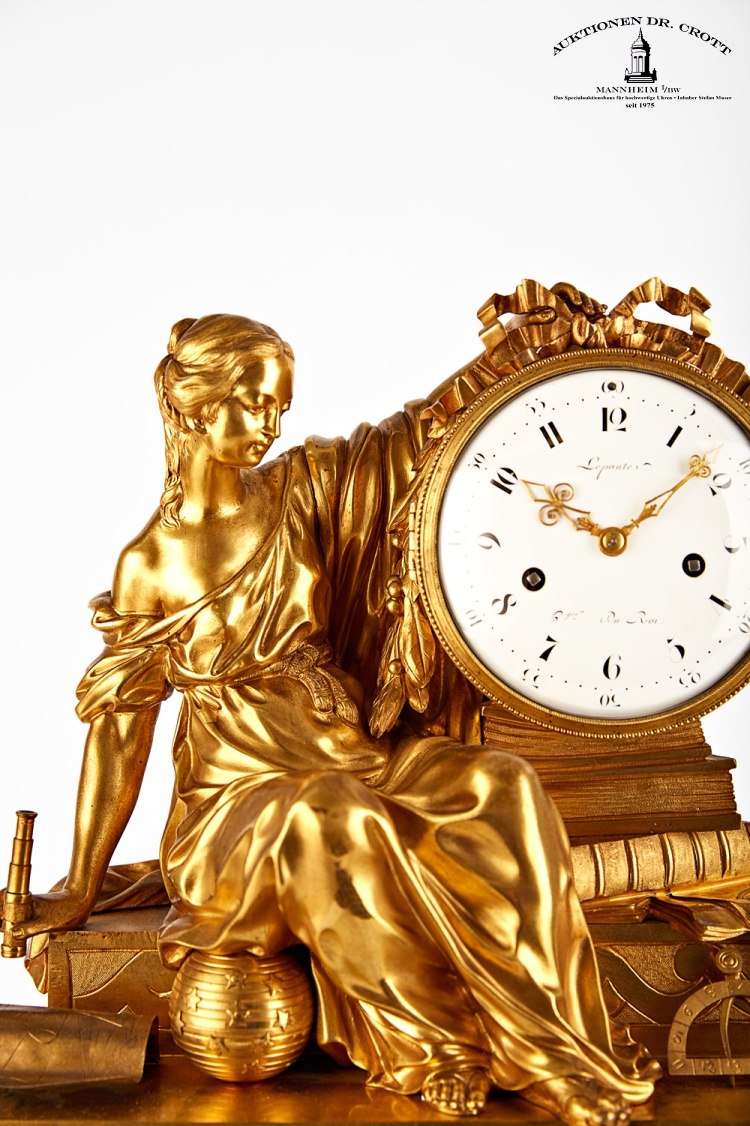
The mantel clock presents an allegorical composition executed in ormolu, depicting Urania, the muse of astronomy. The classically draped figure holds a handheld telescope in her right hand while leaning against a circular clock drum resting upon a stack of sculpted books. The drum itself is surmounted by a ribbon bow and flanked by laurel leaf decoration.
Arranged around the muse are various scientific attributes, including an astronomical quadrant or protractor, an unrolled map scroll, and a banded celestial globe nestled beneath her drapery. According to the auction catalogue, the rectangular base features sound holes on all sides formed as open-work arches decorated with flowers and lined with red silk to emit sound from the musical mechanism.
Evidence for this section
- “Base with sound holes on all sides: open-work arches decorated with flowers and lined with red silk.”
- “On the base sits a sculpture of Urania, muse of astronomy, holding a telescope. She embraces the clock, which sits on a stack of books and is decorated with laurel scrolls.”
Dial Display and Movement Mechanisms
The time is displayed on a white enamel dial signed 'Lepaute', featuring radial Arabic hour numerals, pierced gilt hands, winding apertures, and an outer minute ring with dotted indices and five-minute Arabic markers.
Neither internal mechanism is visible in the lot photograph, but the auction house reports that the timekeeping section consists of a round, firegilt brass full plate movement powered by two barrels, governed by an anchor escapement with a short pendulum, and sounding the hours and half-hours via a count wheel, single hammer, and single bell. Housed within the base is a heavy brass musical movement with gut line and fusee, a governor, and a large pinned barrel with vibrating blades acting on 17 bells and 27 hammers to play six melodies.
Evidence for this section
- “enamel, radial Arabic numerals, signed, pierced and gilt hands.”
- “round brass full plate movement, firegilt, 1 hammer / 1 bell, 2 barrels, anchor escapement, count wheel, short pendulum.”
- “heavy brass movement with gut/fusee and governor, large pinned brass barrel with vibrating blades, 17 bells and 27 hammers.”
Dating, Stylistic Attribution, and Evidence Limitations
The auction description assigns the clock an approximate date of circa 1780 and references scholarly comparisons, noting that Ottomeyer and Pröschel illustrate an almost identical model associated with Pierre-Antoine Foullet and attributed to sculptor Augustin Pajou. The listing also discusses Pierre-Basile Lepaute (1750–1843) and his later imperial titles.
However, the physical evidence remains subject to significant documentation constraints. The internal clockwork, musical movement, silk-lined base sound holes, and rear case are unillustrated in the cataloguing, precluding independent confirmation of their mechanical condition, maker's stamps, or originality.
Evidence for this section
- “Height 520 mm, circa 1780”
- “The definite book "Vergoldete Bronzen" by H. Ottomeyer and P. Pröschel (Vol. I, p. 162) shows a nearly identical clock by Pierre-Antoine Foullet, created around 1760. The book attributes this pendulum clock to the renowned neo-classical French sculptor Augustin Pajou (1730-1809)”