
Skip to content
The Encyclopedia of Horology

Clock · Mantel clock

Le Paute Ormolu Mantel Clock

Partially verified

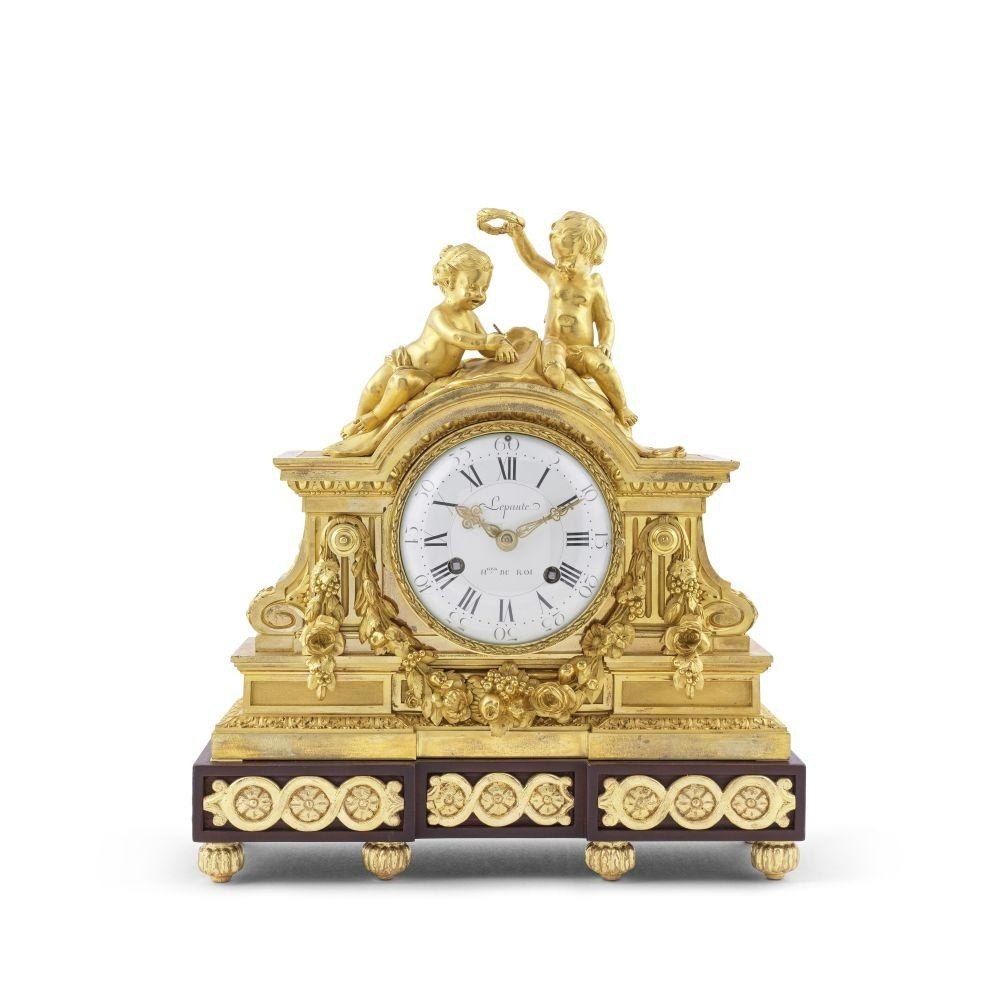
This late 18th-century mantel clock, described as a 'pendule borne', is executed in ormolu. Attributed to the Parisian maker Le Paute, who held the title Horloger du Roi, the clock features an ormolu case themed as the Victory of Science. The composition includes putti at play surmounting the main structure, which is further decorated with a prominent swagged motif beneath the dial. The 6-inch white enamel dial displays black Roman numerals and Arabic five-minute markers, signed 'Le Paute, Hger du Roi' in the center. The movement utilizes a silk suspension pendulum and includes a striking mechanism with a numbered star count wheel. The clock rests upon an ebonised base, which is noted as an associated, later addition. According to the auction report, the movement is currently functional, capable of both ticking and striking the hours.

Frontal view of the Louis XVI-style ormolu mantel clock featuring putti surmounting the dial and an associated ebonised base.
Frontal view of the Louis XVI-style ormolu mantel clock featuring putti surmounting the dial and an associated ebonised base. — Bonhams / Invaluable. Rights pending — permission not yet requested. Original source

Catalogue identity

Source
orbiscollectibles.com
Category
Clock · Mantel clock
Maker / attribution
Le Paute
Reference
Not recorded
Catalogue / lot identifier
206932721
Source-reported date
late 18th century
Source-reported place
France

Source-reported attribution and specifications are not independent authentication. A listing does not establish present ownership, current display, availability or permission to reproduce.

Object description

Case and Aesthetic Design

The clock is housed in an ormolu case, described by the source as an 'Emblematic of the Victory of Science' design. The sculptural top section features two putti at play, which surmount the primary case structure. The central part of the clock incorporates a white enamel dial framed by ormolu work, characterized by a large swagged motif positioned directly beneath the circular dial.

The entire assembly is mounted upon an ebonized base that is explicitly described as a later, associated addition. This base provides a contrasting platform for the gilded bronze, which maintains its original appearance in the accompanying photographic evidence. The case exhibits significant architectural detailing consistent with the specified period attribution.

Evidence for this section
  • “Emblematic of the Victory of Science, with large swagged motif beneath the circular enamelled dial and surmounted by putti at play”
  • “on an ebonised later (associated) base”

Dial and Movement

The time is indicated on a 6-inch white enamel dial marked with black Roman numerals for the hours and large Arabic numerals for the five-minute increments. The center of the dial bears the signature of the maker, Le Paute, Horloger du Roi. The time is displayed via pierced and decorated hands.

The internal movement is controlled by a silk suspension pendulum. The striking mechanism is regulated by a numbered, decorated star count wheel. The backplate of the movement is also signed by the maker, confirming the primary attribution of the mechanism. The auction description states that the clock is currently ticking and striking, indicating the movement is in functional order.

Evidence for this section
  • “6 inch white enamel dial with black Roman numerals and large Arabic five minute markers signed in the centre Le Paute, Hger du Roi”
  • “the movement with silk suspension pendulum striking the hours on a numbered and decorated star count wheel, the backplate signed by the maker”

Condition and Attribution

The auction description provides a detailed report regarding the condition of the individual components of the clock. The case, dial, and movement are assessed in 'fair' condition, while the glass and hands are noted as being in 'good' condition. No restoration history is provided beyond the identification of the ebonized base as a later addition.

The provenance and attribution to Le Paute remain the primary identifiers for this lot. While the auction house links the clock to the late 18th century and the Paris workshop of Le Paute, the source clarifies that independent verification of this type attribution and the specific auction-house claims remains required for full authentication.

Evidence for this section
  • “Case: fair Glass: good Dial: fair Hands: good Movement: fair”
  • “Independent confirmation of type attribution and auction-house statements remains research required.”

Open research questions

  • What is the specific horological date code or serial number on the backplate to refine the 18th-century dating?
  • Has the movement been significantly altered or rebuilt during the period when the associated ebonised base was added?

Source evidence

Recorded claims and source quotations for Le Paute Ormolu Mantel Clock
FieldSource-reported valueSource quotation
MakerLe Paute“Le Paute, Paris Ho.ger du Roi”
Materialsormolu, enamel, ebonised wood“ormolu”
Dimensions36cm high, 36.5cm wide, 12cm deep (without base)“36cm high, 36.5cm wide, 12cm deep (without base)”
Dial detailsWhite enamel with Roman and Arabic numerals“6 inch white enamel dial with black Roman numerals and large Arabic five minute markers”
Movement suspensionSilk suspension“the movement with silk suspension pendulum”
Striking mechanismStar count wheel“striking the hours on a numbered and decorated star count wheel”
ConditionFair overall state“Case: fair Glass: good Dial: fair Hands: good Movement: fair”

Visible details

  • Ormolu case featuring putti figures
  • Enamel dial with Arabic and Roman numerals
  • Associated ebonised base with decorative mounts
  • Pierced clock hands

Research qualifications

  • The ebonised base is identified as an associated later addition.
  • The attribution to Le Paute remains subject to independent confirmation.

Photograph identity and source facts were screened before import; rights clearance remains pending.

Consulted source

Pendule borne Louis XVI en bronze doré

Reviewed 2026-11-02 · Record 4cd2b992b7

Terms in this record

Glossary explanations for terms named in this object’s record.