
Skip to content
The Encyclopedia of Horology

Clock · Wall clock

Wall Clock (Cleveland Museum of Art 1950.376)

Partially verified

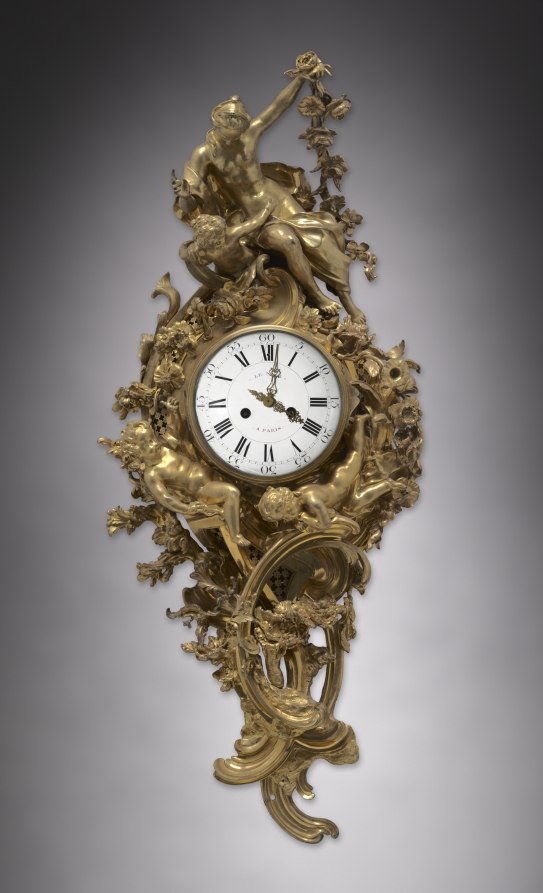
This wall clock, held in the collection of the Cleveland Museum of Art under accession number 1950.376, is dated to circa 1750–1760. The object is constructed from gilt bronze and measures approximately 116.9 cm in height, 50.8 cm in width, and 27.7 cm in depth. It features a decorative gilt-bronze frame incorporating sculptural elements of figures and floral motifs. It entered the collection via the John L. Severance Fund. The provenance of the clock includes the firm Rosenberg & Stiebel, based in New York. The object has been cited in various museum publications, including the 1966 and 1969 editions of the Handbook of the Cleveland Museum of Art. Its origin is associated with France, though further verification of its maker and specific horological type remains a subject for ongoing research.

Frontal view of the gilt-bronze wall clock held at the Cleveland Museum of Art.
Frontal view of the gilt-bronze wall clock held at the Cleveland Museum of Art. — Cleveland Museum of Art. Rights pending — permission not yet requested. Original source

Catalogue identity

Source
orbiscollectibles.com
Category
Clock · Wall clock
Maker / attribution
Le Paute
Reference
Not recorded
Catalogue / lot identifier
1950.376
Source-reported date
c. 1750–1760
Source-reported place
France

Source-reported attribution and specifications are not independent authentication. A listing does not establish present ownership, current display, availability or permission to reproduce.

Object description

Construction and Design

The wall clock is primarily defined by its elaborate gilt-bronze mounting. The case serves as a structural and decorative support, featuring complex relief work that incorporates figures and floral decorative elements. The dial is set centrally within this metal frame, providing a sharp visual contrast to the surrounding gilding.

The dimensions of the object are significant, standing nearly 117 centimeters in height. This scale places the clock within a category of ornamental wall timepieces intended for prominent interior display. The dial layout includes standard Roman numerals for the primary hour markings, accompanied by outer Arabic minute divisions.

Evidence for this section
  • “gilt bronze”
  • “Overall: 116.9 x 50.8 x 27.7 cm (46 x 20 x 10 7/8 in.)”

Documentation and Provenance

The clock is officially recorded as part of the Cleveland Museum of Art collection, where it is classified under Furniture and woodwork. This classification reflects its status as an interior object rather than purely a scientific instrument. Documentation indicates that the museum acquired the piece through the John L. Severance Fund, which has supported numerous acquisitions within the institution.

Tracing the history of the object, the records note the involvement of the New York-based firm Rosenberg & Stiebel in its provenance. Furthermore, the object has been featured in institutional literature, specifically documented in the museum's official handbooks published in 1966 and 1969. These references establish a period of residence and scholarly recognition for the clock within the museum's archives spanning several decades.

Evidence for this section
  • “It is catalogued in the museum's Decorative Art and Design department under Furniture and woodwork. Credit line: John L. Severance Fund.”
  • “Recorded provenance: (Rosenberg & Stiebel, New York).”
  • “The museum lists 4 publications mentioning the object, including The Cleveland Museum of Art. Handbook of the Cleveland Museum of Art/1966.”

Research and Attribution

While the museum provides a date range and an association with French origins, the specific horological history of the movement and the identity of the bronzeworker remain unconfirmed by the provided documentation.

The current cataloguing focuses on the provenance and institutional status of the single museum specimen. Consequently, the horological community has yet to confirm whether this object represents a singular piece or if it belongs to a wider series of identifiable models produced during this timeframe.

Evidence for this section
  • “museum culture/place: France.”
  • “how far it represents a wider collectible type has not been independently verified.”
  • “Research required: this record describes a single museum object; confirm the wider type, maker attribution and specifications against horological references.”

Open research questions

  • What is the identification of the movement maker or the manufacturer of the gilt-bronze case?
  • Does this specific model appear in contemporary inventories or secondary literature from the mid-eighteenth century?

Source evidence

Recorded claims and source quotations for Wall Clock (Cleveland Museum of Art 1950.376)
FieldSource-reported valueSource quotation
Accession number1950.376“1950.376”
Datingc. 1750–1760“c. 1750–1760”
Materialgilt bronze“gilt bronze”
Dimensions116.9 x 50.8 x 27.7 cm“116.9 x 50.8 x 27.7 cm (46 x 20 x 10 7/8 in.)”
ProvenanceRosenberg & Stiebel, New York“Recorded provenance: (Rosenberg & Stiebel, New York).”
Credit LineJohn L. Severance Fund“Credit line: John L. Severance Fund.”
ClassificationFurniture and woodwork“It is catalogued in the museum's Decorative Art and Design department under Furniture and woodwork.”

Visible details

  • Decorative gilt-bronze frame featuring sculptural human figures and floral ornamentation
  • White dial with black Roman numerals and minute markers
  • Two winding holes on the dial indicating a multiple-train movement
  • Pierced and ornate hands for the display of hours and minutes

Research qualifications

  • Maker of the movement and case is currently unidentified
  • The broader type or specific stylistic category remains to be verified by horological reference

Photograph identity and source facts were screened before import; rights clearance remains pending.

Consulted source

Wall Clock (Cleveland Museum of Art 1950.376)

Reviewed 2026-11-02 · Record b601f9852f

Terms in this record

Glossary explanations for terms named in this object’s record.