
Skip to content
The Encyclopedia of Horology

Clock · Longcase clock

Walnut Veneered Longcase Clock by Joseph Windmills

Partially verified

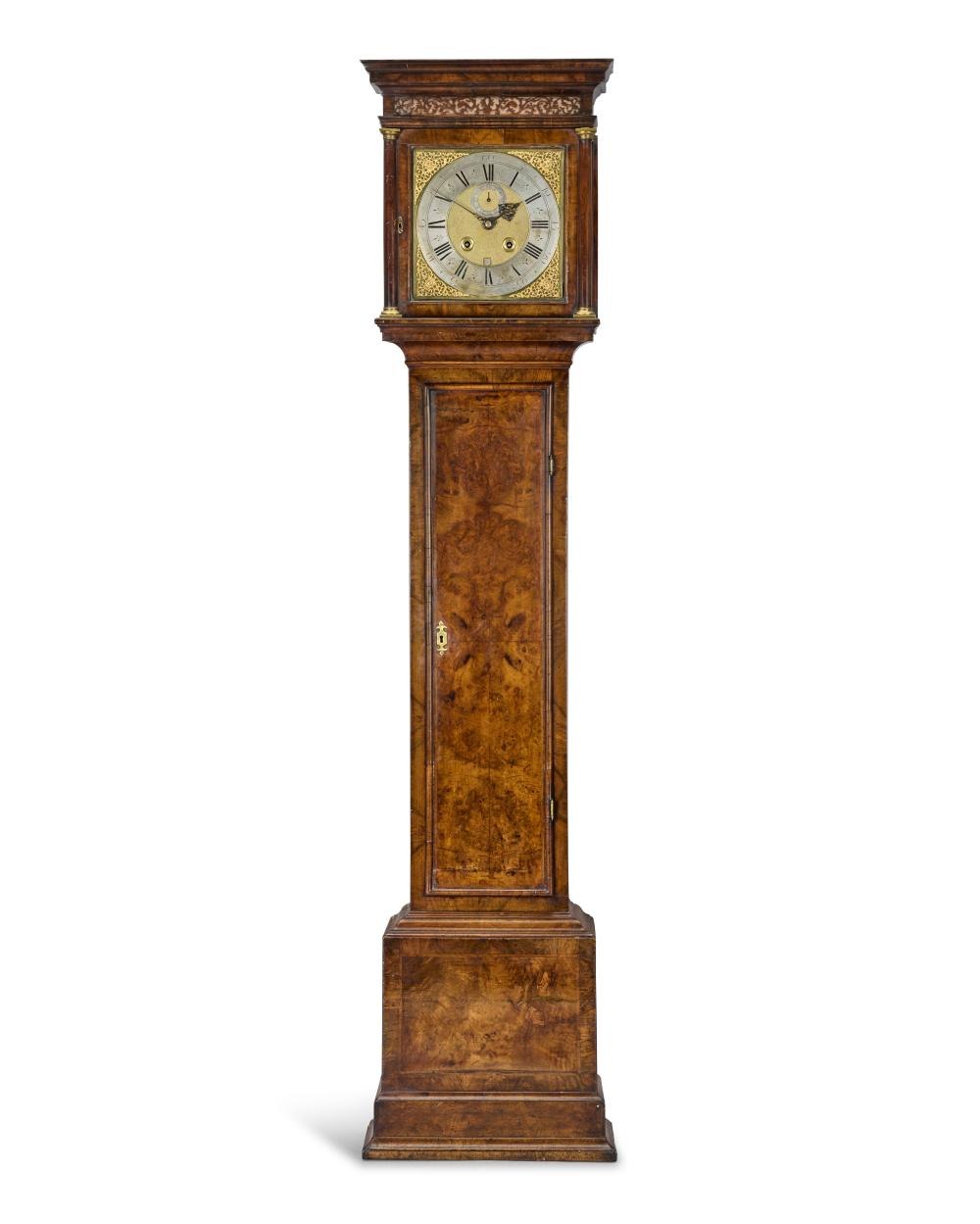
This early 18th-century longcase clock is attributed to the London maker Joseph Windmills. Housed in a walnut veneered case, the clock features a moulded top with a pierced sound fret backed by silk, situated above turned pillars with gilt capitals. The trunk includes a concave throat moulding and a D-moulded, quarter-veneered door, supported by a crossbanded base and double plinth. The 12-inch square brass dial displays cast and gilt spandrels surrounding a silvered chapter ring with Roman numerals and Arabic five-minute markers. The matted dial center incorporates a subsidiary seconds dial and a date aperture, complemented by blued steel hands. The month-going movement is constructed with five knopped pillars and an anchor escapement, utilizing an outside countwheel to strike the hours on a bell. The clock measures 2.21 meters in height and is supplied with a pair of brass-clad weights and a brass-clad pendulum.

Full-length view of the walnut longcase clock, showing the hood, trunk door, and base.
Full-length view of the walnut longcase clock, showing the hood, trunk door, and base. — Bonhams (via Invaluable). Rights pending — permission not yet requested. Original source

Catalogue identity

Source
www.invaluable.com
Category
Clock · Longcase clock
Maker / attribution
Joseph Windmills
Reference
Not recorded
Catalogue / lot identifier
92
Source-reported date
Early 18th century
Source-reported place
London, United Kingdom

Source-reported attribution and specifications are not independent authentication. A listing does not establish present ownership, current display, availability or permission to reproduce.

Object description

Case and Dial Construction

The clock is housed in a walnut veneered case designed with traditional architectural elements. The hood features a moulded top with a pierced sound fret, which is backed by silk, and is supported by turned pillars with gilt capitals. The middle section of the case, or the trunk, utilizes a D-moulded, quarter-veneered door. This rests upon a crossbanded base set on a double plinth, reaching a total height of 2.21 meters.

The 12-inch square brass dial serves as the visual focal point, featuring cast and gilt spandrels. The silvered chapter ring is engraved with Roman numerals and Arabic five-minute markers. The center of the dial is finely matted and houses a subsidiary seconds dial and a date aperture. The dial is signed 'Windmills, London' at the six o'clock position and uses blued steel hands for time display.

Evidence for this section
  • “The moulded top with pierced sound fret backed in old silk on turned pillars with gilt capitals”
  • “D-moulded, quarter-veneered long trunk door”
  • “12-inch square brass dial with cast and gilt spandrels”
  • “signed at the six o'clock position Windmills, London”

Movement and Mechanics

The clock is powered by a month-going movement, a feature that differentiates it from standard eight-day longcase clocks. The architecture of the movement includes five knopped pillars, which provide structural support. The timekeeping is regulated by an anchor escapement.

The striking train is controlled by an outside countwheel mechanism, which strikes the hours on a bell mounted above the movement. The auction description reports that the clock is currently ticking and striking, and it is sold with a pair of brass-clad weights and a brass-clad pendulum, although the pendulum suspension is noted as broken.

Evidence for this section
  • “The month-going movement with five knopped pillars, anchor escapement, and outside countwheel striking the hours on a bell mounted above”
  • “Currently ticking and striking”
  • “sold together with a pair of brass-clad weights and a brass-clad pendulum (suspension broken)”

Maker and Attribution

Joseph Windmills was a significant figure in the London clock and watchmaking trade during the late 17th and early 18th centuries. He became a Freeman of the Clockmakers' Company in 1671 and eventually served as its Master in 1702. His career involved maintaining high-profile timepieces, such as those at the Tower of London, a role he assumed in 1710 after the death of Thomas Tompion.

The scholarly documentation of his work is supported by J. A. Neale's 1999 study, 'Joseph and Thomas Windmills, Clock and Watch Makers 1671–1737'. His professional timeline confirms that he remained active within the Clockmakers' Company until at least 1720, aligning with the early 18th-century dating of this object.

Evidence for this section
  • “Joseph Windmills remains one of the most highly regarded clock and watchmakers of the late 17th and early 18th centuries”
  • “served as Master in 1702, remaining active within the Company until at least 1720”
  • “In 1710, he succeeded Thomas Tompion in maintaining the clocks at the Tower of London”

Open research questions

  • What is the specific provenance of this clock prior to the current auction entry?
  • Does the movement contain any specific hallmarks or secondary signatures that corroborate the attribution to Joseph Windmills?

Source evidence

Recorded claims and source quotations for Walnut Veneered Longcase Clock by Joseph Windmills
FieldSource-reported valueSource quotation
MakerJoseph Windmills“Joseph Windmills, London”
DurationOne month“one month duration”
Dial size12-inch“The 12-inch square brass dial”
Height2.21 meters“2.21m (7.25ft) high”
Movement featuresFive knopped pillars“five knopped pillars”
EscapementAnchor“anchor escapement”
Striking mechanismOutside countwheel“outside countwheel striking the hours on a bell”
Case materialsWalnut veneer“walnut veneered longcase clock”

Visible details

  • Pierced fretwork in the hood
  • Quarter-veneered door panel
  • Gilt spandrels at dial corners
  • Blued steel hands

Research qualifications

  • Pendulum suspension is recorded as broken
  • Actual extent of original finish remains unverified

Photograph identity and source facts were screened before import; rights clearance remains pending.

Terms in this record

Glossary explanations for terms named in this object’s record.