
Skip to content
The Encyclopedia of Horology

Clock · Wall clock

Vienna Regulator Wall Clock

Partially verified

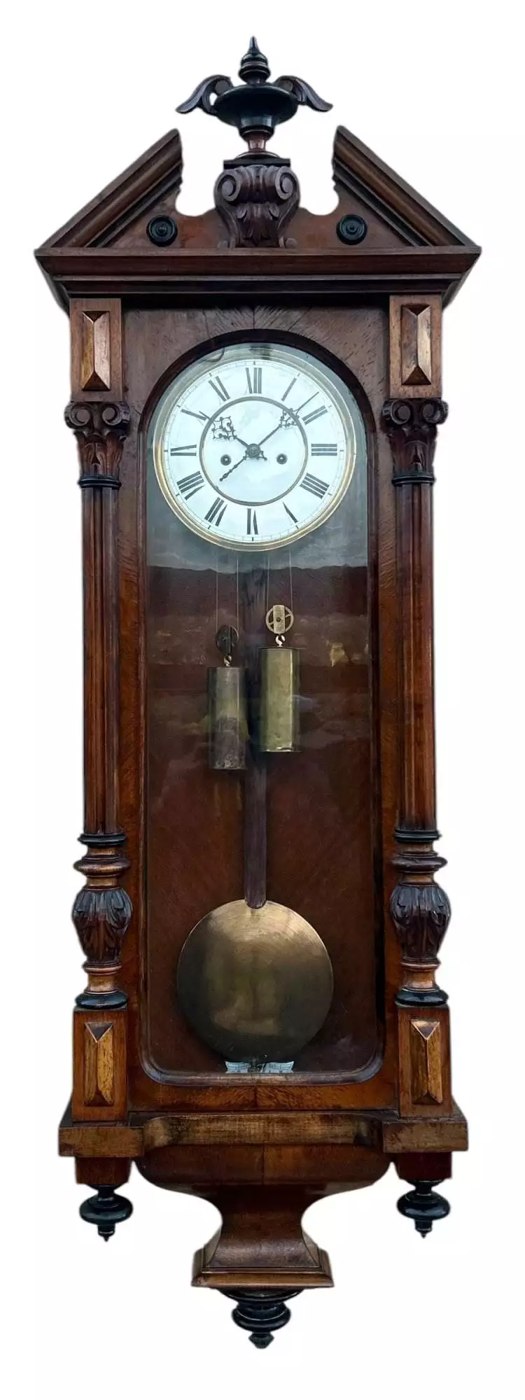
This wall-mounted regulator clock is attributed to the German manufacturer Lenskirch, dating to circa 1890-1900. The timepiece features an eight-day movement with a deadbeat escapement and a power reserve mechanism, designed for gong striking. The case is constructed from walnut and incorporates ebonized turned finials and carved pillars flanking a glazed central section. The upper portion of the clock features an architectural pediment. The clock face comprises an enamel dial accompanied by original ornate foliate hands. The overall height measures 128 cm, with a width of 41.5 cm and a depth of 18 cm. The auction description notes the clock is in working order following a recent service and includes the necessary winding key. The external appearance exhibits minor age-related cosmetic wear consistent with its production period.

Full view of the Lenskirch walnut and ebony wall clock showing the pendulum and twin weights.
Full view of the Lenskirch walnut and ebony wall clock showing the pendulum and twin weights. — Vintage Clocks UK. Rights pending — permission not yet requested. Original source

Catalogue identity

Source
vintageclocks.uk
Category
Clock · Wall clock
Maker / attribution
Lenskirch
Reference
Not recorded
Catalogue / lot identifier
Source URL identifies the listing
Source-reported date
circa 1890-1900
Source-reported place
Germany
Source-reported serial
2317

Source-reported attribution and specifications are not independent authentication. A listing does not establish present ownership, current display, availability or permission to reproduce.

Object description

Case Construction and Design

The clock is housed in a case primarily composed of walnut, accented with ebonized turned finials and architectural decorative elements. The structure features carved pillars positioned on either side of the glazed central section, which permits a view of the pendulum and the twin weights. An architectural pediment surmounts the upper case, providing the clock with its characteristic profile.

The lower section of the case terminates in a tapering base with additional ebonized turnings. The finish combines the natural wood grain of the walnut with dark ebonized details, a combination noted by the seller as a feature of the construction. The overall dimensions are reported as 128 cm in height, 41.5 cm in width, and 18 cm in depth.

Evidence for this section
  • “The case is made of walnut with ebonized turned finials and carved pillars flanking each side of the glazed case, architectural top pediment and ebonized turned finials.”

Dial and Movement

The timekeeping is indicated by an enamel dial displaying Roman numerals. The dial is fitted with original ornate foliate-style hands. The internal mechanism is an eight-day movement designed to strike on a gong. The movement includes a deadbeat escapement and a power reserve feature.

The auction description indicates that the movement is currently in working order and has recently undergone servicing. Two weights are utilized to drive the movement, which are visible within the glazed case. A winding key is supplied with the clock.

Evidence for this section
  • “Original enamel dial with original ornate foliate hands.”
  • “The movement is an 8 day gong striking movement.”
  • “Dead beat escapement with power reserve”

Condition and Attribution

The seller reports the object as a German-made regulator clock manufactured by Lenskirch, providing conflicting dates of circa 1890 and circa 1900 in the provided documentation. The clock is described as being in good condition relative to its age, though it exhibits minor signs of cosmetic wear on both the dial and the wooden case.

No specific manufacturer's markings are highlighted in the source or visible in the photography to confirm the specific workshop of origin. The condition report provided by the auction house serves as the primary assessment of the clock's state and function.

Evidence for this section
  • “Good condition for age, showing minor signs of age and cosmetic wear to the case and dial”
  • “Ca 1900”
  • “Fantastic Walnut & ebony Case Vienna wall clock ca 1890.”

Open research questions

  • Does the movement plate bear the specific Lenskirch trademark or logo?
  • Can the manufacture date be verified through a serial number match in Lenskirch production records?

Source evidence

Recorded claims and source quotations for Vienna Regulator Wall Clock
FieldSource-reported valueSource quotation
MakerLenskirch“made by Lenskirch”
Movement type8-day gong striking“8 day gong striking movement”
EscapementDead beat“Dead beat escapement with power reserve”
MaterialsWalnut and ebony“Walnut and ebony glazed case”
Dimensions128cm x 41.5cm x 18cm“Measures 128cm height, 41.5cm width. 18cm depth.”
SKU2317“SKU: 2317”
Datedcirca 1890-1900“Fantastic Walnut & ebony Case Vienna wall clock ca 1890.”
ConditionWorking order“Working Order, recently serviced”

Visible details

  • Case features walnut wood with ebonized turned finials
  • Enamel dial with Roman numerals
  • Two brass-cased weights suspended within the glazed section
  • Carved decorative pillars flanking the central glass panel

Research qualifications

  • Exact date of manufacture is inconsistent between 'Ca 1900' and 'ca 1890' in the source
  • Attribution to Lenskirch is stated but no specific internal maker's mark is depicted in the provided photos

Photograph identity and source facts were screened before import; rights clearance remains pending.

Consulted source

Beautiful Twin Weight regulator Vienna Wall clock – made by Lenskirch

Reviewed 2026-11-02 · Record f4c02f8b87

Terms in this record

Glossary explanations for terms named in this object’s record.