
Skip to content
The Encyclopedia of Horology

Tool · German vertical disc dial

Vertical Disc Dial

Partially verified

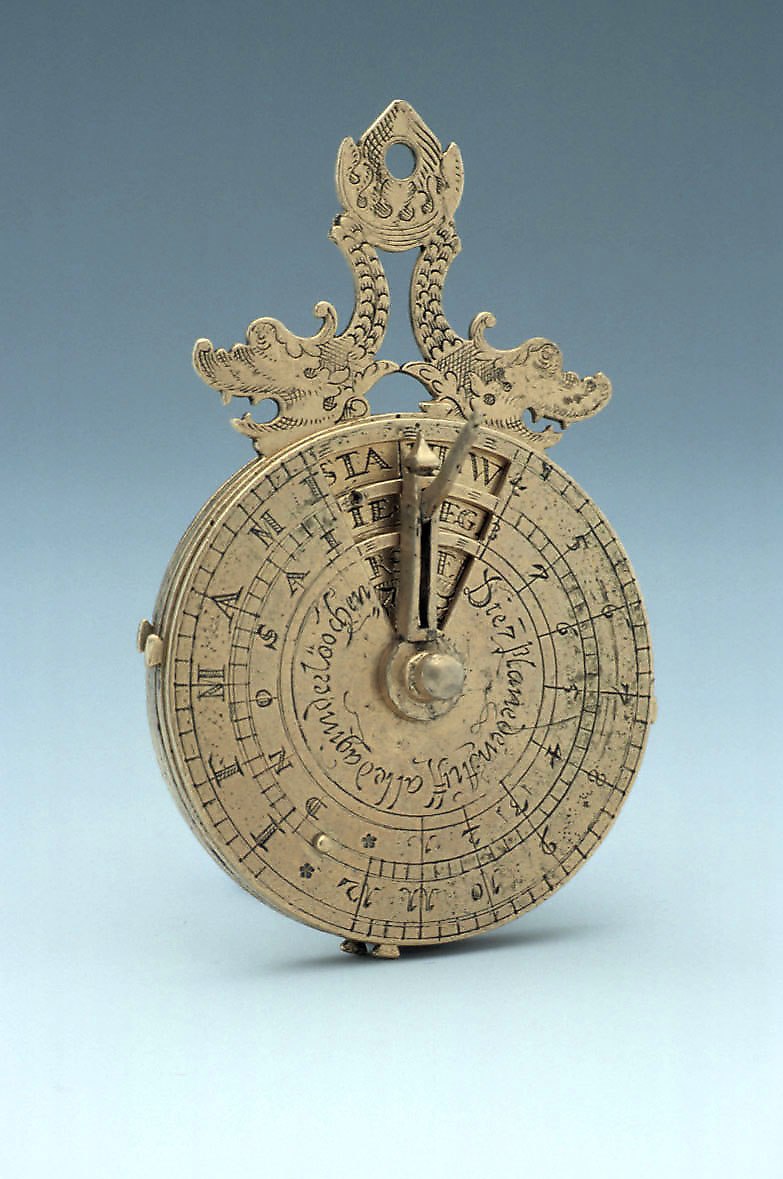
This 50 mm vertical disc dial, held by the Museum of the History of Science, Oxford (inventory 41123), is an unsigned German instrument dating to 1564. The construction consists of five superimposed gilt copper discs, featuring a suspension handle cast and engraved in the form of a double dragon's head. One side contains a brass arm with a pierced, engraved lunar volvelle for tracking moon phases, alongside a perpetual calendar showing days of the month, daylight and night lengths, and ruling planets. The opposing side features a folding gnomon used to indicate hours numbered from 4 to 12 to 8. Various plates include internal notches and hidden inscriptions, such as the signature-like 'Jah. 1564 Lub Soll' engraved on an inner face, which are only accessible when the instrument is disassembled.

Vertical disc dial, German, 1564, showing the folding gnomon and hour markings.
Vertical disc dial, German, 1564, showing the folding gnomon and hour markings. — Museum of the History of Science, Oxford. Rights pending — permission not yet requested. Original source

Catalogue identity

Source
www.mhs.ox.ac.uk
Category
Tool · German vertical disc dial
Maker / attribution
Not established
Reference
Not recorded
Catalogue / lot identifier
41123
Source-reported date
1564
Source-reported place
Germany

Source-reported attribution and specifications are not independent authentication. A listing does not establish present ownership, current display, availability or permission to reproduce.

Object description

Construction and Design

The instrument is composed of five superimposed gilt copper discs, measuring 50 mm in diameter. The assembly is held by a handle cast and engraved in the form of a double dragon's head. The design incorporates mechanical complexity beyond the primary dial face, with several plates featuring notches along the limb to facilitate turning.

The dial contains numerous engravings, some of which are located on the internal faces of the plates and are not visible when the instrument is fully assembled. These include alphabetic inscriptions and technical annotations, such as 'I K' and 'leibi gasteig', which reveal additional details regarding the construction and potential internal adjustments of the dial.

Evidence for this section
  • “It is composed of five copper superimposed discs, the central of which has a handle in the form of a double dragon's head.”
  • “There are some engravings on the sides of the plates which are not visible when the instrument is assembled.”
  • “The central plate has engraved on this side 'I K' and 'leibi gasteig' but the inscription is not visible when the instrument is assembled.”

Functions and Markings

The dial functions as both a solar and calendrical tool. One side features a brass arm equipped with a pierced and decorated lunar volvelle for tracking the phases of the moon. This face also supports a perpetual calendar, indicating the total days of the month, the length of the day and night, and the daily ruling planet through specific engraved references.

The opposite face includes a folding gnomon intended to indicate common hours, which are engraved on the limb and numbered from 4 to 12 to 8. This face also includes the initials of the months and a central inscription referring to the seven planets. Additional planet symbols are revealable via the internal plates to assist with the governing planet indications.

Evidence for this section
  • “On one side of the dial is a brass arm with a pierced and engraved lunar volvelle”
  • “On the other face of the dial is a folding gnomon indicating common hours numbered from 4 to 12 to 8.”
  • “The plate is pierced so as to adjust for the day of the week and to have the indication of the governing planet”

Signature and Identity

The instrument is documented as unsigned on its external surfaces, though an internal marking reads 'Jah. 1564 Lub Soll'. This engraving is found on the inner face of one of the plates, reinforcing the date of 1564 established for the object. Despite these markings, the specific workshop or maker remains unrecorded.

The instrument displays structural similarities to other recorded devices, specifically those catalogued as Epact 86254.

Evidence for this section
  • “Unsigned”
  • “Dated 1564; German”
  • “On the inner face of the plate is engraved 'Jah. 1564 Lub Soll'.”
  • “The instrument is very similar to Epact 86254.”

Open research questions

  • What is the specific meaning of the engraving 'leibi gasteig'?
  • How does the internal plate mechanism interact with the perpetual calendar functions?

Source evidence

Recorded claims and source quotations for Vertical Disc Dial
FieldSource-reported valueSource quotation
Inventory number41123“Inventory number: 41123”
MaterialGilt copper“Gilt copper; 50 mm in diameter”
Date1564“Dated 1564; German”
OriginGermany“Dated 1564; German”
Gnomon typeFolding“On the other side of the dial is a folding gnomon”
Internal inscriptionJah. 1564 Lub Soll“On the inner face of the plate is engraved 'Jah. 1564 Lub Soll'.”

Visible details

  • Handle shaped as a double dragon head
  • Folding gnomon arm at the centre
  • Engraved circular hour scales numbered 4 to 12 to 8
  • Multi-plate construction with visible edge notches

Research qualifications

  • Exact maker not confirmed as unsigned
  • Meaning of the internal 'I K' and 'leibi gasteig' inscriptions
  • Specific function of the internal discs relative to their hidden engravings

Photograph identity and source facts were screened before import; rights clearance remains pending.

Consulted source

Vertical Disc Dial

Reviewed 2026-10-26 · Record 8b9a8d599c

Terms in this record

Glossary explanations for terms named in this object’s record.