
Skip to content
The Encyclopedia of Horology

Tool · German vertical disc dial

Vertical Disc Dial by Erasmus Habermel

Partially verified

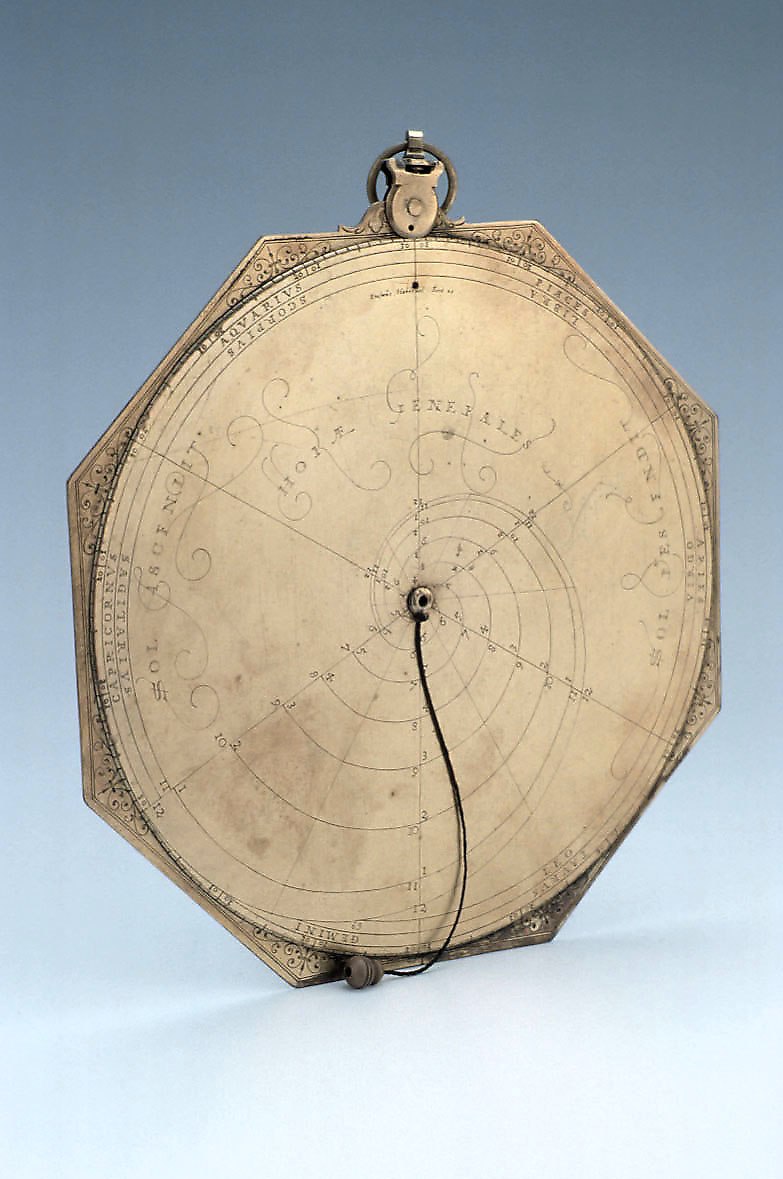
This vertical disc dial, created by Erasmus Habermel in 1586, is a gilt copper timekeeping instrument measuring 160 x 160 mm. The construction features two superimposed plates: one octagonal base plate and a circular plate. The circular plate functions as the primary dial face, featuring hour lines engraved in a spiral pattern, accompanied by inscriptions indicating solar declination and general hours. The border of the circular plate contains a zodiac scale divided by degrees. The octagonal plate is decorated with arabesques at the corners and includes a suspension ring for vertical orientation. The reverse of the dial displays a complex diagram for converting between common, Italian, and Babylonian hours, featuring a central wind rose and a radial arm. Although the gnomon is currently missing, the device originally relied on this component and a plumb line to function as a sundial.

Front view of the vertical disc dial showing the spiral hour markings and Habermel signature.
Front view of the vertical disc dial showing the spiral hour markings and Habermel signature. — Museum of the History of Science, Oxford. Rights pending — permission not yet requested. Original source

Catalogue identity

Source
www.mhs.ox.ac.uk
Category
Tool · German vertical disc dial
Maker / attribution
Erasmus Habermel
Reference
Not recorded
Catalogue / lot identifier
35550
Source-reported date
1586
Source-reported place
Germany

Source-reported attribution and specifications are not independent authentication. A listing does not establish present ownership, current display, availability or permission to reproduce.

Object description

Structural Design

The instrument is composed of two superimposed metallic plates: a square-based octagonal plate and a circular plate mounted on top. The octagonal plate provides the structural frame and is decorated with arabesques at each of its corners. A notch is located at the bottom of this plate. A suspension ring is attached to the top of the frame, indicating its intended use as a suspended vertical device.

The circular plate serves as the principal dial face. On its exterior side, it contains a zodiac scale along the border, subdivided by degrees. The center of the plate features an aperture or attachment point for a gnomon, which is now missing from the assembly. A plumb line is also noted as an original, though detached, component of the dial's functional requirements.

Evidence for this section
  • “This dial consists of two superimposed plates , one octagonal and one circular.”
  • “The corners of the octagonal plate are decorated with arabesques”
  • “This side carried the gnomon (missing) and a plumb line.”

Timekeeping Functions

The dial facilitates the reading of time through a spiral engraving of hour lines on the circular plate. These are numbered from 1 to 12. Solar information is provided through the inclusion of the Latin phrases 'SOL ASCENDIT' and 'SOL DESCENDIT' to track the increase and decrease of solar declination. The designation 'HORAE GENERALES' is also inscribed on this face to denote the general hours.

The reverse side of the dial includes a conversion chart for different timekeeping systems. It displays common hours marked from I to XII twice, as well as Italian and Babylonian hours numbered from 1 to 24. A rotatable index and a radial arm, which features zodiacal symbols, allow the user to convert between these varied time systems. A wind rose is positioned in the center of this diagram.

Evidence for this section
  • “The hour lines are engraved on one side of the circular plate in a spiral”
  • “The other side of the circular plate has a diagram with common , Italian and Babylonian hours and a rotatable index to allow conversion between them.”
  • “In the centre is a wind rose, and the radial arm is engraved with the symbols of the zodiacal signs.”

Signatures and Inscriptions

The maker's mark is present on the circular plate. The signature 'Erasmus Habermel Fecit 86' is engraved in very small characters. This signature serves to attribute the object to the German instrument maker and provides the completion date of 1586.

The inscriptions on the dial appear in both Latin and numeric formats to serve the dial's diagnostic purposes. The zodiac scale is numbered specifically from 10 to 30 by increments of 10. The combination of these inscriptions with the specific arabesque decorative style on the octagon provides the primary evidence for the dial's historical attribution and functional purpose.

Evidence for this section
  • “in very small characters is the signature ' Erasmus Habermel Fecit 86'.”
  • “The corners of the octagonal plate are decorated with arabesques typical of Habermel”

Open research questions

  • What is the specific mechanical function of the notch located at the bottom of the octagonal plate?
  • To what extent is the current suspension ring original to the 1586 manufacture?

Source evidence

Recorded claims and source quotations for Vertical Disc Dial by Erasmus Habermel
FieldSource-reported valueSource quotation
MakerErasmus Habermel“Signed by Erasmus Habermel”
Date1586“Dated 1586”
MaterialGilt copper“Gilt copper”
Dimensions160 x 160 mm“160 x 160 mm”
Inventory Number35550“Inventory number: 35550”
SignatureErasmus Habermel Fecit 86“'Erasmus Habermel Fecit 86'”
OriginGerman“German”

Visible details

  • Arabesque corner decoration on the octagonal plate
  • Suspension ring at the top
  • Spiral hour line arrangement
  • Evidence of a central mounting point for a former gnomon

Research qualifications

  • The gnomon is missing
  • The extent of later modifications is not specified

Photograph identity and source facts were screened before import; rights clearance remains pending.

Consulted source

Vertical Disc Dial

Reviewed 2026-10-26 · Record 9f11cfd1f3

Terms in this record

Glossary explanations for terms named in this object’s record.