
Skip to content
The Encyclopedia of Horology

Tool · German vertical disc dial

Vertical Disc Dial

Partially verified

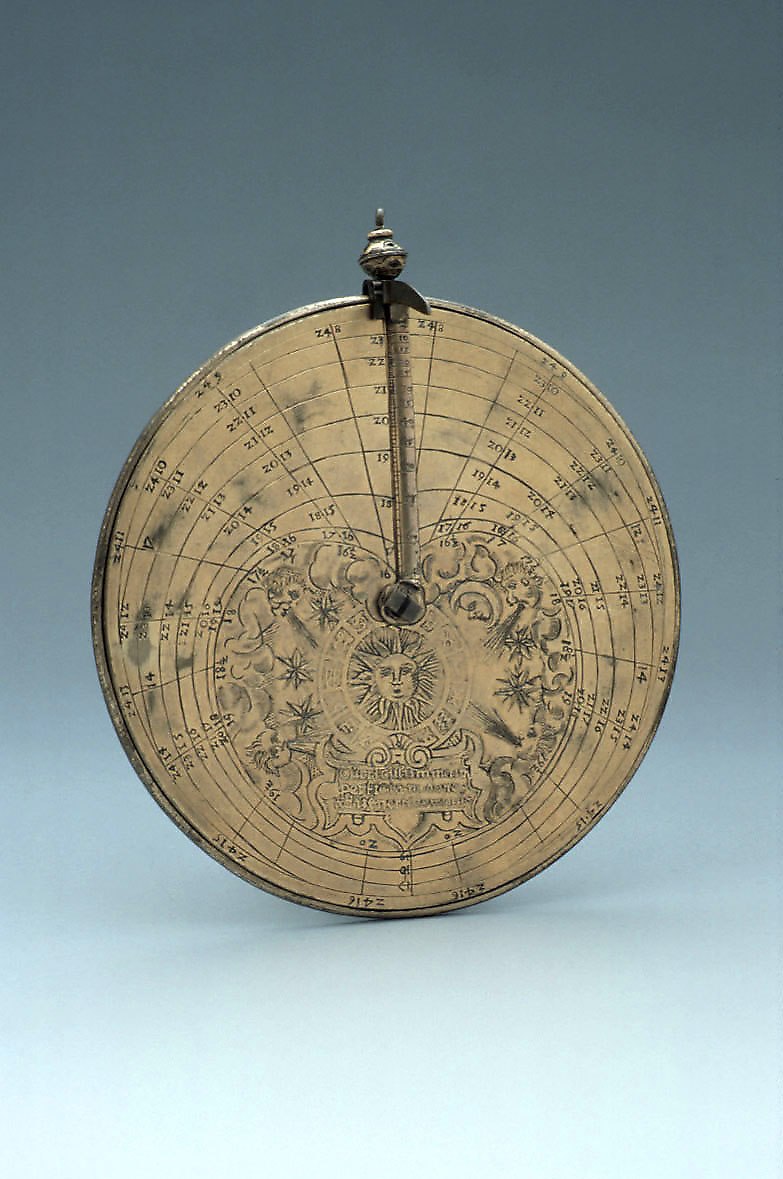
The Vertical Disc Dial (Inventory number 47553) is a brass instrument of German manufacture, dating to approximately 1570. It consists of a primary plate with a raised edge, termed a mater, that houses two removable internal plates. The plates are secured within the mater by lugs. The dial features a folding gnomon located at the top near a hanging ring, connected by a rule graduated from 5 to 64.5, used to determine the height of the sun. The instrument's surface is extensively engraved with calendar scales, zodiacal symbols, seasonal names, and varied hour systems, including common, Italian, and planetary hours. One plate bears a Latin inscription: 'Curriculum meum perficiam donec aduenerit dominus'. A coat-of-arms is engraved at the centre, though its charges have been effaced. The engraving technique is described as an unusual combination of intaglio and relief work.

Front view of the brass Vertical Disc Dial showing the sun effigy, zodiac symbols, and the graduated gnomon rule.
Front view of the brass Vertical Disc Dial showing the sun effigy, zodiac symbols, and the graduated gnomon rule. — Museum of the History of Science, Oxford. Rights pending — permission not yet requested. Original source

Catalogue identity

Source
www.mhs.ox.ac.uk
Category
Tool · German vertical disc dial
Maker / attribution
Not established
Reference
Not recorded
Catalogue / lot identifier
47553
Source-reported date
circa 1570
Source-reported place
Germany

Source-reported attribution and specifications are not independent authentication. A listing does not establish present ownership, current display, availability or permission to reproduce.

Object description

Structural Design and Layout

The instrument follows the general form of an astrolabe, featuring a main plate with a raised edge known as a mater. Two additional plates are designed to fit within this circular frame. To ensure the orientation of these internal components, each plate is equipped with lugs that lock into a specific notch on the edge of the mater, preventing rotation during use.

The external side of the mater displays a comprehensive calendar scale, which includes days and names of months, as well as a circle graduated twice from 5 to 30. Zodiacal symbols, seasons, and scales representing the length of the night and Italian hours for sunrise are also present on the device. The folding gnomon is positioned at the top of the mater adjacent to the hanging ring, and a graduated rule links this gnomon to the centre of the instrument, allowing the user to measure solar altitude.

Evidence for this section
  • “consists of a plate with a raised edge, similar to an astrolabe mater , into which fit two other plates”
  • “prevented from turning by lugs on the plates which fit into a notch in the edge of the mater”
  • “The folding gnomon is at the top of the instrument, next to the hanging ring, and is connected with the centre by a rule graduated from 5 to 641/2.”

Engraving and Symbolism

The dial is notable for its decorative program and varied engraving techniques. One plate features Italian hour lines represented as quasi-concentric segments. At the centre of these lines, an effigy of the sun is depicted, surrounded by zodiacal symbols, blowing faces, stars, and clouds, with a representation of a half-moon.

Beneath this astronomical arrangement, the Latin phrase 'Curriculum meum perficiam donec aduenerit dominus' is inscribed. The central area of the dial incorporates a coat-of-arms; however, the charges that previously occupied the escutcheon have been worn away or intentionally removed. The overall engraving style is described as an unusual combination of relief and intaglio methods.

Evidence for this section
  • “The other side has Italian hour lines in the form of quasi-concentric lines, numbered from 8 to 16 to 24 and in the centre of the hour lines a sun effigy”
  • “below, the inscription 'Curriculum meum perficiam donec aduenerit dominus'”
  • “At the centre is a coat-of-arms in which the charges on the escutcheon have been effaced.”
  • “The engraving on the instrument, partly in intaglio, partly in relief, is unusual.”

Functional Components

Functionally, the instrument serves multiple timekeeping purposes through its interchangeable internal plates. One plate is specifically designed for the reading of planetary hours and includes a table indicating the ruling planets for each day of the week. The reverse of this plate features the aforementioned Italian hour display and sun effigy.

The second plate, which is blank on one side, features common hour lines numbered from 4 to 12 to 8 on the other. Latitude-dependent lines are also engraved on the border of this plate, originating from the centre. The instrument remains unsigned, and its provenance relies upon the museum's cataloguing of the piece within their scientific instrument collection.

Evidence for this section
  • “The other plate has on one side planetary hours numbered from 1 to 6 to 12, with a table showing the ruling planets for each day.”
  • “The other side is engraved with common hour lines numbered from 4 to 12 to 8.”
  • “From the centre depart lines corresponding to different latitudes engraved on the border of the plate.”

Open research questions

  • What is the historical significance of the specific Latin inscription 'Curriculum meum perficiam donec aduenerit dominus' in the context of 16th-century instruments?
  • Can the effaced coat-of-arms be identified through historical records or similar contemporary German sundials?

Source evidence

Recorded claims and source quotations for Vertical Disc Dial
FieldSource-reported valueSource quotation
Diameter117 mm“117 mm in diameter”
InscriptionCurriculum meum perficiam donec aduenerit dominus“'Curriculum meum perficiam donec aduenerit dominus' ('My run will be complete when the Lord will have come')”
MakerUnsigned“Unsigned”
Datecirca 1570“circa 1570”
OriginGerman“German”
Inventory Number47553“Inventory number 47553”

Visible details

  • Folding gnomon at the top
  • Engraved sun effigy surrounded by zodiacal symbols, stars, and clouds
  • Lugs on internal plates for alignment within the mater
  • Rule connecting the gnomon to the center of the plate

Research qualifications

  • The charges on the escutcheon are effaced, preventing identification of the coat-of-arms
  • The engraving style is unusual and its specific regional or workshop origins remain unverified

Photograph identity and source facts were screened before import; rights clearance remains pending.

Consulted source

Vertical Disc Dial

Reviewed 2026-10-26 · Record 43fae53ad8

Terms in this record

Glossary explanations for terms named in this object’s record.