
Skip to content
The Encyclopedia of Horology

Tool · German vertical disc dial

Vertical Disc Dial

Partially verified

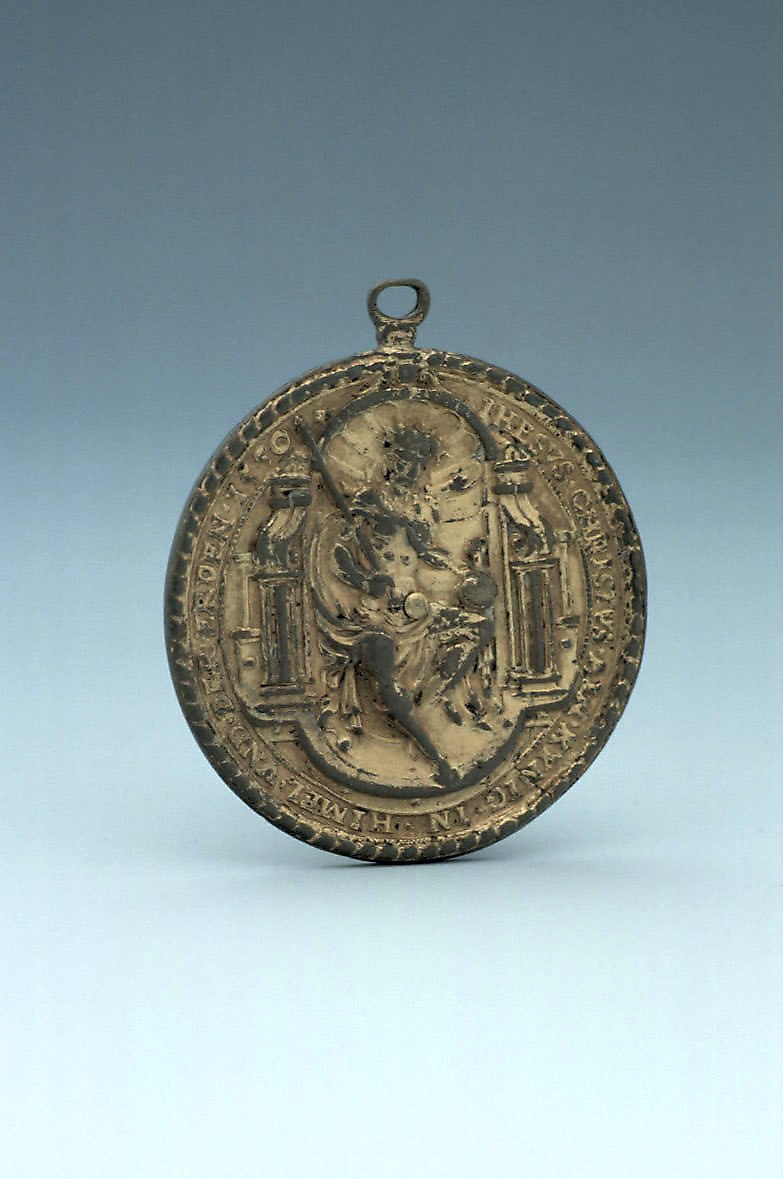
This vertical disc dial, held by the Museum of the History of Science, Oxford (inventory number 46380), is an unsigned horological instrument constructed from gilt brass. Measuring 43 mm in diameter, the object is a portable sun-measuring device. One side features a relief depiction of a crowned Christ enthroned, clutching an orb and sceptre, encircled by an inscription identifying the subject in German and the date 1550. The reverse side contains a calendar scale displaying month names and days, alongside common hours numbered 4 to 12 to 8. These are demarcated by directional terminology in German for morning and afternoon hours, as well as rising and setting solar indicators. The dial contains an additional inscription, '15 74 M T K', which is recorded as a possible, albeit unidentified, signature or marking. The object functions as a solar timepiece.

Obverse of the vertical disc dial showing the enthroned Christ figure in relief.
Obverse of the vertical disc dial showing the enthroned Christ figure in relief. — Museum of the History of Science, Oxford. Rights pending — permission not yet requested. Original source

Catalogue identity

Source
www.mhs.ox.ac.uk
Category
Tool · German vertical disc dial
Maker / attribution
Not established
Reference
Not recorded
Catalogue / lot identifier
46380
Source-reported date
1550 or 1574
Source-reported place
Germany

Source-reported attribution and specifications are not independent authentication. A listing does not establish present ownership, current display, availability or permission to reproduce.

Object description

Visual and Iconographic Design

The primary face of this vertical disc dial is dominated by a relief casting featuring a crowned, seated Christ figure. The deity holds both an orb and a sceptre, symbols of temporal and spiritual authority. The figure is framed by pillars, contributing to the formal composition of the disc's obverse.

A band surrounding the central relief contains an inscription written in German: 'IHESVS ? CHRISTVS ? AIN ? KYNIG ? IN ? HIMEL ? VND ? DER ? ERDEN ? 1550'. This text provides a religious context for the object, translating to 'Jesus Christ King in Heaven and on Earth 1550', effectively linking the time-telling function of the instrument to its devotional iconography.

Evidence for this section
  • “One side of this vertical dial is decorated in relief with a crowned Christ seated on a throne, holding an orb and a sceptre”
  • “surrounded by the inscription 'IHESVS ? CHRISTVS ? AIN ? KYNIG ? IN ? HIMEL ? VND ? DER ? ERDEN ? 1550'”

Horological and Calendar Functions

The reverse of the gilt brass disc is functional, serving as a calendar and sundial. It features a specific scale meant to track the months and the corresponding days of the year. This calendar mechanism suggests the object was used for tracking seasonal changes alongside daily time.

The dial includes common hour markings, specifically numbered from 4 to 12 and back to 8. These hours are grouped by specific German inscriptions that distinguish between morning and afternoon periods, while also indicating the rising and setting of the sun.

Evidence for this section
  • “The other side of the dial has a calendar scale with the names of the months and their days”
  • “common hours numbered from 4 to 12 to 8, indicated respectively by 'STVNDT VORMITTAG' and 'STUNDT NACHMITTAG' and 'ABSTEI G' and 'AVFSTEI G DIE SON{NEN}'”

Markings and Attribution

The instrument remains unsigned by a known maker. The dating remains ambiguous due to the presence of two distinct years on the object: 1550, which appears within the decorative circular inscription, and 1574, which appears elsewhere on the dial.

The secondary date of 1574 is accompanied by the letters 'M T K'. While these characters are noted in the records as a potential signature, no definitive attribution to a specific maker or workshop has been established by the museum.

Evidence for this section
  • “Unsigned”
  • “1550 or 1574”
  • “In one of the circular sectors is inscribed '15 74 M T K'.”
  • “which is possibly a signature but has not been identified.”

Open research questions

  • Does the difference between the dates 1550 and 1574 indicate a later modification of the object?
  • Can the initials 'M T K' be associated with known instrument makers from the late 16th-century German region?

Source evidence

Recorded claims and source quotations for Vertical Disc Dial
FieldSource-reported valueSource quotation
Inventory number46380“Inventory number: 46380”
MaterialGilt brass“Gilt brass”
Diameter43 mm“43 mm in diameter”
OriginGerman“German”
Secondary date1574“15 74 M T K”
MakerUnsigned“Unsigned”

Visible details

  • Object is a circular gilt brass disc with a suspension loop at the top
  • Relief decoration on one side depicts a crowned figure
  • Calendar scale is visible on the reverse side
  • German text is engraved around the perimeter of the Christ image

Research qualifications

  • The dating is presented as a choice between 1550 or 1574 based on conflicting inscriptions
  • The initials 'M T K' are described as a possible but unidentified signature

Photograph identity and source facts were screened before import; rights clearance remains pending.

Consulted source

Vertical Disc Dial

Reviewed 2026-10-26 · Record 004e994fef

Terms in this record

Glossary explanations for terms named in this object’s record.