
Skip to content
The Encyclopedia of Horology

Tool · German vertical disc dial

Vertical Disc Dial

Partially verified

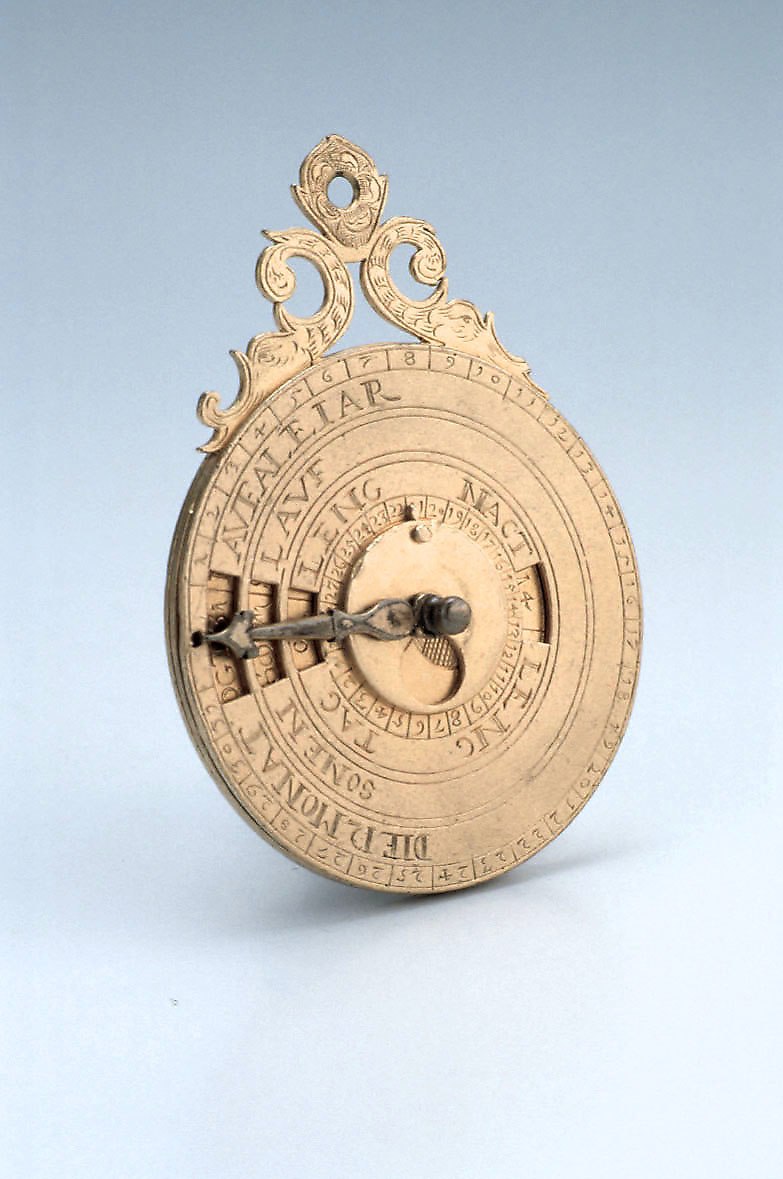
This vertical disc dial is a German-made instrument constructed from gilt copper, measuring 50 mm in diameter. It comprises three plates, with the central plate featuring a decorated handle for manipulation. One side of the instrument includes a folding gnomon and hour lines numbered 4 to 12 to 8, divided into quarter-hour increments, accompanied by the initials of the months. The reverse side features a brass arm and a pierced lunar volvelle used to indicate the moon's age against a 29-day lunar scale. Further inscriptions detail solar declination, day length, and night length. One of the plates is crafted from a repurposed engraved printing plate, with remnants of its original text and illustration still visible on the reverse side. The instrument underwent regilding during the late 19th century. Although parts of the object appear to be missing, the revolving plate mechanism remains functional.

Vertical disc dial showing the lunar volvelle, brass indicator arm, and various astronomical scales including day/night length and sun declination.
Vertical disc dial showing the lunar volvelle, brass indicator arm, and various astronomical scales including day/night length and sun declination. — Museum of the History of Science, Oxford. Rights pending — permission not yet requested. Original source

Catalogue identity

Source
www.mhs.ox.ac.uk
Category
Tool · German vertical disc dial
Maker / attribution
Not established
Reference
Not recorded
Catalogue / lot identifier
48208
Source-reported date
Undated
Source-reported place
Germany

Source-reported attribution and specifications are not independent authentication. A listing does not establish present ownership, current display, availability or permission to reproduce.

Object description

Construction and Materials

This vertical disc dial is composed of three plates fashioned from gilt copper, measuring 50 mm in diameter. The central plate is distinguished by an integrated decorated handle, which serves as a grip for the device. A significant feature of the instrument is the material reuse seen on one of the plates, which was salvaged from an earlier engraved printing plate. Traces of the original illustration and text from this printing plate remain visible on the reverse surface.

The instrument displays a gilt finish, which the museum notes was applied during a regilding process at the end of the 19th century.

Evidence for this section
  • “Gilt copper; 50 mm in diameter”
  • “The plate with the declination scale and hour lines has been cut from and engraved on the back of an old engraved printing plate”
  • “The dial was regilded at the end of the 19th century.”

Dial Functions and Indicators

The dial serves multiple horological and astronomical functions. On its external face, it features a folding gnomon and a scale of hour lines numbered from 4 to 12 and back to 8, calibrated in quarter-hour divisions. The initials representing the names of the months are positioned opposite the hour scales.

The reverse side contains an advanced set of indicators including a brass arm and a pierced lunar volvelle. This volvelle tracks the age of the moon against a circle divided into 29 lunar days. The plate is further inscribed with specific labels for solar declination ('SONEN LAVF') and the duration of day and night ('TAG LENG' and 'NACT LENG'), adjustable via the revolving movement of the plate.

Evidence for this section
  • “On the external side of one of the plates there is a folding gnomon and hour lines, numbered from 4 to 12 to 8”
  • “On the other side are a brass arm and a pierced lunar volvelle showing the age of the moon.”
  • “The circle around the volvelle, on the brass plate, is divided into 29 lunar days.”

Condition and Attribution

The dial is currently unsigned, and its precise date of origin remains undetermined. The historical context provided by the Museum of the History of Science attributes the object to a German source. The physical condition reflects some loss of original components, with researchers noting that part of the instrument appears to be missing.

Comparisons have been drawn to another instrument in the Epact catalogue, 91925. Unlike that reference, this specific example lacks a latitude scale and notches on the limb, although the plate retains its ability to revolve. The identification of its German manufacture is based on institutional research.

Evidence for this section
  • “Unsigned”
  • “Date; place Undated; German”
  • “Part of the instrument appears to be missing.”
  • “This vertical disc dial is very similar to Epact 91925.”

Open research questions

  • What specific missing components were originally intended for the revolving plates?
  • Can the visible printing plate fragment be identified to a specific historical publication or printer?

Source evidence

Recorded claims and source quotations for Vertical Disc Dial
FieldSource-reported valueSource quotation
Inventory number48208“Inventory number: 48208”
MaterialGilt copper“Gilt copper”
Diameter50 mm“50 mm in diameter”
Place of manufactureGerman“German”
Regilding dateLate 19th century“The dial was regilded at the end of the 19th century.”
ConstructionRepurposed printing plate“The plate with the declination scale and hour lines has been cut from and engraved on the back of an old engraved printing plate”

Visible details

  • Decorated handle attached to the central plate
  • Pierced lunar volvelle showing the age of the moon
  • Visible markings of 'SONEN LAVF' for sun declination
  • Gilt copper finish with signs of regilding

Research qualifications

  • Part of the instrument appears to be missing
  • The dating is described as undated
  • The notch on the limb for turning is identified only as probably for that purpose

Photograph identity and source facts were screened before import; rights clearance remains pending.

Consulted source

Vertical Disc Dial

Reviewed 2026-10-26 · Record 3aa025cb9a

Terms in this record

Glossary explanations for terms named in this object’s record.