Construction and Design
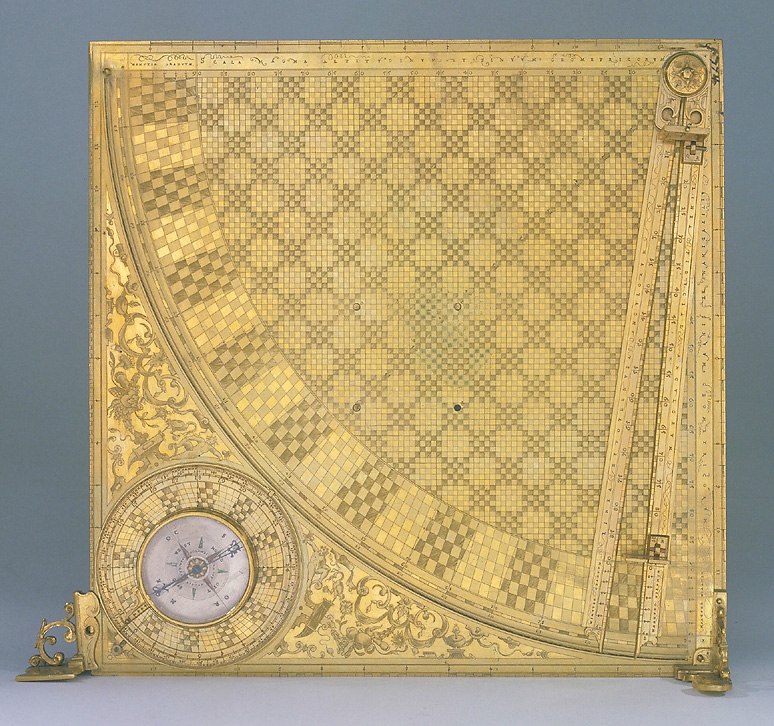
The instrument is a square-shaped, gilt brass device designed for universal application in mathematical, astronomical, and military tasks. It stands on small, removable feet that facilitate a vertical operating position. The primary surface is heavily engraved with various scales, including linear scales divided into twelve parts and a complex system of nonius circles intersected by oblique lines to ensure precision. The overall dimensions are 360 x 360 mm, with decorative engraving occupying the corners of the quadrant.
A prominent feature is the 65 mm diameter removable compass, which includes a wind rose divided into 360 degrees and 24 hours. The compass cover functions as an independent sundial with a folding gnomon and features a lunar nocturnal dial on the underside. Two pivoted alidades with removable sights and sliding pointers extend from the upper right corner to facilitate precise angular measurement.
The grid structure on the main face allows for the measurement of trigonometric functions by intersecting horizontal and vertical lines with the circumference of the quadrant. The bounding radii of the grid are divided into 90 equal parts, which are further grouped into units of five for readability.
Evidence for this section
- “The gilded metal instrument, which is square in shape, is provided with small removable feet, which allow it to maintain a vertical position.”
- “The instrument is provided with a compass , which could be easily installed or removed, and which is itself provided with a lid which works as a sun and moon dial .”
- “The grid is traced in the quarter of circumference inside the nonius.”
Functional Capabilities
The quadrant serves as a multi-functional tool capable of planetary and chronological calculations. Face b of the instrument presents an altimetric scale with markings for Umbra recta, Umbra versa, and Umbra media. Additionally, it contains two separate horary quadrants of the Stoffler type: one for unequal or planetary hours, and the other for equal or common hours. These scales are delimited by zodiacal signs and equinoctial lines, reflecting both horary use and astrological influences.
The device also includes a 'scala iaciendi' and a 'calendarium et locus solis' for tracking seasonal changes and the solar position. For astronomical work, a plumb-line is integrated with the graduated alidade, which features two sliding pointers. This combination allows the user to calculate the influence of planets on zodiacal signs and define seasonal progressions with high accuracy, further enhanced by the nonius divisions of 10' on the angular scale.
Evidence for this section
- “Face b: Here we have an altimetric scale with indications of Umbra versa, Umbra recta and Umbra media, a two-limbed horary quadrant of the Stoffler type, for unequal or planetary hours and a second horary quadrant, of the same kind, for equal or common hours.”
- “The 'scala iaciendi' on one side and the 'calendarium et locus solis' follow, with the distribution of signs and months providing the subdivisions of the seasons.”
Provenance and Signature
The maker's signature is located on the sides of the pivot supporting the alidade. The inscription identifies Tobias Volckmer of Brunswick, goldsmith to the House of Saxony, and confirms the date of production as 1608. The instrument is part of the collection held at the Istituto e Museo di Storia della Scienza in Florence, bearing inventory numbers 2465 and 1495.
Historical records indicate that the instrument was transported from Germany to Italy by Prince Mattias de' Medici in 1635. The instrument is documented as being part of a larger set that originally included a Jacob's staff and a tripod, although the primary focus here is the quadrant itself.
Evidence for this section
- “On the sides of the pivot which holds the alidade is the signature of the maker and the date: 'Auctorae Tobia Volckmero Brunsvicensi Serenis. Ducis Bavarorum etc. Mathe. et Aurifabro faciebat 1608'.”
- “A Jacob's staff with a movable cursor and a tripod also belonged to the instrument, which was brought from Germany by Prince Mattias de' Medici in 1635.”