
Skip to content
The Encyclopedia of Horology

Tool · German quadrant

Quadrant

Partially verified

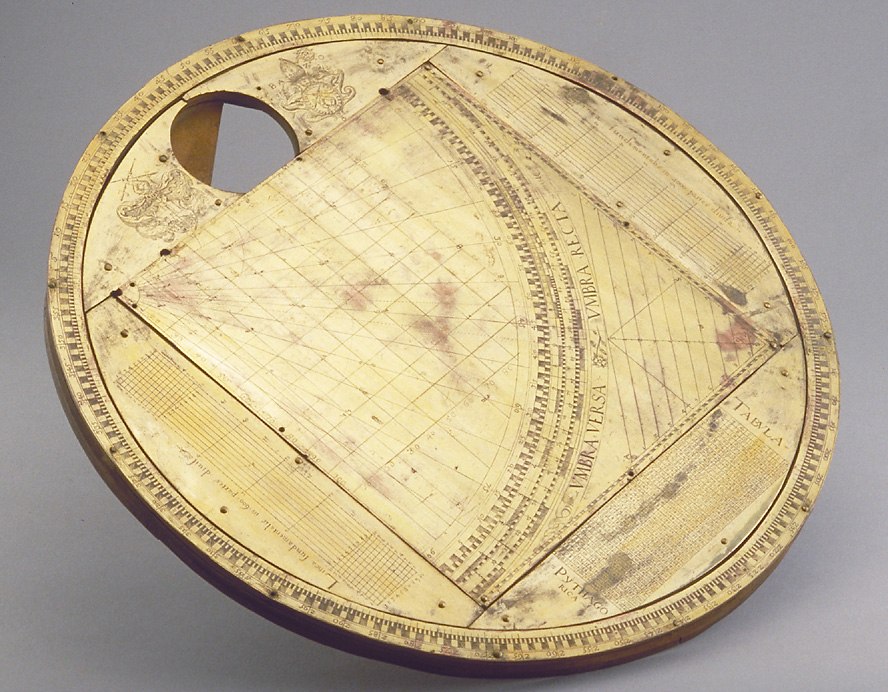
This quadrant, held by the British Museum, consists of a wooden base to which several copper plates are nailed. It measures 390 mm in diameter. The rim features a scale of degrees numbered from 5 to 360, with 45 degrees positioned at the top where a compass compartment is located; however, the compass itself is missing. The surface is adorned with four copper plates featuring intricate scales, a multiplication table labeled 'TABVLA PYTHAGORICA', and two coats-of-arms. A central square copper plate is riveted to the instrument, engraved with a quadrant, 'VMBRA RECTA', and 'VMBRA VERSA' scales decorated with floral scrolls. Underneath this central plate, an ink inscription dated 1759 records the name of Ildephonsus Mahler. It is unclear if the 1759 date applies to the entire instrument or merely a replacement or later addition.

The quadrant featuring the central square plate, engraved scales, and the compass compartment at the top.
The quadrant featuring the central square plate, engraved scales, and the compass compartment at the top. — British Museum, London. Rights pending — permission not yet requested. Original source

Catalogue identity

Source
www.mhs.ox.ac.uk
Category
Tool · German quadrant
Maker / attribution
Not established
Reference
Not recorded
Catalogue / lot identifier
MLA 1897, 1-12.1
Source-reported date
Mid 16th century ?
Source-reported place
Germany

Source-reported attribution and specifications are not independent authentication. A listing does not establish present ownership, current display, availability or permission to reproduce.

Object description

Construction and Materials

The instrument is constructed using a base made of wood, covered by copper plates which are nailed into position. It measures 390 mm in diameter. The outer rim is engraved with a degree scale, which is subdivided and numbered from 5 to 360, with the 45-degree mark situated at the top adjacent to a compartment intended for a compass, which is currently missing. A steel square is used to secure the round part of the instrument to its wooden base.

The surface of the quadrant is layered with four copper plates containing various mathematical and observational tools. These include linear unit scales, a multiplication table identified as 'TABVLA PYTHAGORICA', and two engraved coats-of-arms, one of which displays a mitre and crozier alongside the initials 'B A Z O'. A central square copper plate is riveted to the center of the wood base.

Evidence for this section
  • “Wood and gilt copper; 390 mm in diameter”
  • “The compass is made of copper plates nailed to a wood base.”
  • “A steel square fixes the round part to the base of the instrument.”
  • “The top one has a compartment for the compass, now missing, and on the sides are two coats-of-arms, one of which is surmounted by a mitre and crozier, with the initials 'B A Z O'.”

Scales and Engravings

The central plate, which is riveted to the base, is engraved with a variety of mathematical scales arranged in a quadrant configuration. The borders contain a degree scale numbered from 0 to 100. The limb of the quadrant features the inscriptions 'VMBRA VERSA' and 'VMBRA RECTA', accompanied by floral scroll decorations. Moving toward the center, there are several non-linear and equal scales, along with radial lines engraved at 7.5-degree intervals.

Specific markings include dotted lines corresponding to 42 and 48 degrees on the limb. The outer edge of the square plate contains a series of diagonal lines and specific alphabetical markings at the corners. Additionally, the outer copper plates provide specific linear unit scales with varying divisions, allowing for precise mathematical operations as intended by the quadrant's design.

Evidence for this section
  • “The limb of the quadrant is inscribed 'VMBRA VERSA' and 'VMBRA RECTA' decorated with floral scrolls.”
  • “In the centre of the instrument is riveted a square copper plate, engraved in the manner of a quadrant.”
  • “The inner side of the quadrant is engraved with a square and numbered radial lines, every 71/2 degrees and numbered from 15 to 90 by 15.”
  • “The letters 'A', 'B', 'C', 'T', 'D' and 'S' are engraved on the corners.”

Inscription and Provenance

An ink inscription is located underneath the central copper plate. It identifies Ildephonsus Mahler, a Benedictine monk, and includes the date 1759, alongside reference to an individual named Dominico Beck. Because this date is considered late for the instrument's construction, it is suggested that the central wooden part may be a replacement or that the inscription was added to the device at a later time.

The instrument was purchased in 1897 and is now part of the collection of the British Museum in London. It is documented in the publication 'A Catalogue of European Scientific Instruments in the Department of Medieval and Later Antiquities of the British Museum' by F. A. B. Ward, serving as record number 286.

Evidence for this section
  • “Underneath the central square plate is an inscription in ink, with the name of Ildephonsus Mahler of the Benedictine order and the date 1759.”
  • “It is unlikely that 1759 is the date of the whole instrument, so it has been suggested that this central wooden part is a replacement.”
  • “The instrument was purchased in 1897 and is described in F. A. B. Ward, A Catalogue of European Scientific Instruments in the Department of Medieval and Later Antiquities of the British Museum”

Open research questions

  • What is the significance of the coats-of-arms initials 'B A Z O' in relation to the original ownership of the instrument?
  • Could further technical analysis of the wooden base confirm whether it is original to the 16th-century copper plates or a later 1759 replacement?

Source evidence

Recorded claims and source quotations for Quadrant
FieldSource-reported valueSource quotation
Inventory numberMLA 1897, 1-12.1“MLA 1897, 1-12.1”
Diameter390 mm“390 mm in diameter”
MaterialWood and gilt copper“Wood and gilt copper”
Attributed dateMid 16th century“Mid 16th century ?”
Inscribed nameIldephonsus Mahler“Ildephonsus Mahler”
OriginGerman“German”

Visible details

  • The instrument features a rim engraved with a scale of degrees.
  • A central square plate is riveted to the wood base and decorated with various scales and floral scrolls.
  • Two coats-of-arms are engraved on the plates, one including a mitre and crozier.
  • Multiple linear and degree scales are present across the surface, including diagonal lines.

Research qualifications

  • The 1759 ink inscription underneath the central plate may represent a later addition rather than the original date of the instrument.
  • The compass component is confirmed as missing.

Photograph identity and source facts were screened before import; rights clearance remains pending.

Consulted source

Quadrant

Reviewed 2026-10-26 · Record 1487f83288