
Skip to content
The Encyclopedia of Horology

Tool · German quadrant

Gilt Copper Quadrant

Partially verified

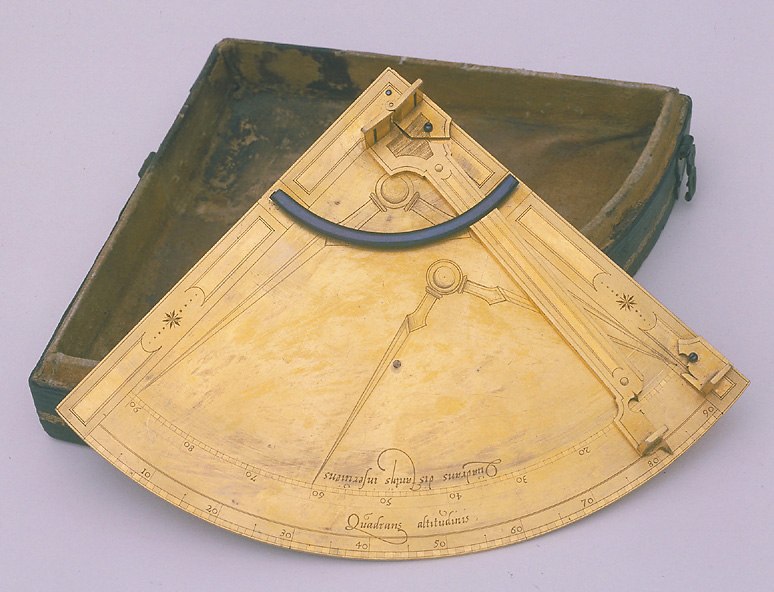
This gilt copper quadrant, measuring 150 mm in radius, is attributed to the maker Josua Habermel. The instrument is designed for the measurement of heights and distances, featuring a limb with dual scales. The outer scale, titled 'Quadrans altitudinis', and the inner scale, 'Quadrans distantijs inseruiens', are both graduated from 0 to 90. The device utilizes an alidade pivoted at the apex, equipped with slit and half-solid sights, which align with corresponding fixed sights on the instrument's edge. A steel spring mechanism on the reverse, working with a curved arc, secures the alidade in place during observation. The reverse also contains a calendar table for determining the date of Easter, referencing the 1582 Gregorian calendar reform. The quadrant is housed in a shaped wooden case, which is lined with leather, although the top cover of the box is missing.

Gilt copper quadrant with pivoted alidade and sighting system.
Gilt copper quadrant with pivoted alidade and sighting system. — Istituto e Museo di Storia della Scienza, Firenze. Rights pending — permission not yet requested. Original source

Catalogue identity

Source
www.mhs.ox.ac.uk
Category
Tool · German quadrant
Maker / attribution
Josua Habermel
Reference
Not recorded
Catalogue / lot identifier
2518
Source-reported date
After 1582
Source-reported place
Germany

Source-reported attribution and specifications are not independent authentication. A listing does not establish present ownership, current display, availability or permission to reproduce.

Object description

Measurement and Sight Systems

The instrument features a primary limb divided into two distinct functional scales. The outer scale, labeled 'Quadrans altitudinis', and the inner scale, designated 'Quadrans distantijs inseruiens', both span 0 to 90 degrees. These scales utilize divisions of 10, with subdivisions at 5 and 1, incorporating alternate hatching for readability.

The use of the instrument varies by scale, with the inner quadrant intended for use with the user's eye positioned at the apex, while the outer scale is operated with the eye placed at the limb. A central alidade, pivoted at the apex, is fitted with slit and half-solid sights designed to coordinate with two corresponding fixed sights positioned along the edge of the quadrant.

Evidence for this section
  • “('Quadrans altitudinis') 0 to 90, divided to 10, subdivided to 5 and to 1 with alternate hatching”
  • “The inner quadrant is used with the eye at the apex of the quadrant, the outer with the eye on the limb”

Construction and Mechanical Features

The device is constructed from gilt copper with a radius of 150 mm. A specific mechanical feature is the steel spring assembly attached to the reverse of the quadrant. This mechanism interacts with a quadrant-shaped arc positioned on top, which serves to restrain the alidade and maintain its position during specific measurements.

The instrument includes an accessory for storage in the form of a shaped wooden box. This container is lined with leather. However, the assembly is incomplete as the top cover of the box is absent from the existing set.

Evidence for this section
  • “A steel spring is attached to the reverse of the quadrant so that a quadrant arc on top restrains the alidade and holds it at its reading.”
  • “Shaped wooden box, covered and lined with leather, top missing.”

Attribution and Calendar Function

The reverse of the quadrant bears a comprehensive calendar table designed for calculating the date of Easter. The presence of the inscription referring to the calendar reform provides the terminus post quem for the object's manufacture, confirming it was created after 1582.

Although the instrument does not bear a formal signature, it is attributed to Josua Habermel. This attribution is based on the technical quality of the engravings, the manufacturing techniques observed, and the overall accuracy of the instrument.

Evidence for this section
  • “On the back is a table for calculating the date of Easter, with the inscription 'iuxta Kalendarii reformationem”
  • “The instrument is unsigned, but the manner in which it is made, the types of engravings and its accuracy allow it to be attributed to Josua Habermel”

Open research questions

  • What is the specific provenance of this instrument before its entry into the Istituto e Museo di Storia della Scienza?
  • Are there other unsigned quadrants by Habermel that share these specific engraving patterns?

Source evidence

Recorded claims and source quotations for Gilt Copper Quadrant
FieldSource-reported valueSource quotation
MakerJosua Habermel“Attributed to Josua Habermel”
DateAfter 1582“After 1582”
MaterialGilt copper“Gilt copper”
Inventory Number2518“Inventory number: 2518”
Dimensions150 mm radius“150 mm in radius”
Calendar InscriptionTabula generalis ad inueniendu diem paschatis et intercallum Iuxts Kalendarii reformatione“A calendar scale on the reverse is marked: 'Tabula generalis ad inueniendu diem paschatis et intercallum Iuxts Kalendarii reformatione'”

Visible details

  • Dual circular scales marked 0-90 on the limb
  • Pivoted alidade with fixed and movable sights
  • Steel spring mechanism mounted on the reverse
  • Leather-lined wooden storage case

Research qualifications

  • The instrument is unsigned and attribution is based on stylistic analysis
  • The original wooden lid for the case is missing

Photograph identity and source facts were screened before import; rights clearance remains pending.

Consulted source

Quadrant

Reviewed 2026-10-26 · Record d8dad43536

Terms in this record

Glossary explanations for terms named in this object’s record.