
Skip to content
The Encyclopedia of Horology

Tool · German quadrant

Quadrant by Christian Heiden

Partially verified

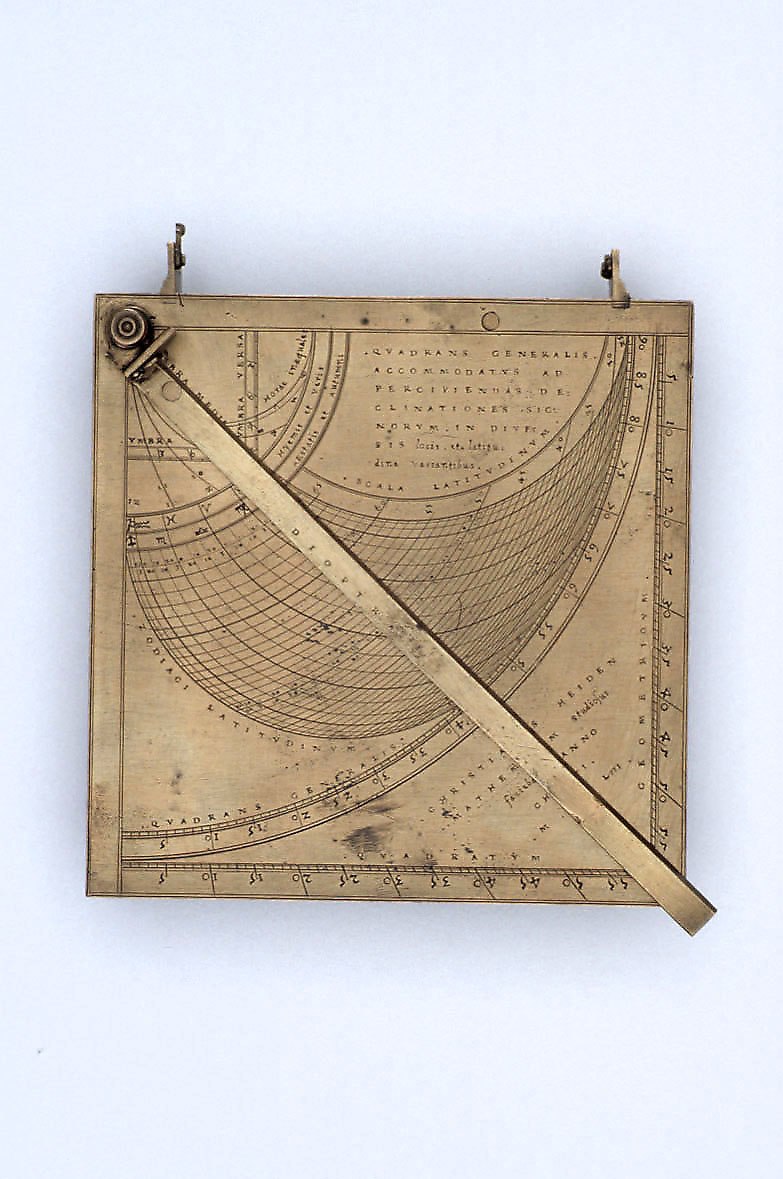
This brass quadrant, measuring 102 mm in radius, is constructed in a square form. It is signed by Christian Heiden and dated 1553. The instrument features a movable rule pivoted at the apex and sights positioned on one straight edge. The front face includes a shadow square, unequal hour lines, a graduation for a general quadrant, and a grid designed for determining solar declination and latitude. The reverse side bears a Regiomontanus-type dial, a table of zodiacal signs, and a catalogue of latitudes for 37 German towns. The device is extensively inscribed with Latin annotations regarding its mathematical and astronomical functions, including zodiacal symbols and geographical directions. Finely engraved foliate decoration ornaments the reverse. The physical configuration departs from the conventional quarter-circle shape commonly associated with quadrant instruments of the period.

Front view of the brass quadrant showing the rule, scales, and grids.
Front view of the brass quadrant showing the rule, scales, and grids. — Museum of the History of Science, Oxford. Rights pending — permission not yet requested. Original source

Catalogue identity

Source
www.mhs.ox.ac.uk
Category
Tool · German quadrant
Maker / attribution
Christian Heiden
Reference
38947
Catalogue / lot identifier
38947
Source-reported date
1553
Source-reported place
Germany

Source-reported attribution and specifications are not independent authentication. A listing does not establish present ownership, current display, availability or permission to reproduce.

Object description

Design and Configuration

The quadrant is fabricated from brass with a radius of 102 mm. Unlike standard quadrants that follow a circular arc, this object adopts a square geometry. It is equipped with two sights on one straight edge and a movable rule that pivots from the apex.

The rule itself serves sighting purposes and bears specific inscriptions, including 'DIOPTRA' and 'LINEA FIDUCIAE'. Every edge of the square is marked with a cardinal direction, including 'MEDIVM COELI' and 'LATVS BOREVM', facilitating orientation for astronomical use.

Evidence for this section
  • “The quadrant has the form of a square instead of a quarter of a circle.”
  • “On one of the edges are two sights which can be both closed and every edge has engraved a direction, '? MEDIVM COELI ?', '? LATVS BOREVM ?', '? MEDIVM NOCTIS ?', '? LATVS AVSTRALE ?'.”

Astronomical Scales and Functions

The face contains complex grid layouts and scales. These include a shadow square, unequal hour lines, and a 'QVADRANS GENERALIS' graduated from 0 to 90. Zodiacal symbols are integrated into the declination diagram to assist in sun observation.

The reverse side functions as a Regiomontanus-type dial. It contains additional scales and a table of common hours, divided into periods before and after midday, along with a list detailing the latitudes of 37 German cities.

Evidence for this section
  • “On the back is a Regiomontanus-type dial and a table of latitudes , and finely engraved foliage decoration.”
  • “On the right-hand side and at the bottom of the quadrant is a list of latitudes for 37 German towns, indicated 'CATALOGVS LATITVDINES CELEBERRIMARVM VRBIVM SVPERIORIS Germaniae'.”

Signature and Identification

The object is identified by a signature on the face near the edge opposite the apex. The inscription identifies the maker as Christian Heiden and records the date of manufacture as 1553, attributing the work to him in his capacity as a 'mathematicum studiosus'.

The inventory number 38947 is assigned by the Museum of the History of Science, Oxford. The instrument is documented as being produced in Germany during the mid-16th century.

Evidence for this section
  • “next to the opposite edge to the apex is the signature 'CHRISTIANVS HEIDEN MATHEMATVM studiosus faciebat ANNO CHRISTI ? M ? D ? LIII ?'.”

Open research questions

  • What is the historical accuracy of the listed latitudes for the 37 German towns compared to modern geographic data?
  • To what extent did the 'square' quadrant design influence subsequent instrument makers in the 16th century?

Source evidence

Recorded claims and source quotations for Quadrant by Christian Heiden
FieldSource-reported valueSource quotation
MakerChristian Heiden“Signed by Christian Heiden”
Date1553“Dated 1553”
CountryGerman“German”
Radius102 mm“102 mm in radius”
Inventory number38947“Inventory number: 38947”
SignatureCHRISTIANVS HEIDEN MATHEMATVM studiosus faciebat ANNO CHRISTI M D LIII“CHRISTIANVS HEIDEN MATHEMATVM studiosus faciebat ANNO CHRISTI ? M ? D ? LIII ?”

Visible details

  • Movable sighting rule pivoted at the apex
  • Extensive Latin inscriptions and scales throughout
  • Foliate decoration on the reverse face

Research qualifications

  • The exact mathematical precision of the historical latitude data is unverified
  • The functional performance of the instrument remains untested

Photograph identity and source facts were screened before import; rights clearance remains pending.

Consulted source

Quadrant

Reviewed 2026-10-26 · Record 9527ef9dc3

Terms in this record

Glossary explanations for terms named in this object’s record.