
Skip to content
The Encyclopedia of Horology

Tool · German quadrant

Medieval Quadrans Vetus

Partially verified

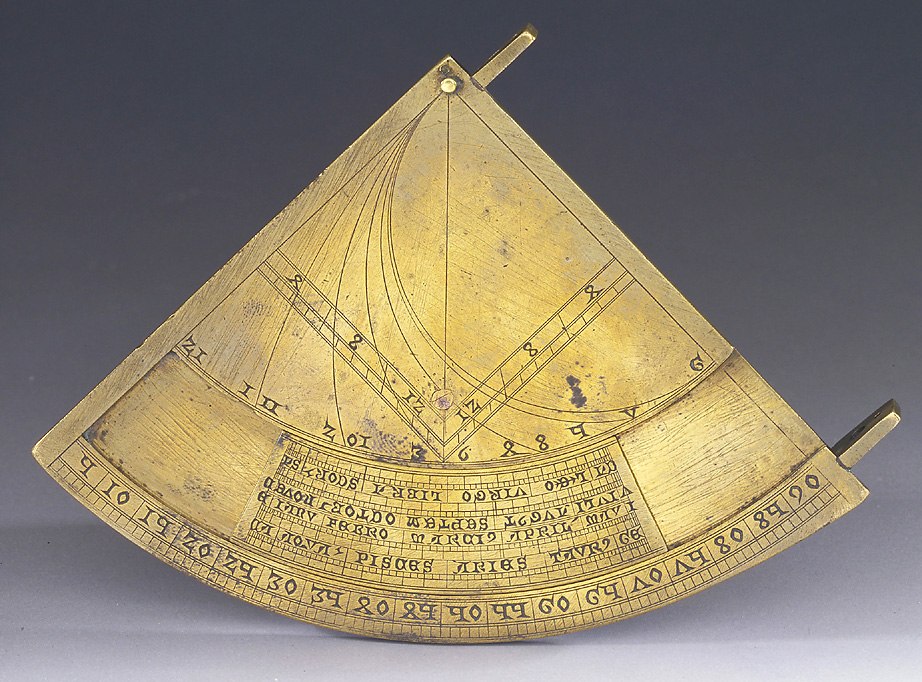
The instrument is designed for measuring heights, distances, and depths, and functions as a universal sundial. The face features a 90-degree scale on the limb, a recessed slot with a mobile zodiac cursor, and a twelve-part shadow square overlaid with unequal hour lines. On the reverse, the instrument displays a circular zodiacal calendar enclosing a lunar scale, originally designed for use with a missing volvelle. Two sighting pinnules are located on the straight edge. The inscriptions are rendered in a gothic script with distinct Latin contractions and decorative calligraphic features.

The face of the brass quadrant, showing the shadow square, unequal hour lines, and the cursor with zodiacal calendar.
The face of the brass quadrant, showing the shadow square, unequal hour lines, and the cursor with zodiacal calendar. — Istituto e Museo di Storia della Scienza, Firenze. Rights pending — permission not yet requested. Original source

Catalogue identity

Source
www.mhs.ox.ac.uk
Category
Tool · German quadrant
Maker / attribution
Not established
Reference
Not recorded
Catalogue / lot identifier
662
Source-reported date
14th century
Source-reported place
Germany

Source-reported attribution and specifications are not independent authentication. A listing does not establish present ownership, current display, availability or permission to reproduce.

Object description

Construction and Layout

The instrument is a brass quadrant with a radius of 102 mm. The limb is engraved with a 90-degree scale, divided into single degrees and grouped into fives. The face includes a recessed slot where a sliding cursor, engraved with zodiacal scales, is housed. Positioned at the apex of the quadrant is a twelve-part shadow square, which is superimposed with arcs indicating the unequal hours. These hours are numbered in two series: a descending series reading in the direction of the limb and an ascending series reading toward the apex.

On the reverse side of the object, there is a circular zodiacal calendar. This area also contains a scale of 28, identified as a lunar scale intended for use with a volvelle that is no longer present. The pivot point for this missing component remains visible in the central blank space. Two sighting pinnules, which exhibit scrolled lower portions, are fixed to the straight edge of the quadrant to facilitate observation.

Evidence for this section
  • “The limb of the instrument is engraved with a 90 degree scale reading to single degrees grouped and numbered by fives.”
  • “Above this in the apex of the instrument is a twelve part shadow square numbered 4, 8, 12 on each side over which are scribed the arcs for the unequal hours”

Inscriptions and Calligraphy

The instrument features detailed Latin inscriptions rendered in a well-executed gothic script. Many of the month names appear in heavily contracted forms, such as 'MARCI<US>' for March and 'FEBRO' or 'FEBROA' for February. The maker employed specific calligraphic flourishes to fill the space within the divisions. Notable features include the letter 'E' in 'LEO' being pierced by an arrow, and the linking of the 'R' and 'A' in 'LIBRA' with a loop.

The zodiac signs are divided into two-degree increments, presented in unnumbered groups of six. Decorative flourishes are also applied to the final 'S' in 'PISCES' and 'ARIES'. The variation in word length and spacing suggests a deliberate effort by the maker to create a visually harmonious arrangement across the available space of the instrument's scales.

Evidence for this section
  • “The zodiac signs are divided to 2 degrees in unnumbered groups of six and named in Latin in a well executed gothic script with contraction marks.”
  • “Two particularities of the inscriptions are the conversion of the centre bar of the 'E' of 'LEO' into an arrow which transpierces the letter”
  • “In effect the maker has attempted to make the different length words fill equal amounts of space in the divisions so as to create an overall harmonious effect.”

Provenance and Comparative Context

This quadrant is identified as a member of a group of only three surviving medieval quadrants of this specific type. The other two instruments are located in the Museum of the History of Science in Oxford, dating to circa 1300, and the British Museum in London, dating to the 14th century. A comparison of the lettering across these three pieces indicates that the Florence instrument is distinct, with the London and Oxford examples appearing closer to one another in style.

The instrument is held at the Istituto e Museo di Storia della Scienza in Florence. A 16th-century drawing by Antonio da Sangallo the Younger is documented as showing a similar quadrant, currently preserved in the Uffizi Gallery. Additionally, the collection in Florence also contains a 16th-century dial of this same type.

Evidence for this section
  • “This instrument is one of a group of only three surviving medieval quadrants of this type”
  • “The lettering of the three pre-1500 quadrants appears to be distinct”
  • “A quadrant very similar to this one is documented in a drawing by Antonio da Sangallo the Younger”

Open research questions

  • What is the physical nature of the missing volvelle mechanism?
  • Do the distinct lettering styles indicate different geographical origins within the 14th-century German region?

Source evidence

Recorded claims and source quotations for Medieval Quadrans Vetus
FieldSource-reported valueSource quotation
Inventory Number662“Inventory number: 662”
MaterialBrass“Brass; 102 mm in radius”
Date14th century“14th century; German”
RegionGerman“14th century; German”
Radius102 mm“102 mm in radius”
FunctionUniversal sundial, measurement of heights, distances and depths“The instrument, designed to measure heights, distances and depths, could also be used as a universal sundial”

Visible details

  • Limb engraved with a 90-degree scale
  • Two sighting pinnules on the straight edge
  • Gothic script with specific Latin contractions
  • Recessed slot containing a mobile zodiac cursor

Research qualifications

  • Original volvelle missing from the reverse
  • Lower parts of sighting pinnules broken
  • Exact dating remains an approximation between late 13th and early 14th century

Photograph identity and source facts were screened before import; rights clearance remains pending.

Consulted source

Quadrant

Reviewed 2026-10-26 · Record b9d6ea6c1f

Terms in this record

Glossary explanations for terms named in this object’s record.