
Skip to content
The Encyclopedia of Horology

Clock · Bracket clock

Twin Fusee Carved Walnut Bracket Clock

Partially verified

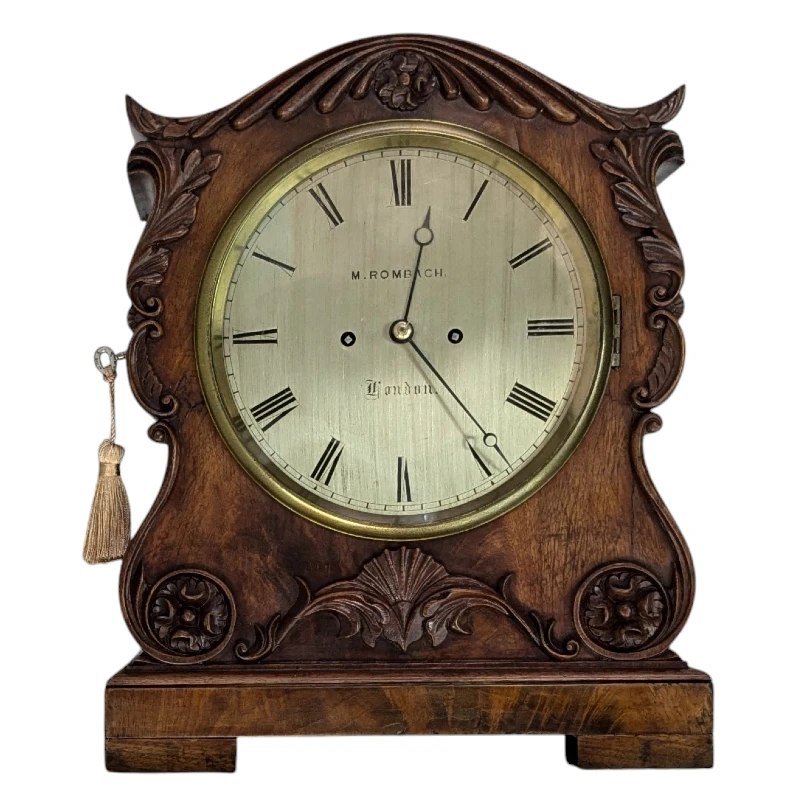
This twin fusee bracket clock is signed by M. Rombach of London and dated to circa 1820. The clock features a walnut case decorated with ornate foliate carvings and includes a locking mechanism for the front and rear doors. The internal mechanism is a substantial 8-day, 5-pillar, key-wound twin fusee movement, which utilizes an anchor deadbeat escapement. It is designed to strike the hours and half hours on a large gong. The dial is made of silvered brass and displays Roman numerals with moon-style hands. The clock stands 44cm high, 33cm wide, and 16cm deep, with a face diameter of 19cm. It is equipped with its original pendulum, a heavy brass bezel with its original glass, and brass fretwork on the rear door, which is backed with red velvet.

Front view of the twin fusee bracket clock showing the dial, hands, and carved walnut case.
Front view of the twin fusee bracket clock showing the dial, hands, and carved walnut case. — W J Morris Clocks. Rights pending — permission not yet requested. Original source

Catalogue identity

Source
wjmorrisclocks.co.uk
Category
Clock · Bracket clock
Maker / attribution
M. Rombach
Reference
Not recorded
Catalogue / lot identifier
Source URL identifies the listing
Source-reported date
circa 1820
Source-reported place
London

Source-reported attribution and specifications are not independent authentication. A listing does not establish present ownership, current display, availability or permission to reproduce.

Object description

Case Construction and Aesthetics

The clock is housed in a walnut case characterized by ornate foliate carvings throughout the exterior. The design includes a heavy brass bezel enclosing the silvered brass dial and its original glass. Security is provided by a locking mechanism on both the front and rear doors, with the original key included.

To the rear, the case features brass fretwork, which is backed by a red velvet lining. The overall dimensions of the clock are 44cm in height, 33cm in width, and 16cm in depth, with the circular face measuring 19cm in diameter.

Evidence for this section
  • “Walnut case with ornate foliate carvings”
  • “lock to front & rear door with original key”
  • “heavy brass bezel with original glass”
  • “brass fretwork to rear door with a red velvet covering.”

Movement and Dial

The timekeeping is powered by a substantial 8-day, 5-pillar, key-wound twin fusee movement. This mechanism incorporates an anchor deadbeat escapement and an original pendulum. The clock is engineered to strike on a large gong, marking both the hours and the half-hour intervals.

The silvered brass dial is marked with Roman numerals and equipped with moon-style hands.

Evidence for this section
  • “Substantial 8 day key wound 5 pillar twin fusee movement, anchor deadbeat escapement.”
  • “Striking a large gong to the hours & half hours.”
  • “Silvered brass dial, roman numerals, moon hands.”

Condition and Attribution

The auction description attributes the clock to M. Rombach of London, with a suggested date of circa 1820. The listing notes that the clock retains its original pendulum and glass, providing further context to its preservation status.

As with historical horological items, physical viewing is recommended by the seller to verify the current state of the mechanism and wood finish, particularly given the age of the piece.

Evidence for this section
  • “Twin Fusee Walnut Striking Bracket Clock by M Rombach of London, circa 1820.”
  • “Original pendulum.”

Open research questions

  • What is the specific history of M. Rombach as a clockmaker in London during the early 19th century?
  • Does the serial number or maker's mark on the movement align with documented work by Rombach of this period?

Source evidence

Recorded claims and source quotations for Twin Fusee Carved Walnut Bracket Clock
FieldSource-reported valueSource quotation
MakerM. Rombach of London“M Rombach of London”
Datingcirca 1820“circa 1820”
Movement8 day, 5 pillar, twin fusee“Substantial 8 day key wound 5 pillar twin fusee movement”
EscapementAnchor deadbeat“anchor deadbeat escapement”
Dimensions44cm x 33cm x 16cm“Height 44cm Width 33cm Depth 16cm”
DialSilvered brass“Silvered brass dial”
StrikingHours and half hours“Striking a large gong to the hours & half hours.”

Visible details

  • Silvered brass dial with Roman numerals
  • Carved walnut case with foliate details
  • Front door fitted with a brass bezel and glass
  • Rear door featuring brass fretwork with velvet lining

Research qualifications

  • The exact provenance history prior to the current listing is not documented.
  • The extent of restoration or replacement parts within the 5-pillar movement is not specified beyond the pendulum.

Photograph identity and source facts were screened before import; rights clearance remains pending.

Consulted source

Twin Fusee Carved Walnut bracket clock

Reviewed 2026-11-02 · Record f2f6ca4fd0

Terms in this record

Glossary explanations for terms named in this object’s record.