
Skip to content
The Encyclopedia of Horology

Pocket watch · Minute repeating pocket watch

Swiss Minute-Repeating Pocket Watch

Partially verified

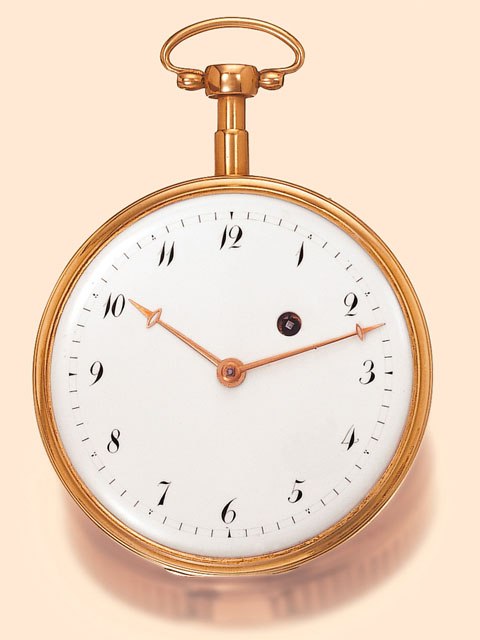
This unsigned Swiss pocket watch dates to circa 1810 and is a minute-repeating instrument. It features a four-body case in the Empire style, distinguished by a fluted band and a polished back. The movement is housed in a 53 mm frame and is constructed with a frosted gilt full plate featuring cylindrical pillars, powered by a fusee and chain. The escapement is of the virgule type, paired with a brass balance and flat balance spring. The repeating mechanism operates on the Le Roy system, activated by depressing the pendant, and incorporates an unusual surprise mechanism to manage the minute striking. The white enamel dial displays Breguet-style numerals, an outer minute track, and a winding aperture located between the 1 and 2 o'clock positions. The watch is fitted with gold 'double crescent' hands. The overall diameter of the timepiece is 60 mm.

Front view of the unsigned Swiss minute-repeating pocket watch showing the white enamel dial, Breguet numerals, winding aperture, and gold double crescent hands.
Front view of the unsigned Swiss minute-repeating pocket watch showing the white enamel dial, Breguet numerals, winding aperture, and gold double crescent hands. — Antiquorum. Rights pending — permission not yet requested. Original source

Catalogue identity

Source
catalog.antiquorum.swiss
Category
Pocket watch · Minute repeating pocket watch
Maker / attribution
Not established
Reference
Not recorded
Catalogue / lot identifier
181
Source-reported date
circa 1810
Source-reported place
Switzerland

Source-reported attribution and specifications are not independent authentication. A listing does not establish present ownership, current display, availability or permission to reproduce.

Object description

Case and Dial Construction

The watch is encased in a four-body construction described as Empire style. It features a fluted band around the case circumference and a polished back. A hinged gilt cuvette is attached to a plate that is mounted directly to the movement.

The dial is composed of white enamel and displays Breguet numerals. An outer minute division track is present. The watch features a winding aperture positioned between the 1 and 2 o'clock markers, accompanied by gold hands in a double crescent design.

Evidence for this section
  • “C. Four-body, "Empire", fluted band, polished back, hinged gilt cuvette fixed to a plate mounted on the movement.”
  • “D. White enamel, Breguet numerals, outer minute divisions, winding aperture between 1 and 2. Gold "double crescent" hands.”

Movement and Escapement

The movement measures 53 mm and is a frosted gilt full plate configuration with cylindrical pillars. Power is provided via a fusee and chain. The timekeeping is regulated by a virgule escapement, a brass balance, and a flat balance spring.

The repeating function is activated by depressing the pendant and strikes on gongs. The system is based on the Le Roy mechanism, notable for its use of an unusual surprise mechanism rather than a fixed star wheel, which was the conventional later standard.

Evidence for this section
  • “M. 53 mm. (23'''), frosted gilt full plate with cylindrical pillars, fusee and chain, virgule escapement, brass balance with flat balance spring”
  • “the repeating mechanism based on the Le Roy system with unusual surprise mechanism, rpeating on gongs by depressing the pendant.”

Repeating Technical Function

The watch utilizes an early minute-repeating mechanism. Unlike later designs using fixed stars to manage the hour-repeating change, this piece employs a movable star wheel. The minute cam is mounted on a 60-tooth ratchet wheel, which is controlled by a jump spring.

This wheel turns loosely on the canon pinion for approximately 10 degrees. The jump spring induces a 3-degree jump every minute, which facilitates the rapid change of the repeating mode at the 60th minute.

Evidence for this section
  • “A rare example of an early minute-repeating mechanism still based on the movable star wheel.”
  • “the minute cam was mounted on a 60-tooth ratchet wheel controlled by a jump pring.”
  • “The jump spring makes the wheel jump about 3 degrees every minute and consequently does the same on the 60th minute, rapidlychanging the mode from striking 14 to none.”

Open research questions

  • What is the identity of the maker who employed the Le Roy repeating system with a 60-tooth ratchet wheel mechanism during this period?
  • Are there extant examples of similar minute-repeaters from this period that corroborate the use of this specific jump-spring movement configuration?

Source evidence

Recorded claims and source quotations for Swiss Minute-Repeating Pocket Watch
FieldSource-reported valueSource quotation
MakerUnsigned“Unsigned, Swiss, circa 1810.”
CaseFour-body, Empire, fluted band“C. Four-body, "Empire", fluted band, polished back”
DialWhite enamel, Breguet numerals“D. White enamel, Breguet numerals, outer minute divisions, winding aperture between 1 and 2.”
Movement53 mm, frosted gilt full plate“M. 53 mm. (23'''), frosted gilt full plate with cylindrical pillars, fusee and chain, virgule escapement”
Repeating MechanismLe Roy system“the repeating mechanism based on the Le Roy system with unusual surprise mechanism”
Diameter60 mm“Diam. 60 mm.”

Visible details

  • White enamel dial with Breguet numerals
  • Winding aperture between 1 and 2 o'clock
  • Gold double crescent hands
  • Four-body Empire case with fluted band

Research qualifications

  • The watch is unsigned
  • Condition reports suggest an overhaul is recommended

Photograph identity and source facts were screened before import; rights clearance remains pending.

Terms in this record

Glossary explanations for terms named in this object’s record.