
Skip to content
The Encyclopedia of Horology

Clock · Lantern clock

Silver Lantern Alarm Clock by David Bouquet

Partially verified

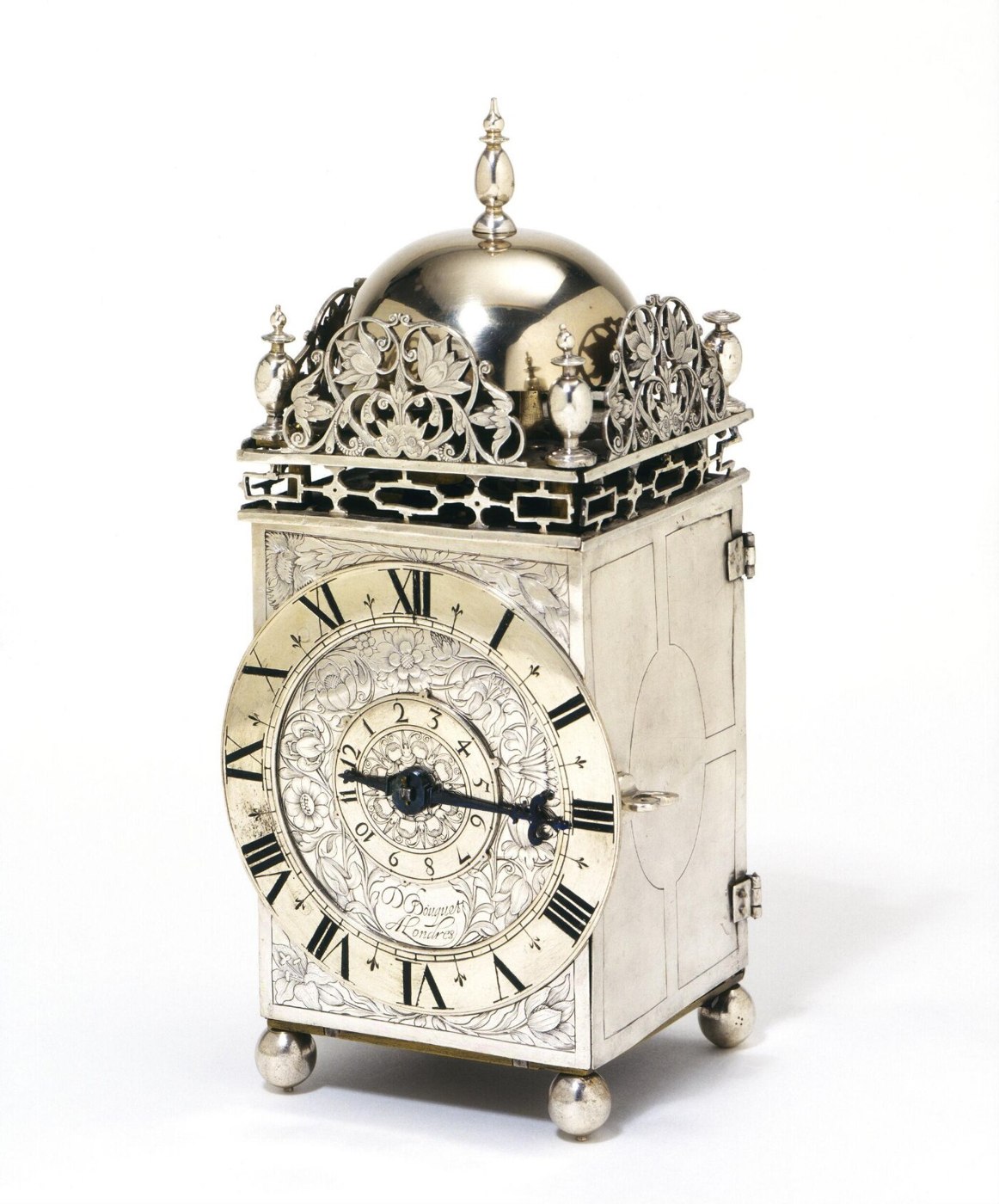
This lantern alarm clock was made in London circa 1650 by the clockmaker David Bouquet, a French immigrant and founding member of the Clockmakers' Company. Measuring 20.1 cm in height, the clock is distinct for its use of silver in the construction of the case, including the dial plate, chapter ring, alarm disc, side doors, and pierced gallery. This construction distinguishes it as the only known lantern clock with a silver case, suggesting it was produced as a special commission for a wealthy patron. The clock stands on four ball feet and features intricate engravings of floral motifs, including pinks, tulips, and lilies on the front. The design incorporates an openwork gallery topped with pierced crestings and corner vases. The movement is weight-driven, in accordance with the standard design for lantern clocks of this period. The gong and finial are recorded as later restorations.

Lantern alarm clock in silver by David Bouquet, London, circa 1650.
Lantern alarm clock in silver by David Bouquet, London, circa 1650. — Victoria and Albert Museum, London. Rights pending — permission not yet requested. Original source

Catalogue identity

Source
collections.vam.ac.uk
Category
Clock · Lantern clock
Maker / attribution
David Bouquet
Reference
M.1139:1-1926
Catalogue / lot identifier
M.1139:1-1926
Source-reported date
ca. 1650
Source-reported place
London

Source-reported attribution and specifications are not independent authentication. A listing does not establish present ownership, current display, availability or permission to reproduce.

Object description

Case and Dial

The front plate is decorated with detailed floral engravings depicting pinks, tulips, and lilies. The design features a dial ring with black numerals, surrounding an integrated alarm disc.

The upper portion of the case includes an openwork gallery, which supports pierced floral crestings and decorative vases situated at the corners. The clock is supported by four ball feet. The construction utilizes silver for the dial plate, chapter ring, alarm disc, and side doors, confirming its status as a singular example of its type.

Evidence for this section
  • “This is the only known lantern clock with a silver case.”
  • “The dial plate, chapter ring, alarm disc, side doors and pierced silver gallery are all of silver.”
  • “the front engraved with pinks, tulips, lilies and other flowers; above, an openwork gallery surmounted by pierced floral crestings with vases at the corners; dial ring with black numerals.”

Movement and Maker

The timepiece was produced by David Bouquet, a French immigrant who arrived in London and became a founding member of the Clockmakers' Company in 1632. His professional standing is indicated by his previous entry into the Blacksmiths' Company in 1628.

The clock operates on a weight-driven mechanism, consistent with the construction of lantern clocks during that period.

Evidence for this section
  • “David Bouquet was a French immigrant who was admitted to the Blacksmiths' Company in 1628. He joined the Clockmakers' Company as a founder member in 1632.”
  • “These clocks were always driven by weights.”

Condition and Attribution

The auction description and museum records report that the object has undergone modifications during its history. Specifically, the gong and the finial currently attached to the case are considered later restorations rather than original components from circa 1650.

The piece is documented by the Victoria and Albert Museum under the accession number M.1139:1-1926 and was acquired from the firm of Eckert & Blake in East Sheen.

Evidence for this section
  • “the gong and finial are later restorations”
  • “Purchased from Henry Eckert of Eckert & Blake, 206 Upper Richmond Road, East Sheen.”

Open research questions

  • What are the technical specifications of the original silver movement if any parts differ from standard brass lantern clock internal layouts?
  • Can the specific wealthy patron who commissioned the silver case be identified through additional archival research?

Source evidence

Recorded claims and source quotations for Silver Lantern Alarm Clock by David Bouquet
FieldSource-reported valueSource quotation
MakerDavid Bouquet“Maker: Bouquet, David (maker)”
Accession numberM.1139:1-1926“Accession number: M.1139:1-1926”
Dateca. 1650“Date: ca. 1650”
Place of originLondon“Place of origin: London (made)”
MaterialsSilver with later restorations“Engraved silver; the gong and finial are later restorations”
Dimensions20.1 cm x 9.4 cm x 8.6 cm“Height: 20.1 cm; Width: 9.4 cm; Depth: 8.6 cm”
SignatureD Bouquet A Londres“Inscribed: 'D Bouquet A Londres'”

Visible details

  • Front plate is engraved with floral motifs including lilies and tulips
  • Movement components are visible through the open side door
  • The dial features an inner alarm disc with numeral markings
  • Case stands on four spherical ball feet

Research qualifications

  • The gong is reported as a later restoration
  • The finial is reported as a later restoration

Photograph identity and source facts were screened before import; rights clearance remains pending.

Consulted source

Lantern clock

Reviewed 2026-10-26 · Record 9f6d0ac084

Terms in this record

Glossary explanations for terms named in this object’s record.