
Skip to content
The Encyclopedia of Horology

Tool · Italian scaphe dial

Scaphe Dial by Stefano Buonsignori

Partially verified

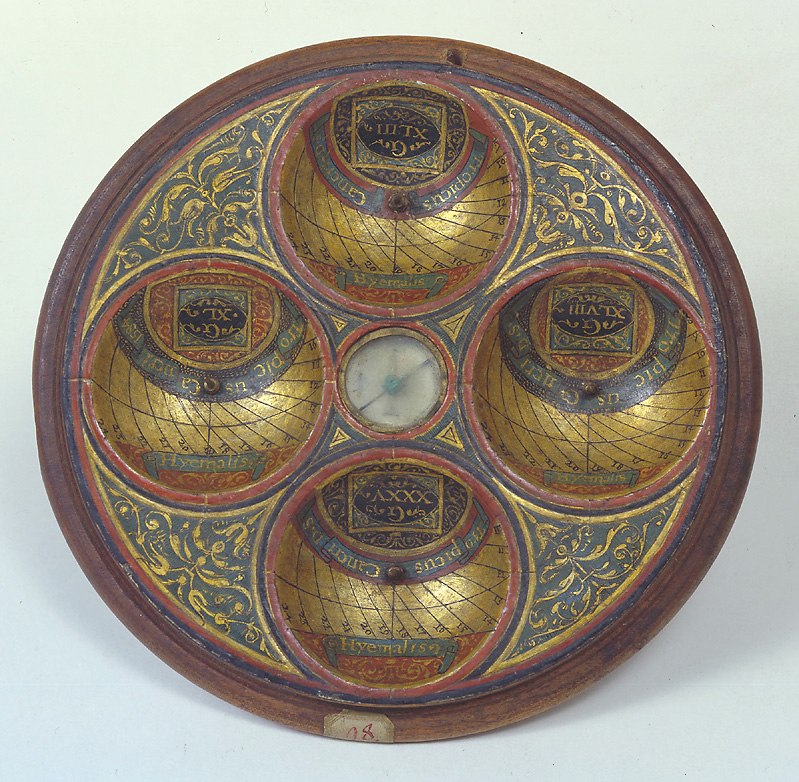
This scaphe dial is a wooden instrument measuring 130 mm in diameter, crafted in Florence by Stefano Buonsignori, cosmographer to Francesco I de' Medici. The object consists of a circular turned wooden box featuring a removable lid. Inside, the lower portion holds four hollowed-out scaphe dials, each equipped with a brass pin-gnomon. A central inset compass with a straight bar needle facilitates correct orientation for timekeeping. Each of the four dials features an hour diagram drawn in black on a gold ground, with latitude markings for 35, 40, 43, and 48 degrees. The instrument is elaborately painted, gilded, and decorated with foliate patterns on an ultramarine ground. Latin inscriptions denoting the tropics, 'Tropicus Cancri' and 'Hyemalis' (winter/Capricorn), are present within the dial cavities. The instrument is signed with the initials 'D.S.' and dated 1584.

View of the interior of the scaphe dial, showing four hemispherical dial cavities, central compass, and decorative gold-leaf foliate work.
View of the interior of the scaphe dial, showing four hemispherical dial cavities, central compass, and decorative gold-leaf foliate work. — Istituto e Museo di Storia della Scienza, Firenze. Rights pending — permission not yet requested. Original source

Catalogue identity

Source
www.mhs.ox.ac.uk
Category
Tool · Italian scaphe dial
Maker / attribution
Stefano Buonsignori
Reference
2485
Catalogue / lot identifier
2485
Source-reported date
1584
Source-reported place
Italy

Source-reported attribution and specifications are not independent authentication. A listing does not establish present ownership, current display, availability or permission to reproduce.

Object description

Construction and Layout

The instrument is a circular turned wooden box with a removable lid. The base houses four hemispherical cavities, each acting as a scaphe dial. These cavities are equipped with conical brass pin-gnomons that serve as the hour-casting elements. At the center of the configuration is an inset compass featuring a straight bar needle, used to align the instrument to correctly read time via the drawn hour lines.

The interior of the box displays extensive ornamentation. The dials feature black hour lines set against a gold-gilt background. Below the hour diagram, the tropic of Cancer is indicated in Latin script. Each dial indicates a different latitude, ranging from 35 to 48 degrees.

Evidence for this section
  • “Circular turned wooden box with removable lid.”
  • “Each dial has the hour diagram drawn in black on a gold ground”
  • “The latitudes of the four dials are, reading clockwise from the top 35?, 40?, 43?, 48?”

Decoration and Signatures

The object is heavily embellished with painted and gilded surfaces. The areas surrounding the dial cavities are decorated with formal, symmetrical leaf patterns rendered in gold on an ultramarine ground. Within the cavities, the tropic of Capricorn is represented by the word 'Hyemalis', inscribed in gold upon a blue-green scroll over a red background, itself decorated with gold foliage.

The instrument bears a signature and date. It is signed three times with the initials 'D.S.', located at the end of the scroll designated for the tropic of Cancer. The date, 1584, is found in the same position within the fourth scroll.

Evidence for this section
  • “all available free surfaces are filled with symmetrical formal leaf decoration in gold on an ultramarine ground.”
  • “The dial is signed three times with the initials 'D.S.' at the end of the scroll marked 'Tropicus Cancri'. In the same position in the fourth scroll is the date.”

Lid and Provenance

The lid of the wooden box is painted light blue on its underside. It features ten concentric bands, which may suggest that the lid was originally intended to carry additional astronomical or time-related scales, though this remains an interpretation. The object is currently held by the Istituto e Museo di Storia della Scienza in Florence.

The dial was crafted by Stefano Buonsignori, who served as cosmographer to Francesco I de' Medici. The instrument is documented as inventory number 2485.

Evidence for this section
  • “The lid is painted light blue on the inside and may originally have been intended to carry scales as it is divided into ten concentric bands.”
  • “the work of Stefano Buonsignori , cosmographer to Francesco I de' Medici.”

Open research questions

  • What specific scales or data were intended for the ten concentric bands inside the lid?
  • What is the full meaning of the triple signature 'D.S.' beyond the initials of the maker?

Source evidence

Recorded claims and source quotations for Scaphe Dial by Stefano Buonsignori
FieldSource-reported valueSource quotation
MakerStefano Buonsignori“Signed by Stefano Buonsignori”
Date1584“Dated 1584; Florence”
MaterialsWood, brass, paint, gilding“Wood; 130 mm in diameter”
Inventory number2485“Inventory number: 2485”
Latitude settings35, 40, 43, and 48 degrees“The latitudes of the four dials are, reading clockwise from the top 35?, 40?, 43?, 48?”
Compass typeStraight bar needle“has a central inset compass with straight bar needle”

Visible details

  • Four individual scaphe dials are arranged symmetrically around a central compass.
  • The interior surfaces are decorated with formal gold foliate patterns on an ultramarine ground.
  • Brass pin-gnomons are installed at the center of each hemispherical cavity.
  • Latitude values for the four dials are inscribed in gold within dark blue ovals.

Research qualifications

  • The original function of the lid's internal ten concentric bands remains speculative.
  • The significance of the three-time signature 'D.S.' is noted but not fully explained in the source.

Photograph identity and source facts were screened before import; rights clearance remains pending.

Consulted source

Scaphe Dial

Reviewed 2026-10-26 · Record 9db5513091

Terms in this record

Glossary explanations for terms named in this object’s record.