
Skip to content
The Encyclopedia of Horology

Tool · Italian scaphe dial

Brass Scaphe Dial

Partially verified

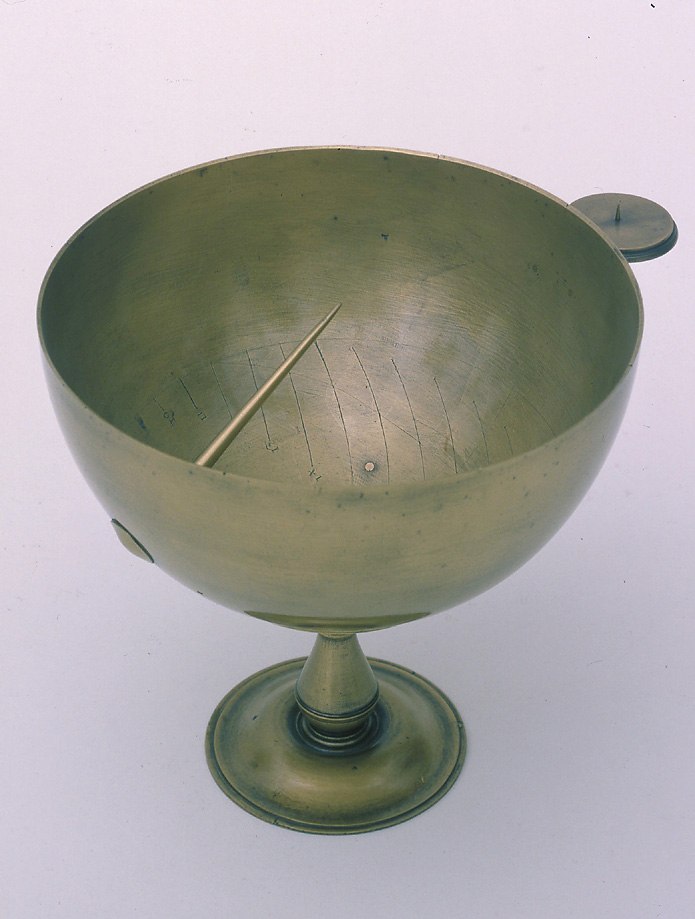
This 16th-century Italian scaphe dial is constructed from brass and measures 175 mm in diameter. The object features a hemispherical bowl mounted on a turned foot with a short, conical central column. The interior surface of the bowl is engraved with a sequence of undivided hour lines, designed to register Italian hours from 9 to 23, intersected by meridian and equinoctial lines. A pointed gnomon is fixed at the base of the meridian. Externally, the bowl includes a support structure for a compass, which is currently absent, leaving only a pivot and a partial declination line. The dial is accompanied by a turned, stepped cover that features applied relief oakleaf clusters. It is currently held within the collection of the Istituto e Museo di Storia della Scienza in Florence.

A brass scaphe dial of hemispherical form, featuring an internal gnomon and hour markings, supported by a turned foot.
A brass scaphe dial of hemispherical form, featuring an internal gnomon and hour markings, supported by a turned foot. — Istituto e Museo di Storia della Scienza, Firenze. Rights pending — permission not yet requested. Original source

Catalogue identity

Source
www.mhs.ox.ac.uk
Category
Tool · Italian scaphe dial
Maker / attribution
Not established
Reference
Not recorded
Catalogue / lot identifier
241
Source-reported date
16th century
Source-reported place
Italy

Source-reported attribution and specifications are not independent authentication. A listing does not establish present ownership, current display, availability or permission to reproduce.

Object description

Physical Configuration and Dialing

The instrument is a scaphe dial, consisting of a brass hemispherical bowl elevated on a turned foot with a conical column. The internal surface serves as the recording plane for the sundial, featuring engraved lines that denote Italian hours ranging from 9 to 23. These lines are traversed by meridian and equinoctial markings.

A pointed gnomon is positioned at the base of the meridian within the cup, casting a shadow onto the engraved bowl wall to indicate time. The exterior rim houses a bracket, originally intended to orient the device using a compass, though this component is no longer present.

Evidence for this section
  • “Hemispherical bowl mounted on a turned foot with a single, short conical column.”
  • “The interior of the bowl is engraved with a series of undivided hour lines for Italian hours reading from 9 to 23 and traversed by the meridian and the equinoctial line.”
  • “The pointed gnomon is rigidly set at the foot of the meridian”

Cover and Construction

The dial includes a turned and stepped cover, which serves as a protective or decorative element for the bowl. This lid features an applied central relief design consisting of an oakleaf cluster. This cluster is constructed from three distinct elements applied to both sides of the lid.

The use of brass as the primary material is consistent with historical instrument manufacture in 16th-century Italy.

Evidence for this section
  • “The turned and stepped cover has a central, independently applied relief oakleaf cluster design composed of three separate elements on both sides.”

Provenance and Documentation

The object has been linked to the Medici collections, with its earliest recorded mention appearing in the 1574 inventory of the possessions of Granduca Cosimo I. Subsequent inventory entries from 1595 and 1578-61 further confirm the presence of the dial within the Medici holdings.

These archival references describe a 'scodella d'ottone' (brass bowl) fitted with a lid and a compass, which corresponds to the physical characteristics of the current object. It is currently catalogued under inventory number 241 by the Istituto e Museo di Storia della Scienza.

Evidence for this section
  • “This dial was present in the Medici collections from 1574.”
  • “'Scodella d'ottone con un coperchio dentrovi un oriuolo da Sole in sua busta di cuoio nera' (Guard. Med. N. 87 Inv. Delle robe del Granduca Cosimo I, 1574: car. 337)”

Open research questions

  • What is the identity of the original compass mechanism that was housed in the fleur-de-lis bracket?
  • Can the specific workshop responsible for the 16th-century Medici instruments be identified through further archival research?

Source evidence

Recorded claims and source quotations for Brass Scaphe Dial
FieldSource-reported valueSource quotation
Diameter175 mm“175 mm in diameter”
OriginItalian“Italian”
Inventory Number241“Inventory number: 241”
Missing componentCompass“intended to house a compass which is now missing”
Hour scaleItalian hours 9 to 23“engraved with a series of undivided hour lines for Italian hours reading from 9 to 23”

Visible details

  • Hemispherical bowl on a turned pedestal base
  • Engraved interior markings for Italian hours
  • External bracket on the rim for a missing compass
  • Projecting conical gnomon within the bowl

Research qualifications

  • Compass component is missing
  • Uncertainty regarding the precise maker as the instrument is unsigned

Photograph identity and source facts were screened before import; rights clearance remains pending.

Consulted source

Scaphe Dial

Reviewed 2026-10-26 · Record 5854fcfb6a

Terms in this record

Glossary explanations for terms named in this object’s record.