
Skip to content
The Encyclopedia of Horology

Tool · Italian scaphe dial

Scaphe Dial by Girolamo della Volpaia

Partially verified

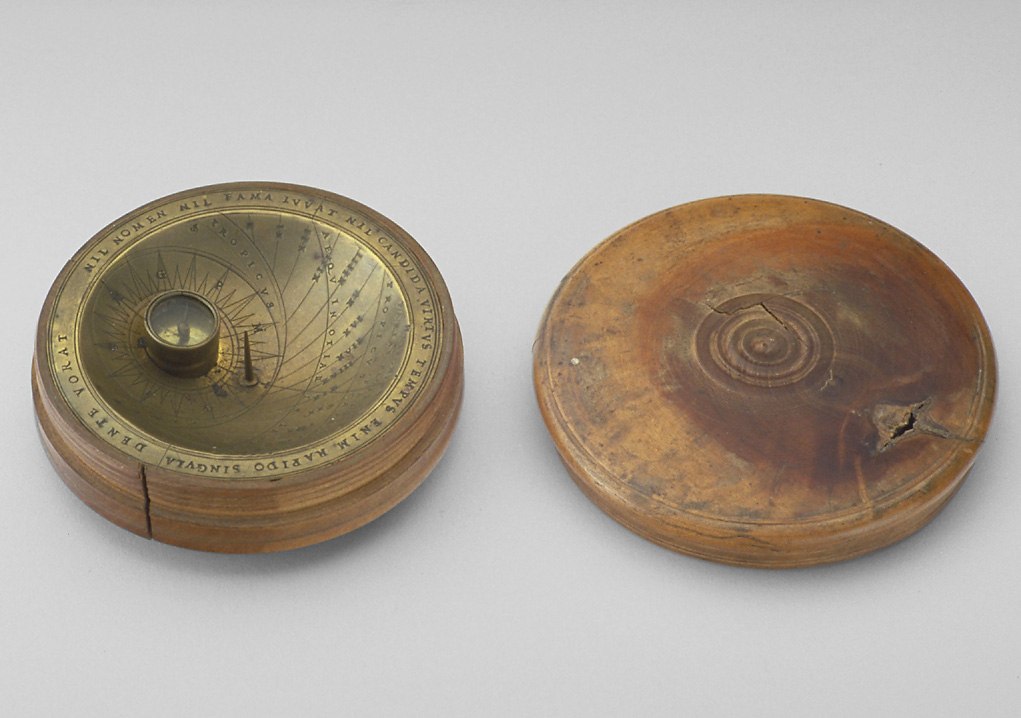
This scaphe dial, measuring 80 mm in diameter, is a portable timekeeping instrument constructed from brass and housed within a turned wooden case. Created by Girolamo della Volpaia in Florence in 1588, the device features a hemispherical interior dial surface engraved with astronomical and temporal markings. These include Italian hours ranging from X to XXIIII, as well as inscribed lines for the tropics, identified as 'TROPICVS CAPRI CORNI' and 'TROPICVS CANCRI', and the 'AEQVINOCTIALIS LINEA'. A brass gnomon is positioned at the top of the scaphe. The dial border carries a Latin inscription reflecting on the passage of time. The instrument also integrates a compass with a wind rose at the base of the bowl, containing initials corresponding to eight wind directions.

The scaphe dial shown in its wooden case with the lid removed, revealing the interior brass bowl, gnomon, and compass.
The scaphe dial shown in its wooden case with the lid removed, revealing the interior brass bowl, gnomon, and compass. — Museum of the History of Science, Oxford. Rights pending — permission not yet requested. Original source

Catalogue identity

Source
www.mhs.ox.ac.uk
Category
Tool · Italian scaphe dial
Maker / attribution
Girolamo della Volpaia
Reference
Not recorded
Catalogue / lot identifier
49
Source-reported date
1588
Source-reported place
Italy

Source-reported attribution and specifications are not independent authentication. A listing does not establish present ownership, current display, availability or permission to reproduce.

Object description

Construction and Dial Design

The scaphe dial is manufactured from brass and presented within a turned wooden container. The dial's hemispherical surface serves as a projection for time measurement, featuring a series of complex engravings. These include lines denoting the tropical boundaries of the sun's annual path, specifically the Tropic of Capricorn and the Tropic of Cancer, alongside the equinoctial line.

The temporal markings engraved on the interior are specifically configured to indicate Italian hours. The numbering is observed from X through XXIIII. A brass gnomon stands at the top of the bowl to cast a shadow across these markings. The outer rim is engraved with a continuous Latin text, which serves as a memento mori concerning the destructive nature of time.

Evidence for this section
  • “The scaphe dial is made in brass and is kept in a turned wooden case.”
  • “The dial indicates Italian hours numbered from X to XXIIII.”
  • “The tropics (indicated 'TROPICVS CAPRI {C} ORNI' and 'TROPICVS CANCRI') and the equinoctial line (indicated 'AEQVINOCTIALIS LINEA') are engraved.”

Signatures and Compass Integration

Located at the upper portion of the scaphe is the signature of the maker, documented as HIERONIMVS VVL PARIAE FLORENTINVS. This placement is central to the dial's layout, identifying the craftsman and his origin in Florence. The signature is accompanied by the date 1588.

A compass is set into the bottom of the bowl, intended for the proper orientation of the instrument. This compass features a wind rose with eight cardinal and intercardinal points. The initials used include 'T' for Tramontana, 'G' for Garbino, 'L' for Levante, 'S' for Sirocho, 'G' for Greco, 'P' for Ponente, and 'M' for Maestro, with an additional unidentified 'M' initial.

Evidence for this section
  • “At the top of the scaphe is the signature 'HIERONIMVS VVL PARIAE FLORENTINVS ? F A ? 1588 ?'”
  • “at the bottom is a small compass with a wind rose.”

Provenance and Historical Context

The object is preserved in the Museum of the History of Science, Oxford, under inventory number 49. It is catalogued as part of the Epact collection of scientific instruments of medieval and Renaissance Europe.

The Latin inscription 'NIL NOMEN NIL FAMA IVVAT NIL CANDIDA VIRTVS TEMPVS ENIM RAPIDO SINGVLA DENTE VORAT' provides thematic context to the object, referencing the classical view of time as a power that consumes all worldly achievements. This stylistic choice aligns with academic traditions of the late sixteenth century.

Evidence for this section
  • “Inventory number 49”
  • “This dial bears on the border the inscription 'NIL NOMEN NIL FAMA IVVAT NIL CANDIDA VIRTVS TEMPVS ENIM RAPIDO SINGVLA DENTE VORAT' referring to the rapid passing of time”

Open research questions

  • Are there other extant scaphe dials by Girolamo della Volpaia that share this specific compass configuration?
  • What is the precise identification of the mystery 'M' initial found on the wind rose compass?

Source evidence

Recorded claims and source quotations for Scaphe Dial by Girolamo della Volpaia
FieldSource-reported valueSource quotation
MakerGirolamo della Volpaia“Signed by Girolamo della Volpaia”
Date1588“Dated 1588”
LocationFlorence“Florence”
MaterialsWood and brass“Wood and brass”
Diameter80 mm“80 mm in diameter”
Inventory Number49“Inventory number: 49”

Visible details

  • Hemispherical brass dial interior with engraved markings
  • Turned wooden case with separate circular lid
  • Compass integrated into the base of the scaphe
  • Latin inscription encircling the dial rim

Research qualifications

  • The exact meaning of the 'M' initial on the wind rose is not explicitly clarified in the source
  • The question mark in the signature transcription suggests potential wear or uncertainty in reading the original engraving

Photograph identity and source facts were screened before import; rights clearance remains pending.

Consulted source

Scaphe Dial

Reviewed 2026-10-26 · Record a6da58f241

Terms in this record

Glossary explanations for terms named in this object’s record.