
Skip to content
The Encyclopedia of Horology

Tool · Italian scaphe dial

Scaphe Dial by Alexander Ravillius

Partially verified

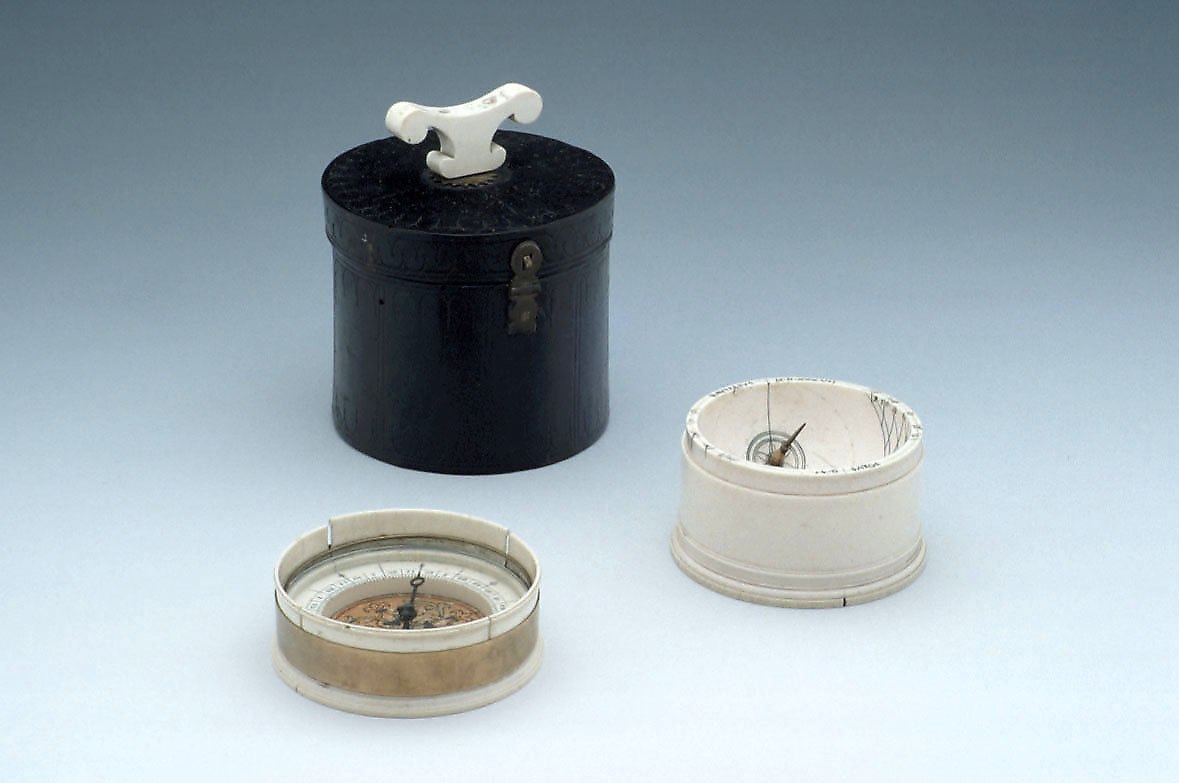
This scaphe dial is a 16th-century horological instrument crafted from ivory, measuring 90 mm in diameter. Attributed to the maker Alexander Ravillius, the instrument dates to 1537. It consists of a turned ivory box designed to house two distinct components for timekeeping and surveying. The lid contains a magnetic compass featuring a scale of degrees and Mediterranean wind initials, set against painted and gilt foliate decoration. Sights cut into the ivory rim allow for use as a surveyor's cross. The base of the instrument contains a hemispherical scaphe sundial with a central pin-gnomon mounted in brass. This dial utilizes Italian hours, with the hour lines numbered 9 to 23. A small, glazed magnetic compass is integrated into the bottom of the hemisphere. The instrument is further inscribed with its latitude of 45 degrees and includes decorative engravings reflecting the sun's path through the zodiac.

The scaphe dial showing the lid with compass, the base with sundial, and the outer case.
The scaphe dial showing the lid with compass, the base with sundial, and the outer case. — Museum of the History of Science, Oxford. Rights pending — permission not yet requested. Original source

Catalogue identity

Source
www.mhs.ox.ac.uk
Category
Tool · Italian scaphe dial
Maker / attribution
Alexander Ravillius
Reference
Not recorded
Catalogue / lot identifier
36708
Source-reported date
1538
Source-reported place
Italy

Source-reported attribution and specifications are not independent authentication. A listing does not establish present ownership, current display, availability or permission to reproduce.

Object description

Construction and Design

The instrument is constructed as a turned ivory box, measuring 90 mm in diameter. Its primary function is dual-purpose, serving both as a timepiece and a surveying tool. The design incorporates two primary sections: the lid and the base. The base contains a hemispherical, concave dial surface, while the lid serves to protect the instrument and provide additional functionality.

The interior of the base is engraved with hour lines numbered 9 to 23, with the line for the 24th hour positioned on the rim. The layout includes lines representing the sun's path between the tropics, marked with zodiac symbols on the rim. A meridian line extends from the interior into the rim, serving as a constant reference for the dial's orientation.

Evidence for this section
  • “In this instrument a turned ivory box opens to reveal two instruments, one for surveying, the other for telling the time.”
  • “There is a scaphe sundial in the base, where the hour lines are engraved on a hemispherical concave surface”
  • “The hour lines are numbered 9 to 23, the position of the line for 24 being on the rim, and they are crossed by seven lines for the sun's path between the tropics”

Integrated Surveying and Orientation Tools

The lid of the instrument functions as a magnetic compass and surveyor's tool. The compass needle is mounted above painted and gilt foliate decoration. The compass circle is divided into eight winds, marked with specific initials, and further subdivided into sections of five degrees. A glass cover is secured by a brass ring to protect the needle and scale.

Slit sights are cut into the ivory rim at the cardinal points, allowing the lid to function as a surveyor's cross. When paired with the compass, these allow the user to measure magnetic bearings. At the base of the hemispherical dial, a small, glazed magnetic compass provides an additional reference for orienting the sundial correctly.

Evidence for this section
  • “In the lid is a magnetic compass , with a scale of degrees marked with initials of the Mediterranean winds”
  • “Sights cut into the ivory rim allow the lid to be used as a surveyor's cross or for taking horizontal angles by the compass”
  • “The glazed magnetic compass at the bottom of the hemisphere is marked with the cardinal points 'O', 'P', 'M' and '[cross]'”

Signatures and Preservation

The instrument bears a signature and date on the rim, inscribed as 'RAVILLIVS M.D.XXXVIII'. This corresponds with the attribution of the dial to Alexander Ravillius. The rim also displays the latitude for which the dial was calculated, indicated as 'POLVS G.45'.

The ivory components have sustained physical wear over time. Specifically, the slit sights used for surveying have caused open cracks in the ivory rim. To stabilize the structure, a brass band has been applied around the rim. The current condition is documented by the Museum of the History of Science, which holds the object in its collection.

Evidence for this section
  • “The rim also carried a note of the latitude, 'POLVS G.45' and the signature and date, 'RAVILLIVS M.D.XXXVIII'.”
  • “Slit sights in the ivory rim at the cardinal points form a surveyor's cross, and can be used with the compass to measure magnetic bearings. They have caused open cracks at these points and the rim is now held together by a brass band.”

Open research questions

  • What is the significance of the discrepancy between the 1537 date in the museum metadata and the 1538 date engraved on the rim?
  • Was the brass band added as a contemporary reinforcement during the 16th century or during a later period of maintenance?

Source evidence

Recorded claims and source quotations for Scaphe Dial by Alexander Ravillius
FieldSource-reported valueSource quotation
MakerAlexander Ravillius“Signed by Alexander Ravillius”
Date1537“Dated 1537”
MaterialIvory“Ivory; 90 mm in diameter”
Latitude45 degrees“The dial has been projected for latitude 45 degrees”
Hours systemItalian hours“The system of hours used here is known as Italian hours , reckoned from zero at sunset to 24 at the following sunset.”
Inventory number36708“Inventory number 36708”

Visible details

  • Ivory housing shows structural cracks at the cardinal point sights.
  • Brass band reinforces the exterior rim of the lid.
  • Pin-gnomon is mounted in the center of a hemispherical concave surface.
  • Magnetic needle is situated above a gilt and painted floral pattern.

Research qualifications

  • There is a discrepancy in the date provided by the source: 'Dated 1537' appears in the header while the signature on the rim is transcribed as 'M.D.XXXVIII' (1538).
  • The function of the brass band as a contemporary or later repair is not explicitly stated.

Photograph identity and source facts were screened before import; rights clearance remains pending.

Consulted source

Scaphe Dial

Reviewed 2026-10-26 · Record 2fc9b12096

Terms in this record

Glossary explanations for terms named in this object’s record.