
Skip to content
The Encyclopedia of Horology

Tool · Italian scaphe dial

Scaphe Dial by Amelli

Partially verified

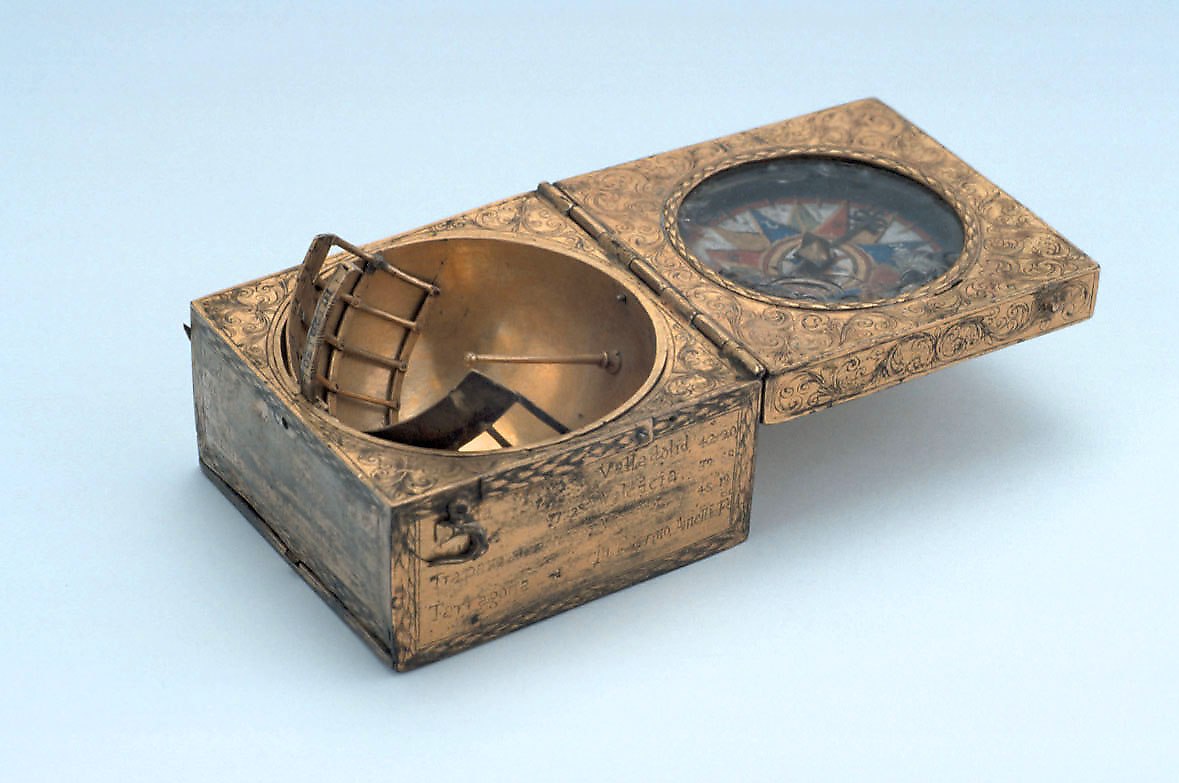
This scaphe dial, inventory number 34154, is a scientific instrument held by the Museum of the History of Science, Oxford. Attributed to the late 16th century, the piece is signed by the maker, Amelli, with the inscription 'In Palermo, Amelli Fecit'. The instrument is constructed from brass and measures 60 x 60 x 40 mm. It consists of a hemispherical dial contained within a box featuring decorative engravings of flowers, arabesques, and fleur-de-lis. The gnomon is fixed, while the hour grid is adjustable to accommodate different latitudes. An integral component is the compass located on the interior of the lid, featuring a painted pasteboard card displaying 16 directions in a multi-colored palette. The exterior of the box includes an engraved list of various Spanish and Italian towns accompanied by their respective geographic latitudes, facilitating the adjustment of the dial for the user's specific location.

A brass scaphe dial with the lid open, revealing a hemispherical dial with a fixed gnomon and an internal compass set into the lid.
A brass scaphe dial with the lid open, revealing a hemispherical dial with a fixed gnomon and an internal compass set into the lid. — Museum of the History of Science, Oxford. Rights pending — permission not yet requested. Original source

Catalogue identity

Source
www.mhs.ox.ac.uk
Category
Tool · Italian scaphe dial
Maker / attribution
Amelli
Reference
Not recorded
Catalogue / lot identifier
34154
Source-reported date
Late 16th century
Source-reported place
Italy

Source-reported attribution and specifications are not independent authentication. A listing does not establish present ownership, current display, availability or permission to reproduce.

Object description

Case and Exterior Features

The instrument is housed in a brass box measuring 60 x 60 x 40 mm. The exterior surfaces exhibit extensive decorative engraving, including floral patterns, arabesque designs, and fleur-de-lis motifs. The structural design incorporates a hinged lid that protects the hemispherical dial and the internal compass.

The sides of the box serve an instructional purpose, featuring engraved lists of various Italian and Spanish towns. These geographical labels are paired with specific latitude measurements, which allow the user to properly set the adjustable grid component when operating the dial.

Evidence for this section
  • “This scaphe dial is kept in a brass box, beautifully engraved with flowers, arabesques and fleur-de-lis.”
  • “The edges of the lower side of the box have engraved names of Spanish and Italian towns with their latitudes”

Dial and Timekeeping Mechanism

The dial functions as a scaphe instrument, utilizing a pin gnomon fixed at the center to cast a shadow within a hemispherical basin. The arrangement of the pin is aligned with the polar axis to track solar time. The system displays both common hours, numbered from 6 to 12 to 6, and Italian hours, which range from 12 to 24.

To adapt the instrument for use across different geographic regions, the hour grid within the basin is designed to be movable. By adjusting this grid relative to the fixed pin, the user can calibrate the dial according to the latitude of their current location as referenced in the case engravings.

Evidence for this section
  • “The actual dial, with the pin aligned with the polar axis, indicates common (from 6 to 12 to 6) and Italian hours (from 12 to 24).”
  • “The pin is fixed but the grid with the hours can be adjusted for different latitudes.”

Compass and Signatures

Located on the inner face of the box lid is a compass designed for orientation. The compass card is constructed from thin pasteboard and features a sixteen-point directional display. The card is decorated with a palette of red, blue, yellow, white, and green paint.

The instrument bears a clear signature attributed to the maker, Amelli. This identifying mark, alongside the location of manufacture, is positioned on the exterior of the box, reading 'In Palermo, Amelli Fecit'.

Evidence for this section
  • “On the inner face of the box lid is a compass, with a card painted on thin pasteboard in red, blue, yellow, white and green, with 16 directions.”
  • “the signature 'In Palermo, Amelli Fecit'.”

Open research questions

  • What is the specific methodology for adjusting the grid to account for the varying latitudes listed on the box?
  • Are there known surviving works by the maker Amelli in other institutional collections to verify the late 16th-century date?

Source evidence

Recorded claims and source quotations for Scaphe Dial by Amelli
FieldSource-reported valueSource quotation
MakerAmelli“Signed by Amelli”
Dimensions60 x 60 x 40 mm“60 x 60 x 40 mm”
MaterialBrass and pasteboard“Brass; 60 x 60 x 40 mm”
SignatureIn Palermo, Amelli Fecit“the signature 'In Palermo, Amelli Fecit'”
Compass compositionThin pasteboard“The compass card is made of thin pasteboard painted in red, blue, yellow, white and green.”
Latitude dataSpanish and Italian towns“The edges of the lower side of the box have engraved names of Spanish and Italian towns with their latitudes”
Inventory number34154“Inventory number 34154”

Visible details

  • External case surfaces are heavily decorated with engraved floral and geometric motifs
  • Compass card features a multi-pointed star pattern painted in red, yellow, blue, and green
  • Hemispherical interior contains a fixed pin gnomon and an adjustable hour grid
  • External edges of the brass case are inscribed with geographic locations and latitude values

Research qualifications

  • The dating to the late 16th century is an attribution provided by the source
  • Attribution to an Italian origin relies on the source description and signature location

Photograph identity and source facts were screened before import; rights clearance remains pending.

Consulted source

Scaphe Dial

Reviewed 2026-10-26 · Record aa2f35a3b5

Terms in this record

Glossary explanations for terms named in this object’s record.