
Skip to content
The Encyclopedia of Horology

Tool · Scientific instrument

Safavid brass and silver astrolabe

Partially verified

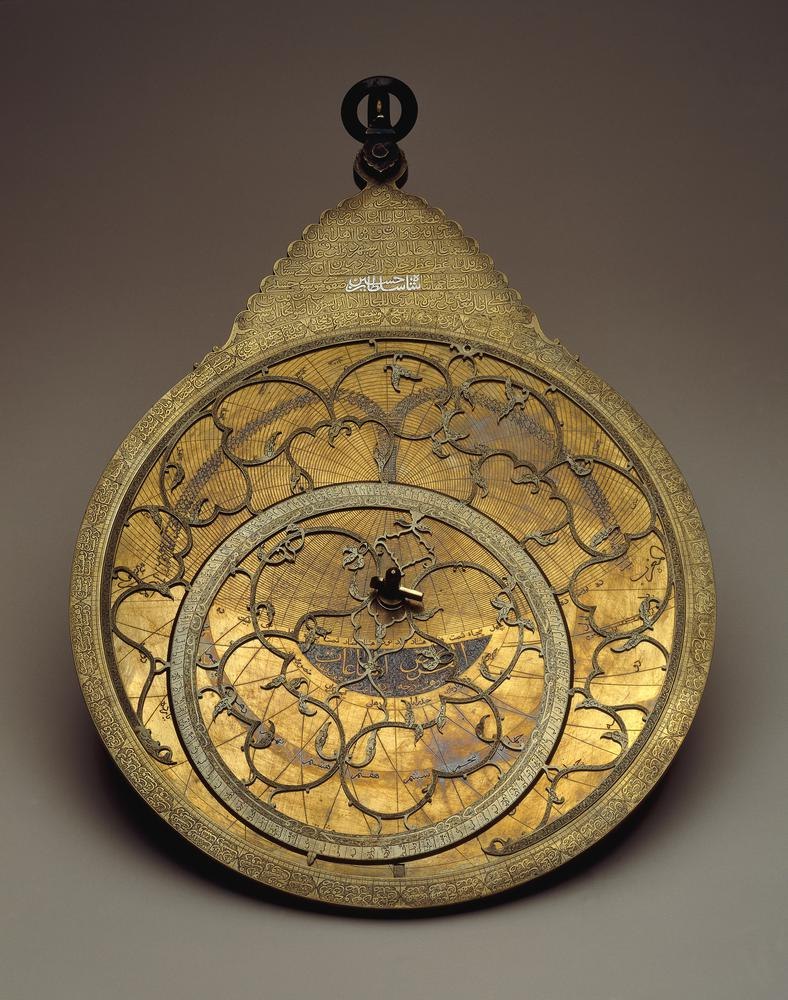
This large astrolabe from the Safavid dynasty is held in the British Museum collection. The source records that it was made of engraved copper alloy inlaid with silver by 'Abd 'Ali ibn Muhammad Rafi' al-Juzi and decorated by Muhammad Baqir in 1712 (Sha'ban 1124). The instrument incorporates a prominent triangular throne, seven latitude plates, and a mater inscribed with a gazetteer of 103 cities across the Islamic world, including Jerusalem, Damascus, Baghdad, Kabul, and Delhi. The openwork rete is fitted with pointers to sixty-three significant stars, secured at the center with a pin and wedge beneath a suspension shackle.

Front view of the Safavid astrolabe showing the rete, latitude plate, and throne
Front view of the Safavid astrolabe showing the rete, latitude plate, and throne — British Museum. Rights pending — permission not yet requested. Original source

Catalogue identity

Source
www.britishmuseum.org
Category
Tool · Scientific instrument
Maker / attribution
'Abd 'Ali ibn Muhammad Rafi' al-Juzi and Muhammad Baqir
Reference
OA+.369
Catalogue / lot identifier
Source URL identifies the listing
Source-reported date
1712
Country
Iran

Source-reported attribution and specifications are not independent authentication. A listing does not establish present ownership, current display, availability or permission to reproduce.

Object description

Construction and Materials

This Safavid-period instrument is composed of a copper alloy and silver, featuring engraving and inlay techniques. It includes seven latitude plates.

The astrolabe features a triangular throne engraved with script and a suspension shackle. The central axis is held by a pin and wedge mechanism.

Evidence for this section
  • “Astrolabe, made of brass, inlaid with silver, and engraved; with seven latitude plates.”
  • “High triangular throne intricately engraved with multi-line Arabic script and fitted with a dark suspension shackle and ring.”
  • “Central axis secured by a pin and wedge mechanism.”

Dial and Technical Features

The openwork rete features pointers for sixty-three stars. The mater contains an engraved gazetteer listing 103 cities, including Jerusalem, Damascus, Baghdad, Kabul, and Delhi.

The circular limb is graduated and has an engraved border. The curator's comments note that the scale and weight suggest the instrument was created for display purposes.

Evidence for this section
  • “The rete is marked with pointers to sixty-three important stars and the mater is inscribed with a gazetteer of 103 cities throughout the Islamic world, including Jerusalem, Damascus, Baghdad, Kabul and Delhi.”
  • “The massive size and weight of this instrument show that it was more for conspicuous ostentation than use.”

Production and Documentation

The instrument was made by 'Abd 'Ali ibn Muhammad Rafi' al-Juzi and decorated by Muhammad Baqir in Iran, dated to 1712 (Sha'ban 1124).

Source dimensions are 58.20 cm in height, 14 cm in width, and 3.40 cm in depth. The alidade, reverse, and internal plates are not visible in the current documentation.

Evidence for this section
  • “Made by: 'Abd 'Ali ibn Muhammad Rafi' al-Juzi Decorated by: Muhammad Baqir”
  • “Production date 1712 (Sha'ban 1124 (Sep-Oct 1712))”
  • “Height: 58.20 centimetres Width: 14 centimetres Depth: 3.40 centimetres”

Open research questions

  • Does the recorded 14 cm width correspond to a specific component or a transcription error given the 58.20 cm height?
  • What is the physical context for the discrepancy between the instrument's reported width and its classification as a circular astrolabe?

Source evidence

Recorded claims and source quotations for Safavid brass and silver astrolabe
FieldSource-reported valueSource quotation
Museum numberOA+.369“Museum number OA+.369”
Maker'Abd 'Ali ibn Muhammad Rafi' al-Juzi“Made by: 'Abd 'Ali ibn Muhammad Rafi' al-Juzi”
DecoratorMuhammad Baqir“Decorated by: Muhammad Baqir”
Production date1712 (Sha'ban 1124 (Sep-Oct 1712))“Production date 1712 (Sha'ban 1124 (Sep-Oct 1712))”
Production placeIran“Made in: Iran”
Materialscopper alloy, silver“Materials copper alloy silver”
Height58.20 centimetres“Height: 58.20 centimetres”
Associated NameShah Sultan Husayn“Named in inscription: Shah Sultan Husayn”
Museum numberOA+.369“Museum number OA+.369”

Visible details

  • High triangular throne intricately engraved with multi-line Arabic script and fitted with a dark suspension shackle and ring.
  • Openwork rete formed of interlacing scrolling tendrils functioning as star pointers above an engraved latitude plate.
  • Central axis secured by a pin and wedge mechanism.
  • Graduated circular limb surrounded by an engraved outer border.

Research qualifications

  • The reverse side, alidade, and interior plates are not visible in the provided photograph.
  • Source notes dimensions of 58.20 cm height and 14 cm width, which appears anomalous for a circular instrument of this proportion, but is reported directly from the record.

Photograph identity and source facts were screened before import; rights clearance remains pending.

Consulted source

astrolabe | British Museum

Reviewed 2026-10-25 · Record 163d058dc5

Terms in this record

Glossary explanations for terms named in this object’s record.