
Skip to content
The Encyclopedia of Horology

Pocket watch · Open-face pocket watch

S. Smith & Son Chronometer 170-20 Pocket Watch

Partially verified

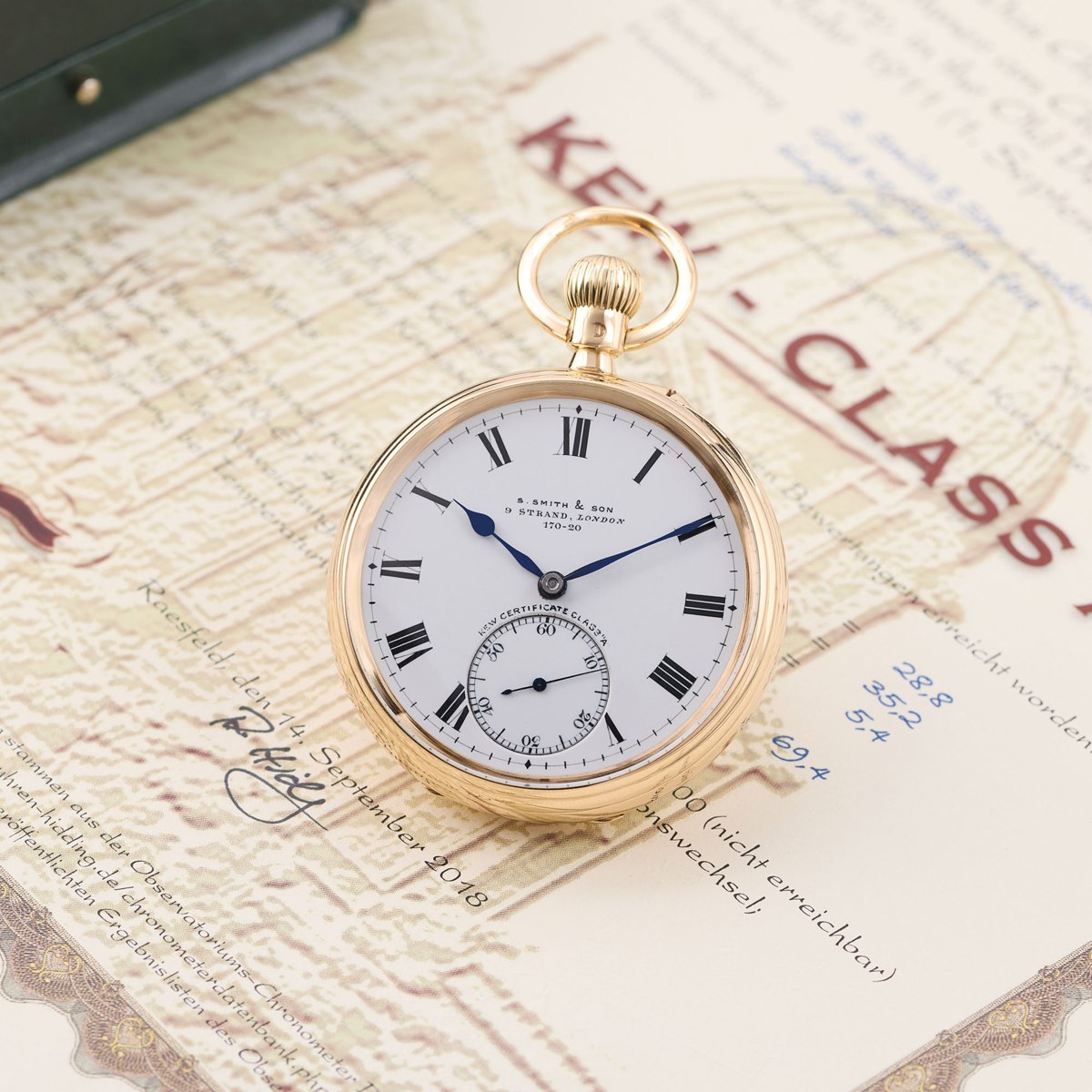
This is an open face pocket watch cased in 18K yellow gold by S. Smith & Son, dating to circa 1911. Measuring 50 mm in diameter, the keyless timepiece features a white enamel dial with black Roman numerals, blued steel hands, and a subsidiary seconds dial at 6 o'clock. Text on the dial notes its Kew Certificate Class 'A' status along with the maker's address at 9 Strand, London. According to catalog notes, it participated in the 1911 Kew Observatory chronometer trials and employs a single roller escapement with a going barrel winding system.

Front view of the S. Smith & Son 18K yellow gold open face pocket watch resting on archival documentation
Front view of the S. Smith & Son 18K yellow gold open face pocket watch resting on archival documentation — Antiquorum. Rights pending — permission not yet requested. Original source

Catalogue identity

Source
catalog.antiquorum.swiss
Category
Pocket watch · Open-face pocket watch
Maker / attribution
S. Smith & Son
Reference
Chronometer 170-20
Catalogue / lot identifier
24
Source-reported date
circa 1911
Source-reported place
United Kingdom
Source-reported serial
170-20

Source-reported attribution and specifications are not independent authentication. A listing does not establish present ownership, current display, availability or permission to reproduce.

Object description

Dial and Visual Presentation

The pocket watch displays a white enamel dial with black Roman hour numerals bordered by an outer minute track. Time is indicated by blued steel hands, with running seconds tracked on an inset subsidiary seconds dial positioned at 6 o'clock.

Dial text marks the piece's chronometric certification and maker identity. The upper dial features multi-line lettering reading 'S. SMITH & SON / 9 STRAND, LONDON / 170-20', while the lower half states 'KEW CERTIFICATE CLASS "A"'.

Evidence for this section
  • “White enamel dial with black Roman numerals and an outer minute track”
  • “Blued steel hands and subsidiary seconds dial at 6 o'clock”
  • “Dial inscription reads 'S. SMITH & SON / 9 STRAND, LONDON / 170-20' and 'KEW CERTIFICATE CLASS "A"'”

Case Construction and Signatures

The timepiece is an open-face, keyless design in polished 18K yellow gold, configured with a round pendant and bow at the 12 o'clock position. The auction catalog notes a diameter of 50 mm and an approximate weight of 108.8 grams.

The case is listed under number '170-20' with catalog entries noting signatures on the 'dial, case and movement'. Specific interior case hallmarks, casemaker initials, or stamps are not recorded in the visible dial-side view or auction summary.

Evidence for this section
  • “Polished 18K yellow gold open face case with round pendant and bow at 12 o'clock”
  • “Diameter 50 mm.”
  • “Weight 108.8gr. (approx.)”
  • “Case No. 170-20”
  • “Signature dial, case and movement”

Reported Movement and Kew Observatory Trials

Cataloged under caliber reference 170-20, the movement is reported by the seller to incorporate a 'single roller' escapement and a 'going barrel' winding mechanism. Movement components are not visible in the provided image.

According to catalog notes citing an extract dated September 14, 2018 from the Chronometer Database, this watch (Chronometer No. 170-20) was submitted by S. Smith & Son to the Kew Observatory Chronometer Competition in Richmond, Surrey. Tested between September 1 and October 15, 1911, it received classification under the 'Kew - Class A' category.

Evidence for this section
  • “Caliber 170-20”
  • “featuring a ‘‘single roller’’ escapement and a ‘‘going barrel’’ winding mechanism”
  • “According to the extract dated September 14, 2018, the pocket watch with Chronometer No. 170-20 was an official participant in the Chronometer Competition held at the Kew Observatory, located in the Old Deer Park, Richmond, Surrey, during the year 1911 (from September 1 to October 15).”
  • “The watch was tested and classified under the «Kew - Class A» category.”

Open research questions

  • What specific hallmarks, date letters, and maker marks are stamped inside the case back and cuvette?
  • What jewel count, balance arrangement, and finishing details are present on caliber 170-20?
  • Does the 2018 Chronometer Database extract record the trial score points achieved during the 1911 Kew Class A trial?

Source evidence

Recorded claims and source quotations for S. Smith & Son Chronometer 170-20 Pocket Watch
FieldSource-reported valueSource quotation
Case Material18K yellow gold“18K yellow gold, keyless, open face pocket watch”
Case Number170-20“Case No. 170-20”
Diameter50 mm“Diameter 50 mm.”
WeightApproximately 108.8 grams“Weight 108.8gr. (approx.)”
EscapementSingle roller“featuring a ‘‘single roller’’ escapement”
Winding MechanismGoing barrel“and a ‘‘going barrel’’ winding mechanism”
AccompanimentsFitted box and 2018 Chronometer Database extract“Accessories S. Smith & Son fitted box, extract from Chronometer Database dated 2018”
Caliber170-20“Caliber 170-20”
Trial DatesSeptember 1 to October 15, 1911“during the year 1911 (from September 1 to October 15)”

Visible details

  • White enamel dial with black Roman numerals and an outer minute track
  • Blued steel hands and subsidiary seconds dial at 6 o'clock
  • Polished 18K yellow gold open face case with round pendant and bow at 12 o'clock
  • Dial inscription reads 'S. SMITH & SON / 9 STRAND, LONDON / 170-20' and 'KEW CERTIFICATE CLASS "A"'

Research qualifications

  • Movement and interior case hallmarks are not visible in this dial-side photograph
  • Technical mechanism details rely on auctioneer cataloging notes

Photograph identity and source facts were screened before import; rights clearance remains pending.

Terms in this record

Glossary explanations for terms named in this object’s record.