
Skip to content
The Encyclopedia of Horology

Clock · Mantel clock

Royal Mantel Clock

Partially verified

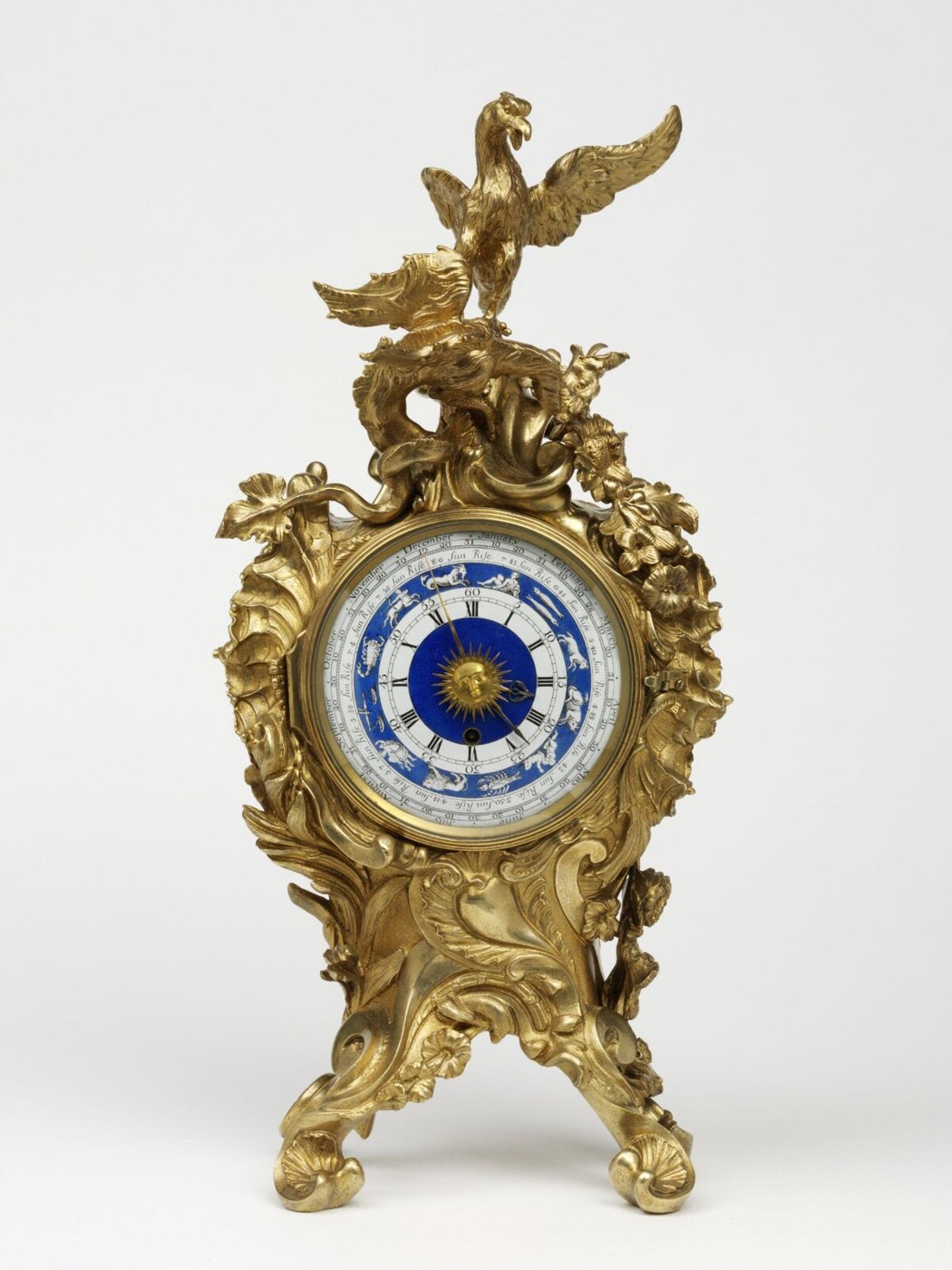
This royal mantel clock, dating to 1736, features a gilt-brass case manufactured in Paris and a movement by London-based clockmaker Charles Clay. The clock was supplied for Frederick Louis, Prince of Wales, through jeweller Peter Dutens. The elaborate rococo case is surmounted by an eagle perched on a draco, with sides decorated in floral, shell, and batwing motifs. The circular enamelled dial, a significant feature, includes a cobalt blue centre, Roman numeral chapter ring, and concentric bands displaying the signs of the Zodiac and sunrise data, centered by a chased gold sun mask. The movement is an eight-day spring-driven going train with a chain fusee, verge escapement, and a short-bob pendulum. The backplate incorporates a rotating disc linked to the calendar hand. The clock was formerly part of the collection of the Duke of Sussex and was acquired by the V&A in 2016.

Front view of the Royal Mantel Clock showing the gilt-brass case, the enamelled dial with Zodiac signs, and the eagle and draco surmount.
Front view of the Royal Mantel Clock showing the gilt-brass case, the enamelled dial with Zodiac signs, and the eagle and draco surmount. — Victoria and Albert Museum. Rights pending — permission not yet requested. Original source

Catalogue identity

Source
collections.vam.ac.uk
Category
Clock · Mantel clock
Maker / attribution
Charles Clay
Reference
Not recorded
Catalogue / lot identifier
M.1:1,2-2016
Source-reported date
1736
Source-reported place
France (case); London (movement/assembly)

Source-reported attribution and specifications are not independent authentication. A listing does not establish present ownership, current display, availability or permission to reproduce.

Object description

Case Design and Ornamentation

The gilt-brass case is executed in the French rococo style. The upper section is surmounted by a figure of an eagle with one wing raised and one lowered, perched upon a draco, which is a dragon with a snake-like tail ending in foliage. The teeth and tongue of the dragon are detailed.

The case exterior is embellished with floral elements, shells, and batwings. The front apron incorporates a heart-shaped cartouche, while the rear apron features two superimposed shells. The clock stands on four scroll-shaped feet, each decorated with shells. The back of the case is finished with the same degree of detail as the front, suggesting it was intended to be displayed against a looking glass.

Evidence for this section
  • “Gilt-brass case with pierced side panels”
  • “The clock case is mounted on top with an eagle with one open and one closed wing perched on the body of a draco”
  • “The sides of the case are decorated with flowers, shells and batwings”

Dial and Timekeeping Functions

The circular dial measures 4.25 inches and is constructed of enamel. The centre is cobalt blue, featuring a gold chased solar mask. Surrounding the centre are small Roman numeral chapter rings and Arabic five-minute intervals. Beyond these, concentric bands display painted signs of the Zodiac, sunrise times for each sign, and a calendar track with month names.

A calendar hand is driven by the movement, issuing from behind the solar mask. The assembly utilizes fine sculpted steel hands for hours and minutes. The dial is protected by a hinged convex glazed bezel.

Evidence for this section
  • “The 4.25 inch circular enamelled dial has a cobalt blue centre within small diameter Roman numeral chapter ring”
  • “fine sculpted steel hour and minute hands to centre and calendar hand issuing from a gold solar mask”

Movement and Technical Construction

The movement is an eight-day, spring-driven going train featuring a circular five-pillar construction with a single chain fusee. The escapement is a verge type with a short-bob pendulum. A rotating disc on the backplate is connected to the centre arbor, which advances the calendar hand by means of a pallet flag engaging teeth on the disc circumference, secured by a jumper spring.

The movement is mounted to a wooden platform inside the case. The fusee includes an additional steel stop-piece. Observations suggest the first wheel may be a later replacement, as it lacks characteristic period marks. The dial plate contains scratched records of repairs conducted in 1899 and 1906.

Evidence for this section
  • “The back of the dial plate has the scratched inscriptions ‘CRMX 326’ and September/99 Oct/06 indicating repairs undertaken in 1899 and 1906”

Open research questions

  • Can the origin of the 'CRMX 326' marking on the dial plate be definitively linked to a specific horological workshop?
  • Is there further evidence in archival documents to confirm if the pierced brass back cover was indeed replaced?

Source evidence

Recorded claims and source quotations for Royal Mantel Clock
FieldSource-reported valueSource quotation
MakerCharles Clay“the movement signed Clay for Charles Clay (working in London 1720 to 1740)”
Date1736“The clock was ordered in February and delivered at the end of August, 1736.”
Accession NumberM.1:1,2-2016“M.1:1,2-2016”
Dial Diameter4.25 inches“The 4.25 inch circular enamelled dial”
Movement typeEight-day spring-driven going train“The clock movement has an eight-day spring-driven going train.”
SupplierPeter Dutens“This mantel clock was supplied by the London-based Huguenot jeweller Peter Dutens for Frederick Louis, Prince of Wales”
Case OriginParis“The elaborate case in the French rococo style was made in Paris.”
EscapementVerge“verge escapement and short-bob pendulum.”

Visible details

  • The case is surmounted by an eagle with one wing extended.
  • The dial features a central gold sun mask.
  • The feet are of a scroll design with shell embellishments.
  • The case front features a heart-shaped cartouche.

Research qualifications

  • The first wheel of the movement may be a later replacement.
  • The back glazed aperture is likely a later replacement for an original pierced cover.
  • The origin of the case model is attributed to a possible wooden or terracotta carving sent to Paris.

Photograph identity and source facts were screened before import; rights clearance remains pending.

Consulted source

Royal Mantel Clock

Reviewed 2026-11-02 · Record 5901d0dfa6

Terms in this record

Glossary explanations for terms named in this object’s record.