
Skip to content
The Encyclopedia of Horology

Clock · Regulator clock

Regulator Clock by Robert Ellery

Partially verified

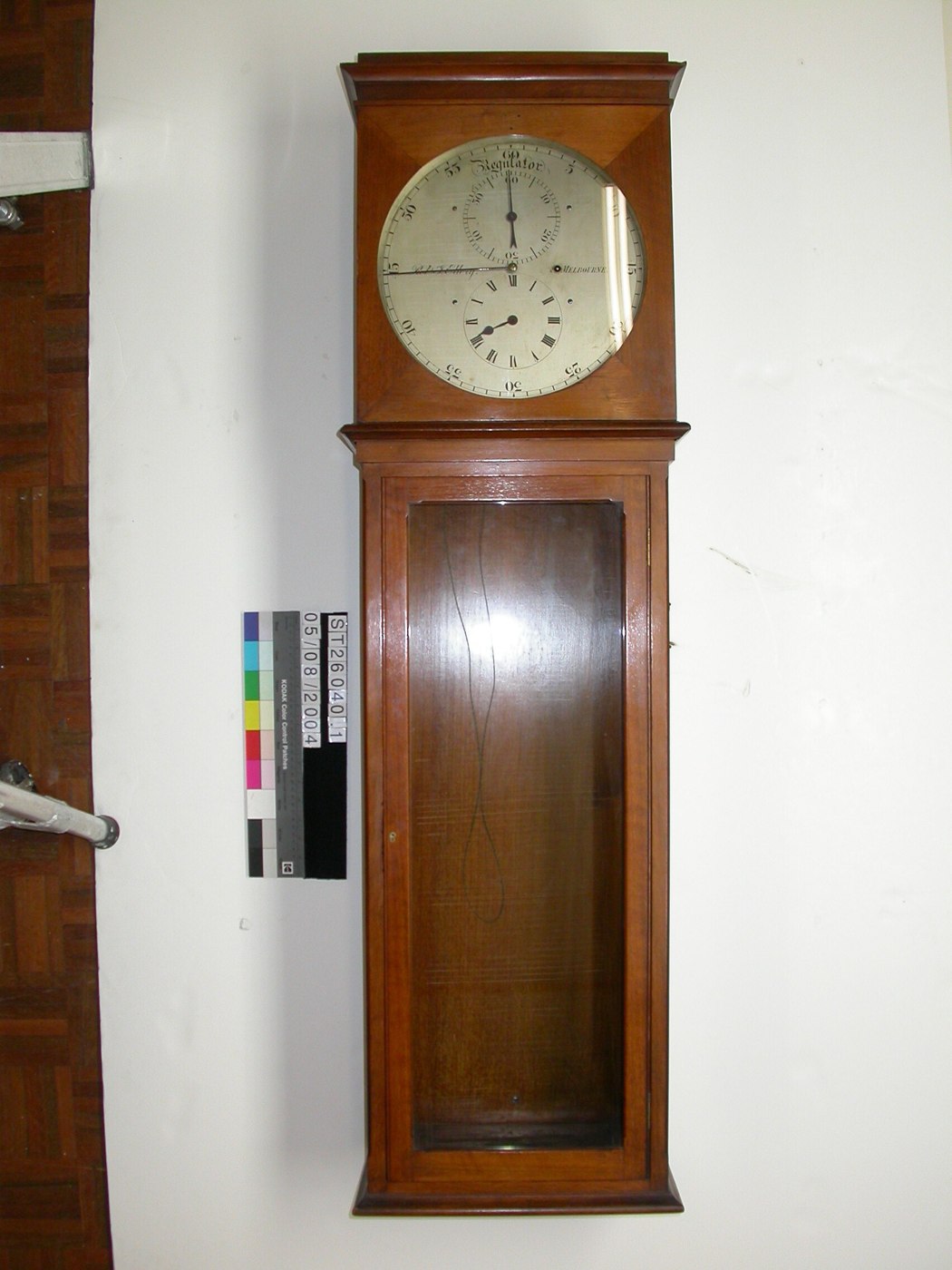
Intended for use at the Melbourne Observatory in Victoria, the clock served the technical purpose of sending time-signals via telegraph to the Williamstown time-ball, facilitating the daily checking of marine chronometers. The timepiece features a weight-driven movement equipped with a deadbeat escapement. It is distinguished by its specialized pendulum mechanism, designed to provide a prolonged electrical contact for consistent signaling. The clock displays time on separate dials for hours, minutes, and seconds, with the dial signed "REGULATOR ROBERT J. ELLERY MELBOURNE". The construction includes a steel-shafted pendulum paired with a cylindrical brass bob.

Regulator clock designed by Robert Ellery, view of the front dial and wooden case.
Regulator clock designed by Robert Ellery, view of the front dial and wooden case. — Museums Victoria. Rights pending — permission not yet requested. Original source

Catalogue identity

Source
collections.museumsvictoria.com.au
Category
Clock · Regulator clock
Maker / attribution
Robert Lewis John Ellery
Reference
Not recorded
Catalogue / lot identifier
ST 26040
Source-reported date
1888
Source-reported place
Australia

Source-reported attribution and specifications are not independent authentication. A listing does not establish present ownership, current display, availability or permission to reproduce.

Object description

Design and Function

Robert Ellery, acting as the Government Astronomer, created this regulator clock to integrate horology with the telegraph network. The primary objective was to facilitate the precise dropping of the time-ball at Williamstown, providing a standard reference for ships' officers to calibrate their chronometers.

The clock's mechanical innovation lies in its pendulum-driven signaling system. Ellery designed the assembly to ensure that the seconds wheel closes contact springs as each tooth passes, with the pendulum motion slowing the wheel sufficiently to generate a prolonged electrical signal, overcoming previous difficulties with relay adjustments.

Evidence for this section
  • “Ellery designed this clock to send time-signals by telegraph line from Melbourne Observatory to the time-ball at Williamstown.”
  • “I therefore designed a controlled pendulum clock, in which the pendulum drives the seconds wheel and hand, and thence the minute and hour hands.”

Construction and Inscription

The clock is housed in a wooden case and utilizes a weight-driven movement featuring a deadbeat escapement. It is designed with a specific pendulum configuration consisting of a steel shaft and a cylindrical brass bob, as noted in the physical description of the object.

The time is presented on a round silvered dial that displays separate scales for hours, minutes, and seconds. The face is clearly marked with the inscription "REGULATOR ROBERT J. ELLERY MELBOURNE", identifying the designer and the location of the observatory where the clock was constructed and used.

Evidence for this section
  • “Weight driven; deadbeat escapement. Pendulum has steel shaft with cylindrical brass bob.”
  • “Round silvered dial marked "REGULATOR ROBERT J. ELLERY MELBOURNE".”

Provenance and Association

The clock is associated with the Melbourne Observatory in South Yarra, where it served as part of the facility's instrumentation in 1888. The museum records attribute the design to Robert Lewis John Ellery and identify Carl M.

The object was subsequently acquired by the museum through a donation from L. Smith in 1967.

Evidence for this section
  • “Association: type: Designer, name: Mr Robert Lewis John Ellery, date: 1888”
  • “Association: type: Maker (Probable), name: Carl M. Otto, date: 1888”
  • “Acquisition: Donation from L. Smith, 08 Feb 1967”

Open research questions

  • What is the current operational status of the internal telegraphic contact mechanism?
  • Are there archival records at the Melbourne Observatory providing further detail on Carl M. Otto's role in the production?

Source evidence

Recorded claims and source quotations for Regulator Clock by Robert Ellery
FieldSource-reported valueSource quotation
Registration numberST 26040“Registration number: ST 26040”
Date1888“date: 1888”
DesignerRobert Lewis John Ellery“type: Designer, name: Mr Robert Lewis John Ellery”
Maker (Probable)Carl M. Otto“type: Maker (Probable), name: Carl M. Otto”
Dimensions1410 mm (Height) x 420 mm (Width) x 260 mm (Depth)“Overall Dimensions, dimensions: 260 mm (Length), 420 mm (Width), 260 mm (Depth), 1410 mm (Height)”
Dial InscriptionREGULATOR ROBERT J. ELLERY MELBOURNE“Round silvered dial marked "REGULATOR ROBERT J. ELLERY MELBOURNE”
EscapementDeadbeat escapement“deadbeat escapement”

Visible details

  • Circular silvered dial with three separate time-keeping indicators
  • Wooden case with glass panels
  • Two brass terminals visible on the case exterior
  • Rear circular aperture revealing internal mechanism

Research qualifications

  • The identity of the maker as Carl Otto is described as probable by the source
  • The exact functional state of the electrical contact springs is not verified

Photograph identity and source facts were screened before import; rights clearance remains pending.

Terms in this record

Glossary explanations for terms named in this object’s record.