
Skip to content
The Encyclopedia of Horology

Clock · Regulator clock

Charles Frodsham Eight Day Astronomical Regulator Clock

Partially verified

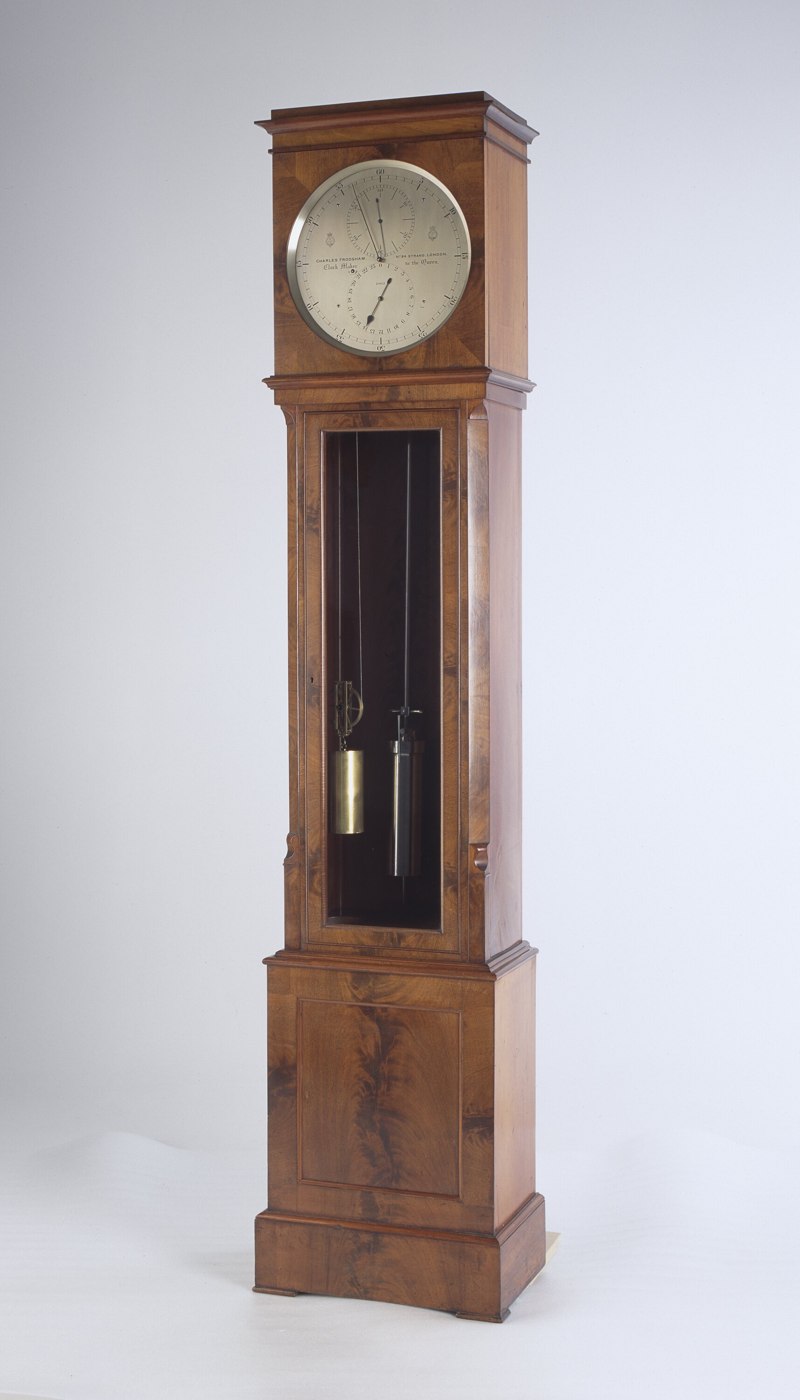
This eight-day long-case astronomical regulator clock, manufactured in 1865 by Charles Frodsham in London, represents an example of precise 19th-century horological instrumentation. Identified by serial number 1062, the clock features a weight-driven movement equipped with a dead-beat escapement and a mercury compensation pendulum designed for temperature stability. The dial is configured for astronomical utility, with a central minute hand and separate sub-dials for seconds and a twenty-four hour display. The movement is housed in a wooden long-case. The clock served as a primary instrument at the Melbourne Observatory from 1865 until 1944, where it was utilized for mapping stars and establishing the longitude of Melbourne and the Standard Time for the Colony of Victoria. Following the closure of the Melbourne Observatory, the clock was transferred to the Mt Stromlo Observatory, eventually entering the museum's permanent collection.

The Frodsham Regulator clock showing its wooden long-case and dial configuration.
The Frodsham Regulator clock showing its wooden long-case and dial configuration. — Museums Victoria. Rights pending — permission not yet requested. Original source

Catalogue identity

Source
collections.museumsvictoria.com.au
Category
Clock · Regulator clock
Maker / attribution
Charles Frodsham
Reference
Not recorded
Catalogue / lot identifier
ST 46202
Source-reported date
1865
Source-reported place
England
Source-reported serial
1062

Source-reported attribution and specifications are not independent authentication. A listing does not establish present ownership, current display, availability or permission to reproduce.

Object description

Construction and Dial Configuration

The clock is designed as a long-case astronomical regulator, featuring a wooden exterior case that provides stability for the internal mechanism. The dial, finished in silver, is specifically calibrated for scientific observation. It utilizes a central minute hand as the primary indicator, complemented by an upper subsidiary dial for the tracking of seconds.

A 24-hour dial is positioned at the base of the main dial, facilitating the temporal requirements of astronomical recording. The internal movement is powered by a weight-driven system and incorporates a dead-beat escapement to ensure consistent timekeeping. Temperature compensation is achieved through the use of a mercury compensation pendulum, a design choice intended to mitigate the effects of thermal expansion on the length of the pendulum rod.

Evidence for this section
  • “Wooden case.”
  • “Main dial denotes minutes. Upper small dial denotes seconds and 24 hour dial sits below.”
  • “Weight driven with dead-beat escapement and mercury compensation pendulum.”

Operational History and Scientific Usage

Installed at the Melbourne Observatory in 1865, the Frodsham regulator served as a central timing reference for 19th-century astronomical endeavors. It was integrated into the observatory's scientific infrastructure through electrical connections to various transit instruments and telescopes. These configurations allowed astronomers to map southern hemisphere stars and provided the necessary precision to determine Melbourne's longitude.

Beyond stellar mapping, the regulator was vital for the colony's civic infrastructure, serving as the clock used to set the Standard Time for Victoria. Following the integration of telegraphic connections with Greenwich Observatory, the clock was instrumental in refining the geographic accuracy of the Melbourne location. The clock's long service life extended to 1944, encompassing its transfer to the Mt Stromlo Observatory before it was eventually preserved in a museum collection.

Evidence for this section
  • “The Frodsham Regulator was the most important of the scientific clocks used by the Melbourne Observatory in the 19th century.”
  • “In conjunction with the 8 inch transit telescope and one or two other clocks, the Frodsham No 1062 was used to set Standard Time for the Colony of Victoria.”
  • “The Frodsham was also involved in fixing the longitude of Melbourne.”

Signatures and Provenance

The clock bears clear identifying marks on the dial, which include the signature of its maker and the specific location of the London workshop. The dial is engraved with the text 'CHARLES FRODSHAM CLOCKMAKER TO THE QUEEN, NO. 84 STRAND, LONDON', accompanied by the distinct serial number '1062'.

The provenance of the clock is well-documented, beginning with its acquisition for the Melbourne Observatory. In 1997, the clock was subject to a public auction by the Mt Stromlo Observatory. The transaction was ultimately halted, and the object was retained in Australia under the provisions of the Protection of Moveable Cultural Heritage legislation, ensuring its status as a preserved historical instrument.

Evidence for this section
  • “'CHARLES FRODSHAM CLOCKMAKER TO THE QUEEN, NO. 84 STRAND, LONDON'”
  • “The Frodsham No 1062, along with another ex-Melbourne Observatory Frodsham clock, was sold at public auction by Mt Stromlo in 1997.”
  • “The clock was prevented from being exported under the Commonwealth Government's Protection of Moveable Cultural Heritage legislation.”

Open research questions

  • What specific modifications or repairs were performed on the movement during the period between 1865 and 1944?
  • How was the electrical interface between the clock and the 8-inch Transit Telescope physically realized within the Observatory's architecture?

Source evidence

Recorded claims and source quotations for Charles Frodsham Eight Day Astronomical Regulator Clock
FieldSource-reported valueSource quotation
MakerCharles Frodsham“Charles Frodsham Clockmaker”
Serial Number1062“serial number '1062'”
Registration NumberST 46202“Registration number: ST 46202”
Dimensions1917 mm Height“1917 mm (Height)”
Movement typeWeight driven with dead-beat escapement“Weight driven, with dead-beat escapement and mercury compensation pendulum.”
Original locationMelbourne Observatory“Used at Melbourne Observatory from 1865 until the Observatory closed in 1944.”

Visible details

  • Wooden long-case construction
  • Silvered dial with 24-hour sub-dial
  • Visible weight-driven mechanism
  • Mercury compensation pendulum

Research qualifications

  • The source attributes the clock to Charles Frodsham but does not detail the extent of maintenance or modifications during its long service at the Melbourne Observatory.
  • The exact nature of the electrical linking mechanism to external telescopes mentioned in the text is not fully described.

Photograph identity and source facts were screened before import; rights clearance remains pending.

Terms in this record

Glossary explanations for terms named in this object’s record.