
Skip to content
The Encyclopedia of Horology

Clock · Longcase clock

Queen Anne ebonised thirty-hour longcase clock with alarm

Partially verified

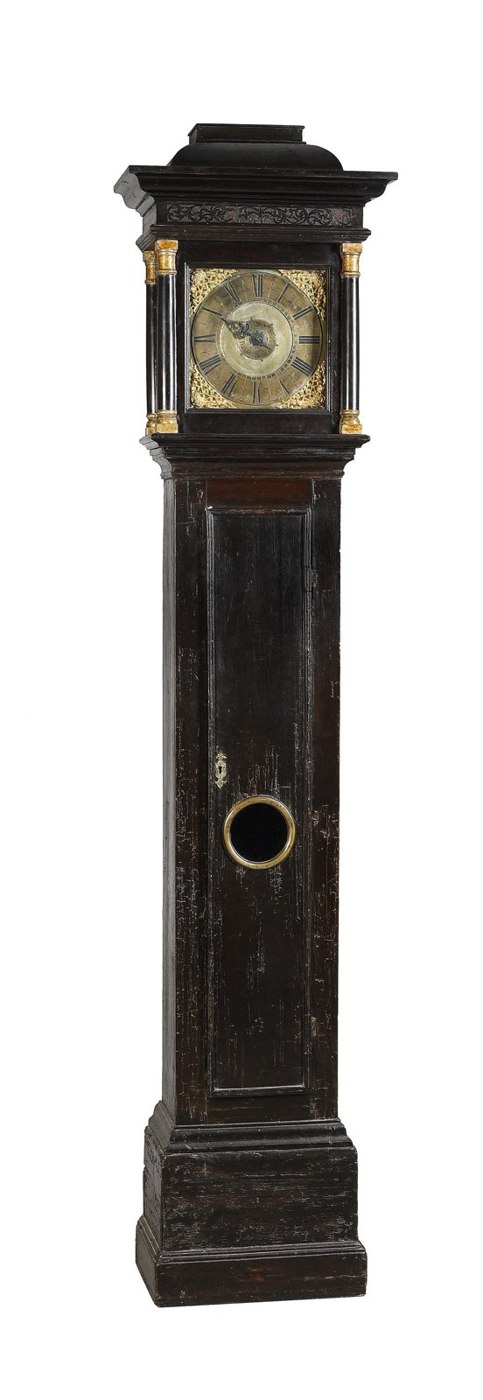
This longcase clock, attributed to the maker William Brock of Axbridge, dates to approximately 1715. It features a thirty-hour posted countwheel movement equipped with a bell striking mechanism and an integrated alarm system located on the lower right, which sounds on the hour bell. The clock is regulated by an anchor escapement with a seconds pendulum. The 10-inch square brass dial is characterized by a matted center, an engraved rose alarm disc, and a Roman numeral chapter ring including cruciform half-hour markers, all framed by gilt twin-cherub-and-crown spandrels. The clock is housed in an ebonised pine case standing 222.5 cm tall. The exterior design incorporates a domed caddy superstructure, an ogee moulded cornice, and parcel gilt three-quarter columns. The trunk includes a concave throat moulding and a brass-edged circular lenticle above a plinth base.

Full view of the ebonised longcase clock showing the hood, trunk, and plinth.
Full view of the ebonised longcase clock showing the hood, trunk, and plinth. — Auction house Dreweatts 1759 Fine Sales, via Invaluable. Rights pending — permission not yet requested. Original source

Catalogue identity

Source
orbiscollectibles.com
Category
Clock · Longcase clock
Maker / attribution
William Brock
Reference
Not recorded
Catalogue / lot identifier
Source URL identifies the listing
Source-reported date
circa 1715
Source-reported place
United Kingdom

Source-reported attribution and specifications are not independent authentication. A listing does not establish present ownership, current display, availability or permission to reproduce.

Object description

Case Construction and Aesthetics

The clock is housed in an ebonised pine case that stands to a height of 222.5 cm. The upper section features a domed caddy superstructure sitting above an ogee moulded cornice. The dial aperture is flanked by parcel gilt three-quarter columns, which provide decorative contrast against the dark ebonised finish.

The trunk section incorporates a concave throat moulding, leading down to the main body of the case. A brass-edged circular lenticle is centrally positioned in the trunk door to view the pendulum. The entire assembly rests upon a plinth base finished with a moulded skirt, maintaining a total width of 49.5 cm and depth of 29 cm.

Evidence for this section
  • “housed within an ebonised pine case”
  • “The case includes a domed caddy superstructure, an ogee moulded cornice, and parcel gilt three-quarter columns flanking the glazed dial aperture”
  • “The trunk features a brass-edged circular lenticle and a concave throat moulding, supported by a plinth base with a moulded skirt.”

Dial and Timekeeping Mechanism

The clock face consists of a 10-inch square brass dial featuring a matted center. Time is indicated by a single scroll-pierced iron hand moving across a Roman numeral chapter ring that includes cruciform half-hour markers. The corners of the dial are ornamented with gilt twin-cherub-and-crown spandrels. An engraved rose-patterned alarm disc is incorporated into the dial design.

Internal movement is a thirty-hour posted countwheel configuration with a seconds pendulum regulated by an anchor escapement. The striking system includes a bell for the hour, with an integrated alarm mechanism positioned on the lower right that utilizes the same bell to provide the alert signal.

Evidence for this section
  • “10-inch square brass dial displays a matted center with an engraved rose alarm disc”
  • “Roman numeral chapter ring with cruciform half-hour markers, and gilt twin-cherub-and-crown spandrels”
  • “The substantial posted countwheel movement includes bell striking and an integrated alarm mechanism positioned on the lower right”

Provenance and Attribution

The clock is signed by the maker, William Brock of Axbridge, at the lower margin of the dial. The overall classification of the object is regarded as probable, with the source noting that while credible evidence exists, the full establishment of the object's history remains partial.

The current documentation is based upon a single auction-house listing provided by Dreweatts 1759 Fine Sales. The details provided in the listing apply strictly to this specific example, and the source cautions that other examples of this type may differ in detail or construction.

Evidence for this section
  • “The clock face is signed by the maker, William Brock of Axbridge, at the lower margin”
  • “Probable”
  • “Described from a single auction-house listing published on Invaluable”

Open research questions

  • What is the specific mechanical design of the integrated alarm train within the posted movement?
  • Can further documentation be located to move the attribution of William Brock from 'probable' to confirmed?

Source evidence

Recorded claims and source quotations for Queen Anne ebonised thirty-hour longcase clock with alarm
FieldSource-reported valueSource quotation
MakerWilliam Brock“William Brock of Axbridge”
Datecirca 1715“dating to approximately 1715”
EscapementAnchor“regulated by an anchor escapement”
Dimensions222.5 cm x 49.5 cm x 29 cm“total height is 222.5 cm, with a width of 49.5 cm and a depth of 29 cm”
Dial10-inch square brass“10-inch square brass dial”
Case MaterialEbonised pine“housed within an ebonised pine case”

Visible details

  • Case finished in ebonised pine
  • Brass-edged circular lenticle in the trunk
  • Gilt twin-cherub-and-crown corner spandrels
  • Single scroll-pierced iron hand

Research qualifications

  • Classification of the maker/provenance is described as probable
  • The source denotes evidence exists but is not fully established

Photograph identity and source facts were screened before import; rights clearance remains pending.

Consulted source

Queen Anne ebonised thirty-hour longcase clock with alarm by William Brock

Reviewed 2026-11-02 · Record 0764b6378b

Terms in this record

Glossary explanations for terms named in this object’s record.