
Skip to content
The Encyclopedia of Horology

Pocket watch · Pocket watch

Pocket watch with marriage celebration scene

Partially verified

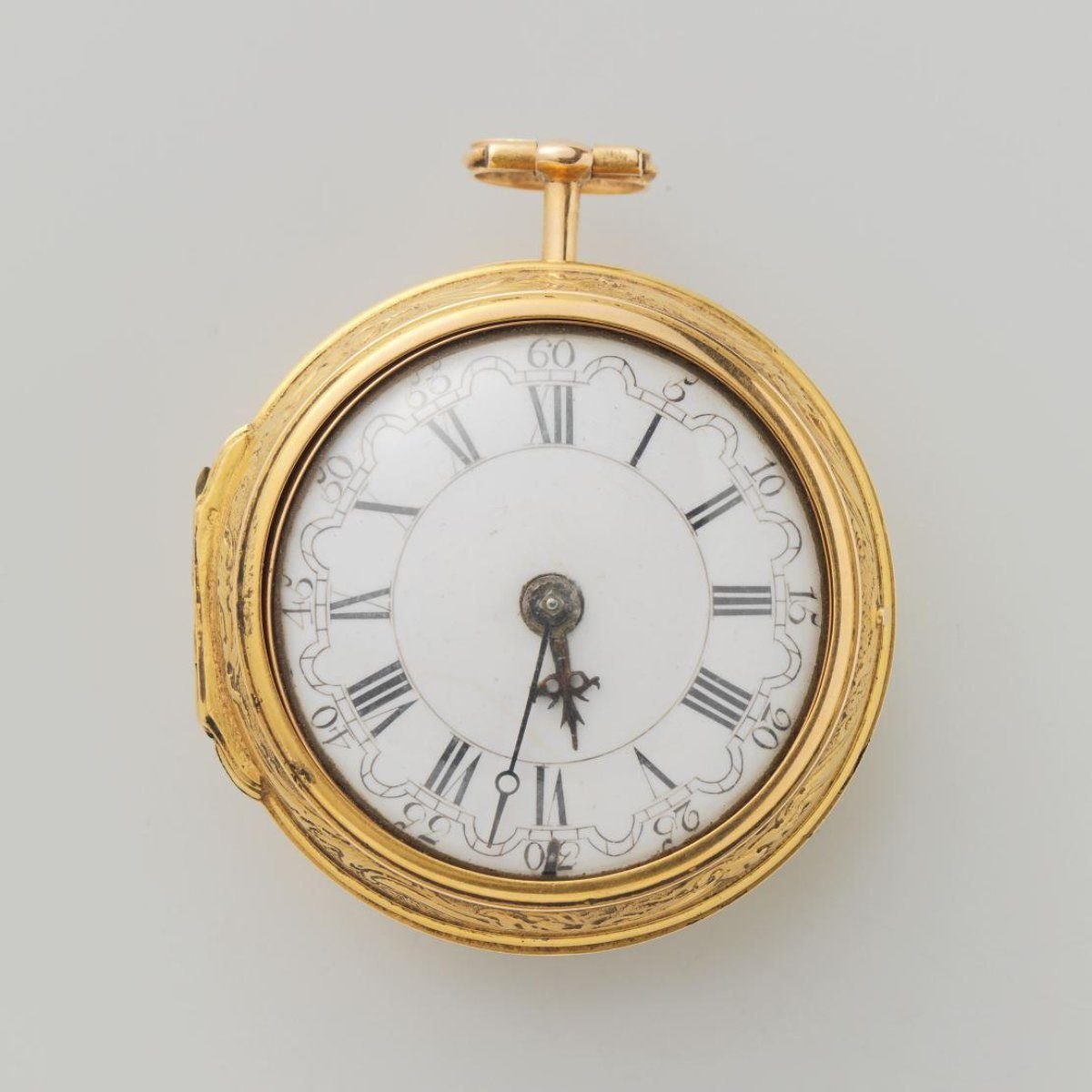
This golden pocket watch, dating to the late 18th century, features a complex casing arrangement consisting of two separate outer covers. The primary internal casing is constructed from gold and is decorated with an embossed figural scene depicting a marriage ceremony, which includes a young man, an older man, two women, and a dog. In addition to the primary gold case, the watch is accompanied by a secondary protective outer shell fashioned from tortoiseshell applied over copper. The internal movement carries a mark reading "Wilter London 3006," though the Rijksmuseum notes this as a rejected attribution, suggesting an anonymous Swiss origin for the movement and British origin for the goldsmith work. A paper label affixed inside the case identifies a subsequent retailer, H.C. Fehr of Rotterdam, who dealt in watches, pendulums, and musical works at Hoofdsteeg 11-136, illustrating the later commercial history and maintenance of the instrument within the Dutch market.

Front view of the pocket watch showing the white enamel dial and decorative gold case.
Front view of the pocket watch showing the white enamel dial and decorative gold case. — Rijksmuseum. Rights pending — permission not yet requested. Original source

Catalogue identity

Source
www.rijksmuseum.nl
Category
Pocket watch · Pocket watch
Maker / attribution
Not established
Reference
Not recorded
Catalogue / lot identifier
BK-NM-13197
Source-reported date
ca. 1750 - ca. 1800
Source-reported place
Switzerland
Source-reported serial
3006

Source-reported attribution and specifications are not independent authentication. A listing does not establish present ownership, current display, availability or permission to reproduce.

Object description

Case Construction and Decoration

The object is characterized by a multi-layered housing design intended for protection and aesthetic display. The primary gold casing features elaborate repoussé work, specifically depicting a narrative scene of a marriage celebration. This scene includes detailed figures: a young man accompanied by an older mentor, two women, and a dog positioned between the central figures.

A supplementary protective outer case is provided, constructed from tortoiseshell applied to a copper core. The internal gold housing also bears a manufacturer's mark described as a heart containing the letters "PP" placed above a star, providing further insight into its metallurgical origin.

Evidence for this section
  • “Op de losse gouden kast een figurale voorstelling in drijfwerk met de huwelijksvoltrekking.”
  • “De tweede losse kast is van schildpad op koper”
  • “merk, binnenkast: ‘PP boven ster in hart’”

Movement and Signatures

The British goldsmith responsible for the decorative metalwork of the case is also listed as anonymous.

The numerical designation "3006" appears on the plate, serving as the primary identifier for the movement's production or assembly batch.

Evidence for this section
  • “Op de platine gemerkt: Wilter London 3006.”
  • “uurwerkmaker: anoniem, Zwitserland”
  • “uurwerkmaker: Wilter, Londen [verworpen toeschrijving]”

Retail and Provenance

The object carries evidence of its circulation within the Netherlands through a paper label affixed to the inside of the case. The label identifies the business of H.C. Fehr, located at Hoofdsteeg 11-136 in Rotterdam. The text on the label specifies that the shop dealt in "horlogien, pendules, muziekwerken, klokken" (watches, pendulums, musical works, clocks), documenting its role in the trade and potential maintenance of the piece during the 19th century.

The watch was donated to the Rijksmuseum in 1924 by Mrs. M. Lugten-Zevenbergen of The Hague, entering the permanent collection as part of a public legacy.

Evidence for this section
  • “In de kast op een ingeplakt groen papier: H.C. Fehr horlogemaker. Hoofdsteeg 11-136.”
  • “Schenking van mevrouw M. Lugten-Zevenbergen, Den Haag”
  • “schenking 1924”

Open research questions

  • What is the specific meaning of the "PP" mark found on the internal casing?
  • Can the movement construction be further analyzed to confirm its Swiss provenance versus the London-marked plate?

Source evidence

Recorded claims and source quotations for Pocket watch with marriage celebration scene
FieldSource-reported valueSource quotation
Movement markWilter London 3006“Op de platine gemerkt: Wilter London 3006.”
Retailer markH.C. Fehr, Rotterdam“In de kast op een ingeplakt groen papier: H.C. Fehr horlogemaker. Hoofdsteeg 11-136.”
Outer case decorationMarriage scene“Op de losse gouden kast een figurale voorstelling in drijfwerk met de huwelijksvoltrekking.”
Secondary case materialTortoiseshell and copper“De tweede losse kast is van schildpad op koper”
Internal markPP above a star in a heart“merk, binnenkast: ‘PP boven ster in hart’”
Accession numberBK-NM-13197“Objectnummer BK-NM-13197”

Visible details

  • White enamel dial with Roman numerals
  • Decorative floral-style central hand motif
  • Highly ornate repoussé work on the outer gold cover
  • Tortoiseshell and copper second outer case

Research qualifications

  • The "Wilter London" signature is noted as a rejected attribution
  • The exact origin of the movement remains anonymous

Photograph identity and source facts were screened before import; rights clearance remains pending.

Consulted source

Watch with a Marriage Celebration

Reviewed 2026-11-02 · Record 31e96028f0

Terms in this record

Glossary explanations for terms named in this object’s record.