
Skip to content
The Encyclopedia of Horology

Movement · Pocket watch movement

Pocket Watch Movement by Thomas Tompion, London, 1695-1696

Partially verified

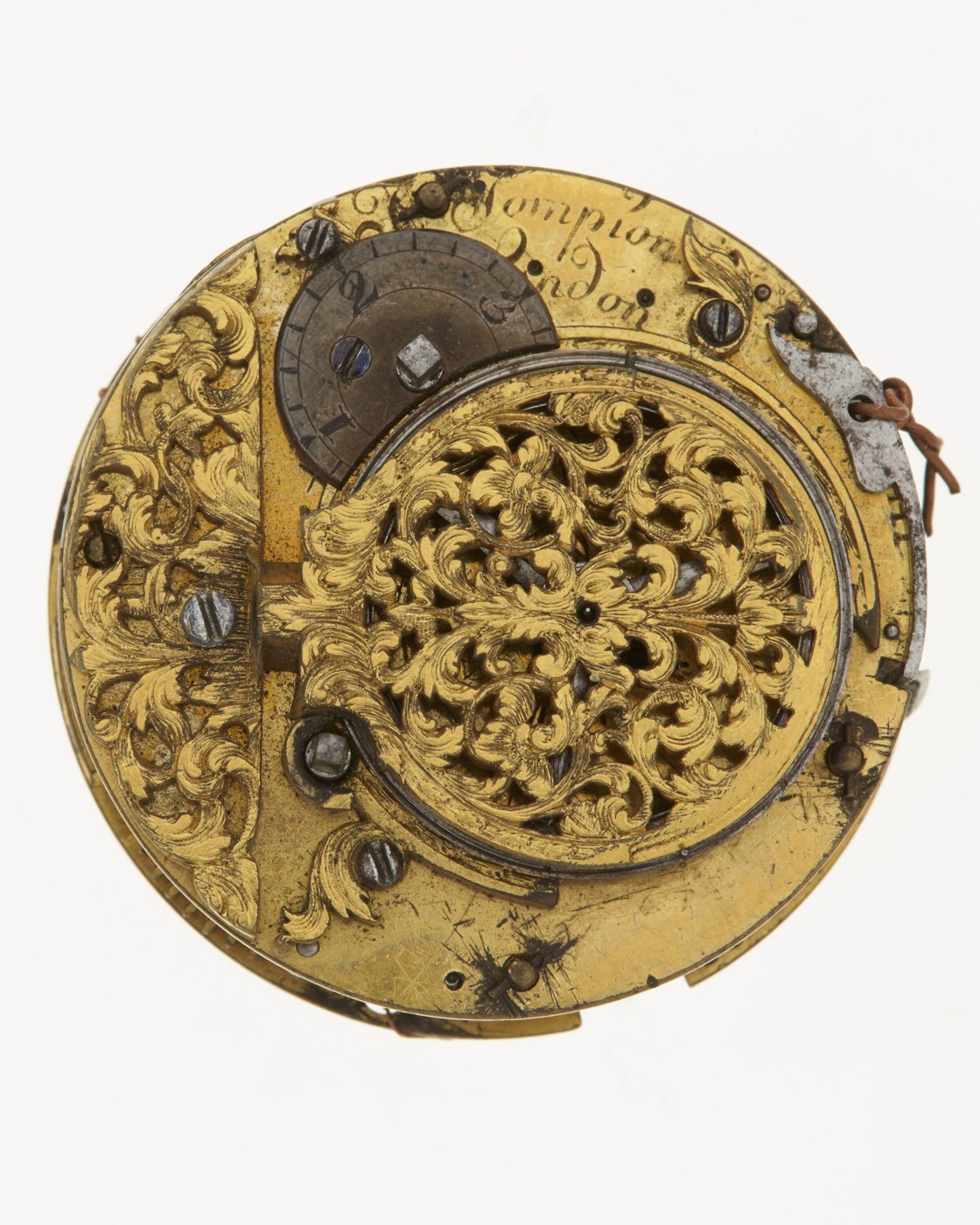
This pocket watch movement, numbered 111, was created by Thomas Tompion in London between 1695 and 1696. The object consists of a key-wound movement featuring a verge escapement, a fusee and chain mechanism, and a winding dial. The back plate is engraved with the signature "Tompion, London" alongside the number 111, although part of the first digit is obscured due to the removal of metal from the plate. The front plate also bears the serial number 111. The movement is fitted with a fretted balance bridge. The dial and the original gold pair-case are missing. Historical reports suggest this movement was part of a collection stolen from an artist and recovered in a Melbourne cemetery after the original cases had been removed.

Back view of the pocket watch movement, showing the balance bridge, winding dial, and signature.
Back view of the pocket watch movement, showing the balance bridge, winding dial, and signature. — Museums Victoria. Rights pending — permission not yet requested. Original source

Catalogue identity

Source
collections.museumsvictoria.com.au
Category
Movement · Pocket watch movement
Maker / attribution
Thomas Tompion
Reference
Not recorded
Catalogue / lot identifier
ST 33112
Source-reported date
1695-1696
Source-reported place
England
Source-reported serial
111

Source-reported attribution and specifications are not independent authentication. A listing does not establish present ownership, current display, availability or permission to reproduce.

Object description

Movement and Mechanism

The movement is a key-wound type designed for a pocket watch. It incorporates a verge escapement and a fusee and chain mechanism to provide constant force to the gear train. A winding dial is integrated into the structure. The back of the movement features a fretted bridge, which protects the balance wheel and contributes to the overall mechanical configuration of the period.

The current state of the movement reflects the loss of external components. The dial, which would have been of a gold champleve design, is no longer attached, leaving the plate and gear train exposed.

Evidence for this section
  • “Key wound spring; verge escapement. Fusee and chain. Winding dial.”
  • “Movement has fretted bridge.”
  • “The watch would originally have had a gold champleve dial and gold pair-case.”
  • “Dial is missing.”

Signatures and Identification

The movement is attributed to Thomas Tompion of London. Identification is confirmed by inscriptions found on the plates. The back plate is engraved with 'Tompion, London' and the serial number '111'. The inscription on the back plate shows signs of physical alteration, as the first digit of the serial number has been partially removed due to damage to the plate.

The number '111' is also inscribed on the front plate of the movement, serving as a secondary identification mark. These inscriptions, despite the damage to the back plate, provide a clear link to the maker and the individual production sequence of the movement.

Evidence for this section
  • “Back plate marked 'Tompion, London' and '111' [although first '1' has been cut away with part of the plate.”
  • “Front plate marked '111'.”

Provenance and History

Records indicate that this movement was part of a collection that was stolen from an artist. Following the theft, the watch cases were discarded, and the movements were recovered from the Melbourne Cemetery. This history accounts for the missing original case and dial, as well as the observed condition of the plates and serial number engravings.

The object is catalogued as a horological item, specifically identified as a movement without its companion case or dial. The documentation emphasizes the movement as a distinct entity within the museum's science and measurement collection.

Evidence for this section
  • “This watch was one of a collection that was stolen from an artist. The cases were removed and the movements were left in the Melbourne Cemetery.”

Open research questions

  • What specific materials were used for the bridge and plates?
  • What is the technical significance of the winding dial arrangement on this specific Tompion movement?

Source evidence

Recorded claims and source quotations for Pocket Watch Movement by Thomas Tompion, London, 1695-1696
FieldSource-reported valueSource quotation
MakerThomas Tompion“Mr Thomas Tompion”
Date1695-1696“1695-1696”
EscapementVerge“verge escapement”
Registration numberST 33112“ST 33112”
Dimensions2.7 cm width, 3.5 cm diameter“2.7 cm (Width), 3.5 cm (Outside Diameter)”

Visible details

  • Fretted balance bridge
  • Engraved signature on the back plate
  • Missing dial
  • Visible fusee and chain mechanism

Research qualifications

  • Part of the serial number 111 on the back plate is cut away
  • Original dial and pair-case are not present

Photograph identity and source facts were screened before import; rights clearance remains pending.

Consulted source

Pocket Watch Movement - Thomas Tompion, London, 1695-1696

Reviewed 2026-10-26 · Record 1180cc7dd0

Terms in this record

Glossary explanations for terms named in this object’s record.